



UGC is great for affordable, ownable content produced for paid social performance. Influencer marketing is ideal when you’re leveraging borrowed trust and reach from an audience you don’t have yet. Most brands use both eventually, sequenced around the funnel stage.
If you’ve asked whether your brand needs UGC or influencer marketing, you’ve probably gotten conflicting answers. That's because most people answer "which one performs better" when the real question is "which one solves the problem sitting in front of you right now."
At TIA, we see user-generated content and influencer marketing get lumped together constantly under the same content marketing umbrella, but they’re two different tools solving two different problems within your marketing strategy.
We’ve already covered what user-generated content actually is in a separate blog post. Here, we delve deeper and explore which one to invest in first, and whether a combined UGC-influencer marketing approach fits your brand now.
What is user-generated content?
User-generated content (UGC) is authentic, creator-made photo or video content that your brand owns and runs through its own marketing channels. Sometimes called customer- or consumer-generated content, it's briefed by you, produced by a creator, and used in paid social, on your site, or in email, just like you'd run traditional ads.
Social media users interact with and trust UGC more than polished marketing campaigns because it reads as real rather than produced user content.
What is influencer marketing?
Influencer marketing pays a creator to promote your brand to their own audience. It's a paid or gift-based arrangement built on the credibility the creator has earned over the years through their social media channels, and that borrowed trust is exactly what you're paying for.
UGC vs. influencer marketing: Key differences
The key differences between UGC and influencer marketing come down to five factors: cost, control, reach, longevity, and platform fit.
Cost and scalability
UGC is priced per asset, while influencer marketing is priced per audience. According to 2026 industry benchmark data, almost 80% of UGC creator costs fall below $500 USD per video. Influencer prices are proportional to follower count: micro-influencers (10K–100K) charge $100 to $2,000 USD per post, and macro-influencers (100K to 1M) run $5,000 to $20,000 USD or more, using current creator-rate benchmarks.
That disparity means the same budget buys very different things: $5,000 USD on one entry-level macro-influencer post, or upwards of 10 UGC assets ready for sponsored social testing. UGC scales predictably for always-on programs; influencer budgets buy something volume can't recreate: an existing relationship with a particular audience.
Creative control
UGC gives your brand more control over messaging and brand identity, since you own the content instead of licensing someone else’s voice. Influencer content asks you to trade some of that control for authenticity, and that trade is the entire reason to hire an influencer in the first place.
The biggest mistake brands make with UGC is over-scripting it. The value is in reading as authentic, so scripting every phrase strips out what you paid for and leaves you with something that looks like traditional advertising.
For similar reasons, UGC often wins in regulated categories like health, fitness and financial services, where a thoroughly vetted, in-house message beats spontaneity.
Trust and reach signals
Influencer marketing has one fundamental advantage that owned content can’t fake: it leverages an audience’s existing trust, along with the social proof and brand sentiment that come with it.
According to a 2025 industry report on sponsored content performance, 92% of marketers say they get better reach from sponsored posts than organic content, and 86% of consumers say they make at least one influencer-inspired purchase every year, numbers that make influencer marketing one of the fastest ways to increase brand awareness at scale.
But reach alone doesn’t guarantee conversion, and it seldom moves the needle on its own. The first thing we tell clients when they’re considering an influencer-heavy social media strategy is that influencers open the door; they don’t close it.
A program without a plan for the click is reach without a destination. That’s why more brands are having us map the customer journey as well.
Content longevity
UGC lasts longer than influencer content because your brand owns it outright. A single UGC asset can run across sponsored social, your website, email, and product pages for months, then get re-edited into new variations without a new licensing agreement.
Influencer content is tied to a moment: it peaks shortly after posting, and only keeps working afterward if you’ve negotiated the rights to reuse it elsewhere.
Platform fit
UGC tends to perform better on TikTok and Reels. The format rewards raw, unscripted content, and the algorithm treats authenticity as a ranking signal rather than a liability.
Instagram and YouTube are biased toward influencer content, in which a cultivated audience values long-term trust and long-form narratives.
Algorithms shift constantly, so treat this as a general pattern rather than a hard rule. The strongest programs span multiple video and social media platforms rather than betting on just one user-generated content platform.
For a closer look at who’s getting this right, our roundup of top UGC creators to follow is a good next read.
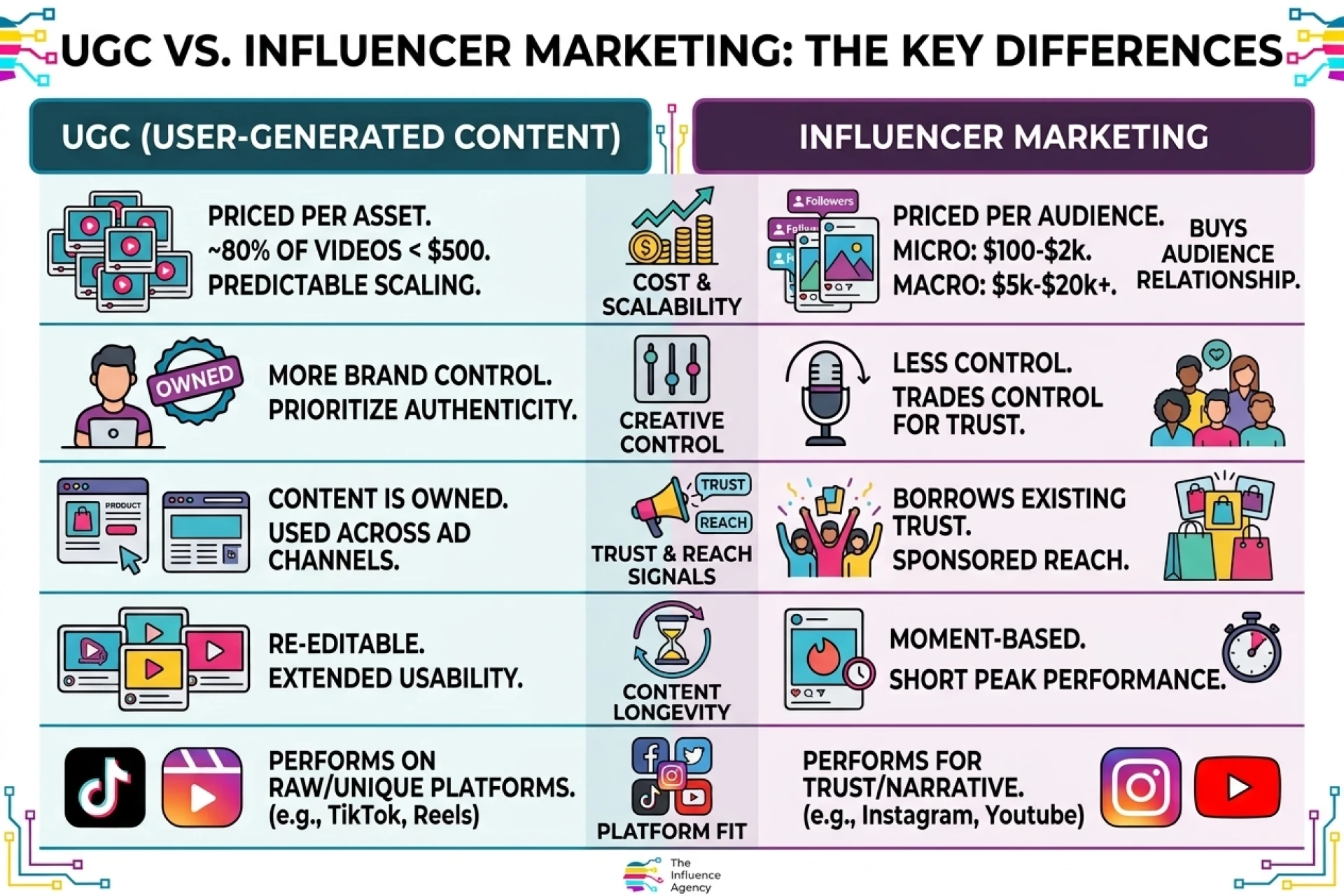
Image Source: Gemini 2026
When to use UGC
Lean toward UGC if performance is the goal, rather than borrowing someone else’s audience. It’s usually the right call when:
- You need a good volume of fresh creative for paid social testing across your marketing efforts.
- Your budget needs to scale predictably per asset, not by follower count.
- You’re starting from zero brand trust with potential customers and need performance data before investing in relationships.
This applies to business-to-business (B2B) brands too, more than most expect: our piece on UGC in B2B social campaigns breaks down why unpolished, authentic content works outside consumer categories.
When to use influencer marketing
Influencer marketing is a good fit when trust and awareness are more important than sheer asset volume. It’s often the right move when:
- You’re selling an aspiration, a lifestyle, or exclusive access and that matters more than any single product feature in categories like fashion, travel, and hospitality.
- You already have creator relationships or community trust to build on, since a genuine brand ambassador relationship compounds faster than a one-off post.
- You’re building brand credibility and brand loyalty over a long sales cycle, where one conversion touchpoint isn’t realistic.
When to use both UGC and influencer marketing
Use both when your sales cycle is long enough that trust and consistent presence both matter. Real estate and financial services typically need both techniques from day one. Trust drives the sale, but the cycle runs long enough that brands also need consistent in-market content to remain top of mind.
We’ve seen this with a TIA client: a long-running influencer campaign has done what it was meant to do and created significant brand recognition. As goals shifted to bottom-funnel metrics, we introduced a UGC production stream for paid amplification because awareness alone was no longer the ask.
Imagine influencer marketing and UGC as sequential or parallel methods that shift based on your brand’s funnel stage, rather than two line items vying for the same budget. You see this confusion in briefs even before a campaign begins: clients request “influencers” when what they need is a UGC brief. Once that’s established, most teams recognize they need both.
Here’s the quick summary of all three paths:
- For paid social performance and creative volume: pick UGC.
- For brand trust, awareness and borrowed reach: pick influencer marketing.
- A long sales cycle where trust and consistent presence both matter: pick both, sequenced around your funnel data.
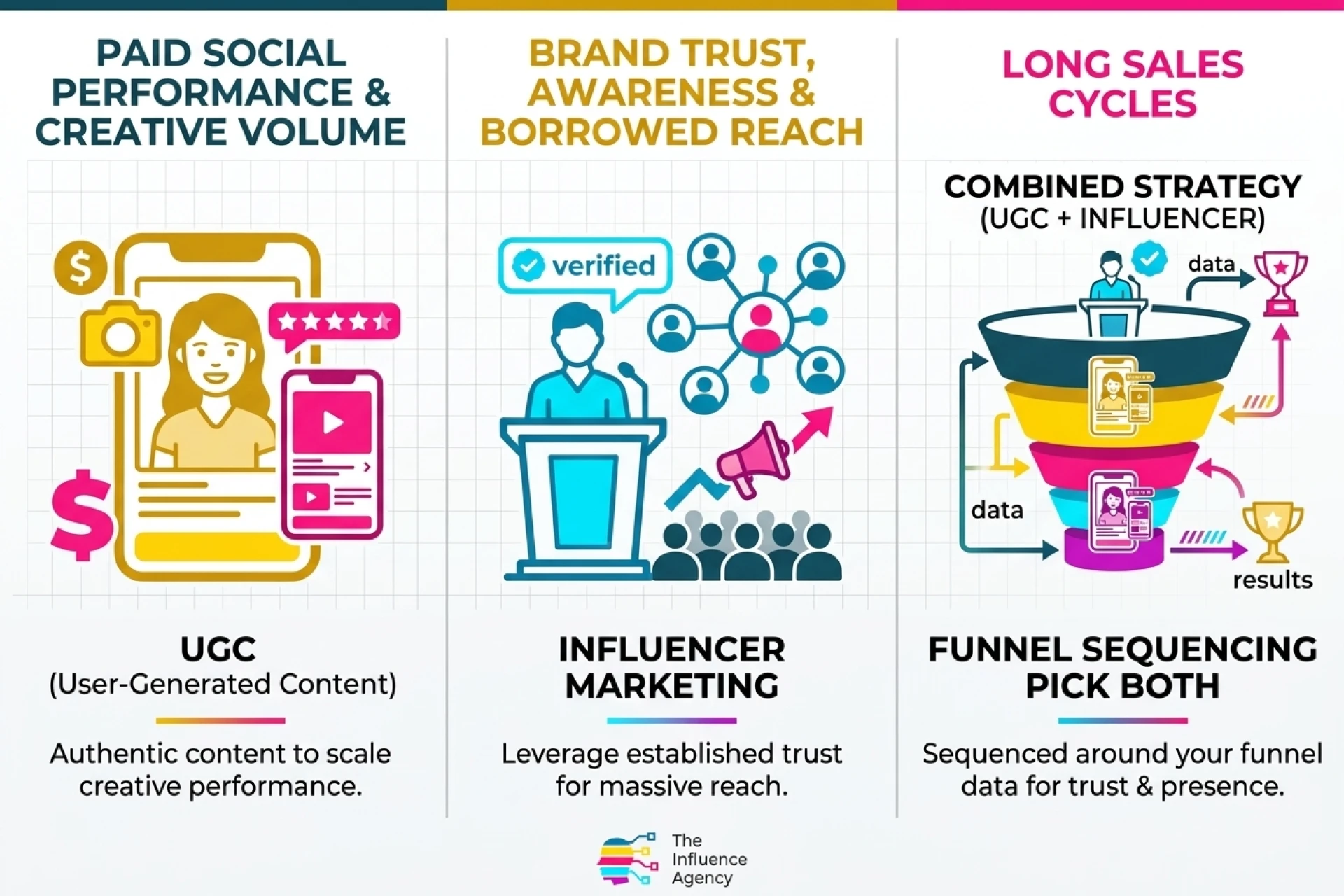
Image Source: Gemini 2026
FAQs
Key takeaways
Ready to build the right mix for your brand?
At The Influence Agency, we run both sides of this equation every day. Our UGC team builds always-on creative libraries priced for testing at scale, while our influencer marketing team taps a global network of over 10 million creators to land the right partnership for your brand, not just the biggest name available.
We don't hand you a menu and ask you to pick. Our specialists audit your funnel stage, budget and existing brand trust first. That's how you invest in the approach that moves your numbers, instead of the one that sounds best in a pitch deck.
Whether your brand needs a steady stream of user-generated content for paid social, an influencer marketing program built for trust and reach, or both, The Influence Agency can help you figure out where to start.
Talk to us about your goals, and we'll help build the mix that fits.