
.jpg)

We surveyed North American consumers about how they discover, trust, and buy in 2026. The data confirms what fragmentation feels like from the inside. There’s no shared internet, no single journey, and no default source of trust. Here’s what we found, and what it means for your brand.
We talk about media fragmentation as a trend. For the people living inside it, it’s simply how the internet works now. Earlier this year, we ran our 2026 Consumer Trends Survey to measure that experience directly: how consumers discover brands, who they trust, and how comfortable they have become with AI in the buying journey.
Three hundred and thirty-six people answered. The findings map almost exactly onto the forces we explore in this year's Yearbook. Here are six of them.
1. Fragmentation isn’t a theory. Consumers feel it.
Eighty-three percent of respondents say the way they discover new products and brands has changed in the last two years.
Eighty-seven percent say their version of the internet looks different from what their friends and family see. That second number is the one to consider. Personalization has gone so deep that consumers now assume their feed belongs to them alone.
Discovery no longer starts in one place either. When we asked where product discovery begins, no single platform held even a clear majority:
- Instagram led at 57 percent
- TikTok at 49 percent
- YouTube at 30 percent
- Google at 27 percent
- ChatGPT at 14 percent
… all in play at the same time. Traditional search still gets a seat at the table where consumers interact, but search engines are sharing it with three social platforms and a chatbot. The starting line didn’t just move; it split into five digital channels.
2. The consumer is a curator now
Ninety-one percent of respondents save, screenshot, or bookmark content to return to later. Sixty-eight percent say they do it all the time. This is the user behavior we keep returning to, because it rewrites the job of content, and the customer journey along with it.
Look at why people save. The top reason was useful information to come back to, chosen by 270 respondents, followed by a product they were considering (197) and an aesthetic or idea worth remembering (171).
None of that is passive scrolling. It’s active curation. Consumers are building private collections of the brands, ideas, and products that have earned a place.
"I don't think we're dealing with an attention problem anymore. We're dealing with a consistency problem,” says Noah Parker, Partner, The Influence Agency. “Most brands are producing more content than ever, showing up on more platforms than ever, and investing more money than ever. Yet consumers tell us they trust people over institutions and move fluidly between dozens of discovery points. That tells us the winning strategy isn't to be everywhere. It's making sure your brand still feels like itself everywhere. That's a much harder challenge, but it's the one that matters."

3. Consumer trust moved from institutions to people
We asked respondents to rate how much they trust different sources on a five-point scale. The pattern was unmistakable:
- Friends and family scored highest at 4.01, with 77 percent placing them in the high or very high trust band.
- A brand's own website scored a respectable 3.54, but still below a personal recommendation.
- Micro influencers came at 3.09.
- Major news publications landed at 2.95, barely above verified or paid influencers at 2.72.
Forced to name the single source they trust most, 117 chose their personal network, 76 chose a small niche creator, 45 trusted reviews from strangers, and only 16 named the brand itself.
4. Consumers are ready to buy where they already are
Social commerce has moved past the experiment stage. Asked how likely they are to purchase directly inside a social platform, respondents averaged 5.9 out of 10.
More telling, 51 percent rated themselves a seven or higher.
Over half of the people we surveyed are ready to convert without ever leaving the feed, no switching apps or a trip to physical stores required. The distance between discovery and purchase is collapsing into a single screen.
5. Artificial intelligence is already normal
The comfort question surprised even us. Seventy-five percent of respondents say they’re comfortable or very comfortable using artificial intelligence tools, an average of 4.05 out of 5. This widespread adoption isn’t theoretical.
Fourteen percent already name ChatGPT as a place they start product discovery. AI didn’t arrive as a future disruption. For a growing share of new consumers, it’s already a step in the customer journey, no human intervention required to trust what it hands back.
Some of that discovery is already happening through AI agents that don’t just browse, but choose. Accenture’s Consumer Pulse Research 2026 found that 32% of their respondents would let an agent pick the product, as long as they still approve the payment themselves.
6. Attention belongs to short-form video
When we asked which ad format consumers are most likely to engage with, short-form video did not just win; it beat every other format combined: 193 of 336 respondents chose it over static images, long-form video, display, audio, and everything else put together.
Our responders aren’t outliers. The short-form video statistics from Wyzowl’s 2026 Video Marketing Statistics survey point the same way: when consumers were asked how they’d rather learn about a product or service, 63 percent chose a short video, well ahead of text-based articles, infographics, sales calls, and webinars or ebooks.
Two different surveys, one answer. If you’re deciding where to put creative effort in 2026, the audience has already voted.

What this adds up to
Read together, these six findings describe one consumer:
- They live in a personalized internet that no one else sees.
- They collect rather than consume.
- They trust people over institutions.
- They’re ready to buy in the feed, comfortable with AI, and most reachable through short-form video.
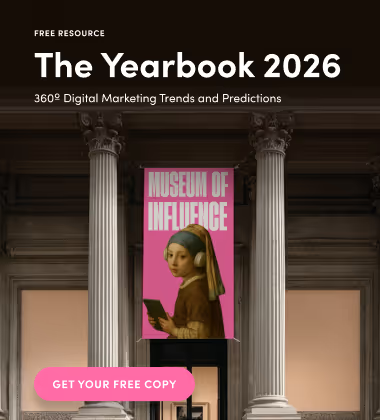
That’s not six digital consumer trends; it’s one behavioral shift, and it’s the shift our 2026 Yearbook, The New Anatomy of Influence, is built to address.
The hard part isn’t naming the fragmentation. It’s responding to it coherently across every campaign execution, not just the flagship ones. That’s what our Stitchwork Framework is designed to do: connect the scattered pieces of a brand into something a fragmented consumer can still recognize and follow.
The survey told us who the consumer has become. The Yearbook is our answer.
Which mode are you?
These consumer behaviors don’t show up evenly. Different consumers move through the fragmented internet in different modes shaped by emerging trends in how they discover and trust. Knowing which mode your audience favors changes how you reach them.
We built a quick way to find out. Take the “What’s Your Mode?” quiz! See which of the five behavioral modes describes you. Two minutes, no funnel required.
The full picture, including a detailed look at the Stitchwork Framework, arrives this November 2026 in the print and online editions of The New Anatomy of Influence.
Key takeaways on digital marketing trends
- 87% of consumers say their internet looks different from everyone else's, and discovery now starts across Instagram, TikTok, YouTube, Google, and ChatGPT at once.
- 91% save or screenshot content to return to later, making consumers active curators rather than passive audiences.
- Trust has moved from institutions to people. Micro-influencers now out-trust both major news publications and paid influencers.
- Over half of consumers (51%) are ready to buy directly inside a social platform.
- 75% are comfortable with AI, and 14% already start product discovery with ChatGPT.
- Short-form video is the single most engaging ad format, chosen more often than all other formats combined.
Methodology: Findings are drawn from TIA's 2026 Consumer Trends Survey, a first-party study of 336 North American consumers fielded in early 2026. Percentages are rounded.
This piece on digital consumer trends is part of TIA's 2026 thought leadership series exploring how brands build coherence in the age of fragmentation. The full Yearbook, The New Anatomy of Influence, arrives in print this November.