


No. Your rankings are probably fine. Your traffic is the part that's lying to you.
That's the gap nobody wants to explain, because explaining it means admitting the old scorecard is broken. A page holds position, sometimes for months, while the clicks tied to that position quietly shrink. Marketers check their rank tracker and core web vitals, see green, and assume the channel is healthy. It isn't.
Every agency with a blog has taken a swing at "is SEO dead" this year, and nearly every swing lands in the same spot: it's evolving, keep doing what you're doing, sprinkle in some AI keywords. That's not an answer. That's stalling. It treats AI like a new channel bolted onto Google, when it's really a change to what happens after your page ranks.
This new search landscape isn't theoretical for us. Across our content over the past year, we've watched the search results page change shape faster than the rankings beneath it.
Our keyword footprint has held roughly steady, yet the surfaces those keywords show up on have shifted sharply toward AI Overviews and other answer-style features. Older wins like featured snippets have thinned out and People Also Ask has expanded. The practical effect is that more of the answer now lives on the results page itself, so a page can keep its position and still lose the click.
In traditional search, ranking got you in the conversation. But it was never the whole conversation, and for a while nobody noticed since the two moved together. Now they've split. The brands losing ground don't have bad SEO. They have good SEO pointed at a results page that stopped looking like this two years ago.
Here's the myth-bust version: five assumptions still running most SEO programs, and what's replacing each one.
Myth 1: Ranking number one is the finish line

For a decade, the search engine optimization industry trained everyone to treat position one in Google search queries as the finish line. Get the top spot, get the click, job done. That’s the whole SEO strategy. Now, that link between rank and reward is what's broken, not ranking itself.
What's replacing it: position as an input, not the outcome. This isn't in tension with the ChatGPT study's finding that search rank is one of the strongest predictors of AI recommendation. It's the reason the finish line moved. Ranking well still earns you a real shot at getting cited. What changed is what happens after you rank.
In how to get featured in Google's AI Overviews, we broke down what it takes to get pulled into the AI-generated answer box: answering the question before the reader scrolls, marking up FAQ, HowTo, and Article schema so a model can parse the page cleanly, and building the credibility signals Google calls E-E-A-T. None of it guarantees placement. It's what separates a page that ranks and gets cited from one that ranks and gets skipped over.
The commercial case is stark: organic click-through rate drops from 15% to 8% once an AI Overview appears on the page. A brand cited inside that Overview captures attention a brand ranked first underneath it never gets a shot at.
Myth 2: More content is better content

Publishing volume used to be a defensible digital marketing strategy. Ten thin posts used to beat two strong ones if you were optimizing purely for keyword coverage. That math doesn't work in an AI search environment.
What's replacing it: content quality carries more weight. When researchers behind the ChatGPT SEO study ran 105,000+ prompts across 145 industries, they tested thirteen different signals against real recommendations. Homepage keyword relevance came in dead last. Stuff your homepage with keywords all day, ChatGPT barely notices.
What moved a recommendation, globally, was showing up in search results and ranking well, followed closely by backlinks. Entity presence in places like Wikidata and Wikipedia mattered too, though unevenly across industries. None of it gets built by publishing ten thin posts a month. It gets built one high quality content piece at a time.
The same math plays out inside a single page. Bolt five half-finished subtopics onto a post and you haven't made it more citable, just harder to trust. A page that fully resolves one question outweighs a page that gestures at ten. Volume used to stand in for authoritative content. Once machines started reading for substance instead of counting for frequency, that stand-in stopped working.
Myth 3: SEO and AEO are competing strategies
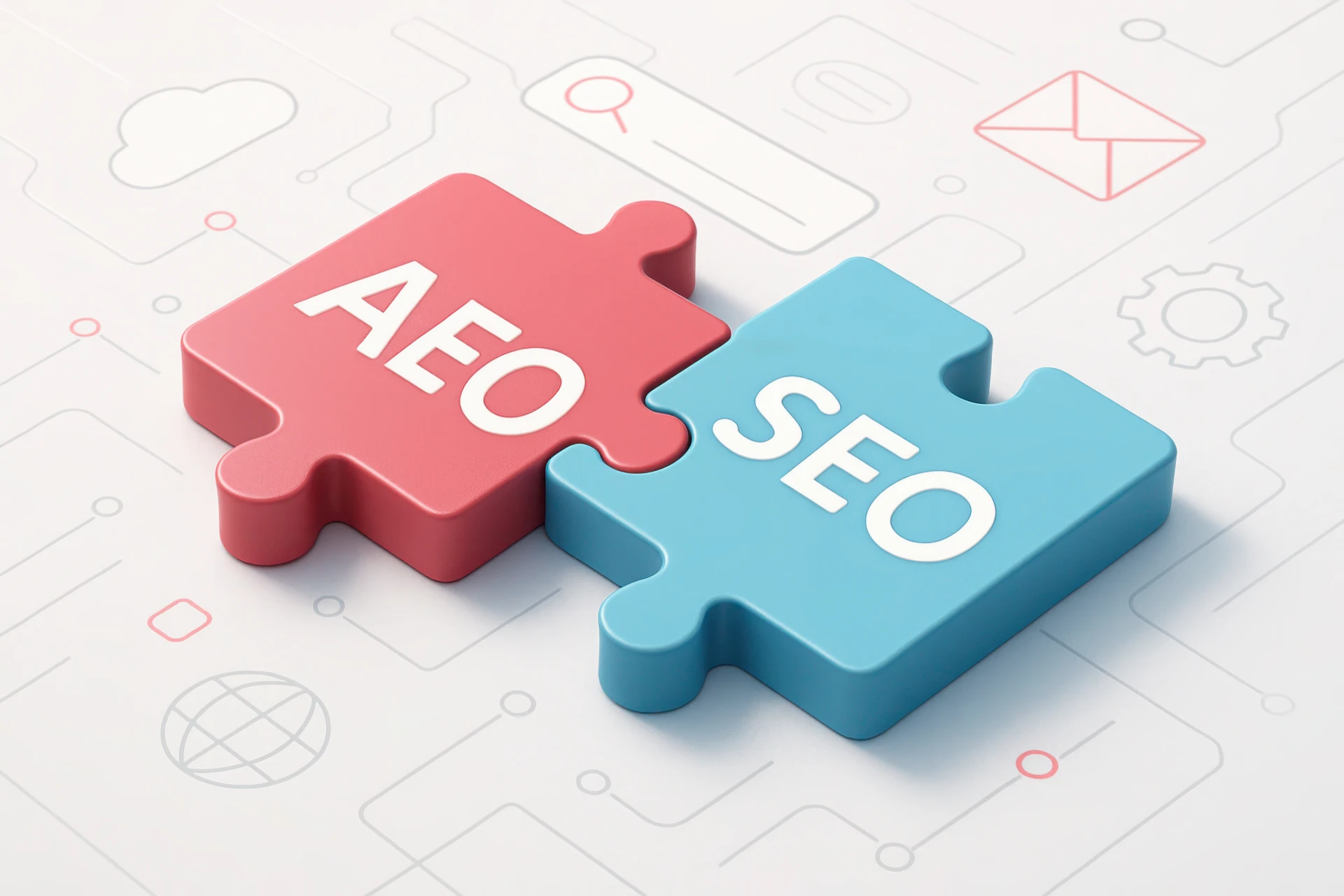
We hear this one from clients constantly: should we be doing SEO or should we be doing answer engine optimization? The framing itself is the mistake. No one’s saying kill SEO or SEO is dead.
What's replacing it: one discipline, and the numbers confirm it. In that same 145-industry study, Search Engine Appearances and Best Search Engine Rank correlated with a ChatGPT recommendation more strongly than every other signal researchers tested.
Translation: showing up and ranking well on Google is still the single best move you can make for your odds of getting recommended by ChatGPT. AEO isn't a second discipline competing for the same budget. It's what SEO looks like once it's working the way it's supposed to, pulling answers from the most helpful content.
We laid out the fuller mechanics in AEO vs SEO: crawlability, structured data, and topical authority earn both a ranking and a citation, the same prerequisites wearing two names. What changes is the last mile, writing the page so a model can lift a clean answer out without reinterpreting it.
Split that into two teams chasing separate goals and you optimize the same page against itself. Run it as one strategy and it pays out twice.
Myth 4: Featured snippets were the AI-era prize

Featured snippets were the closest preview of this future: get the boxed answer, win the click without needing position one. Brands built content strategy playbooks around snippet capture and assumed that skill would carry forward.
What's replacing it: the AI generated summaries, like Google’s AI Overview, and it plays by different rules. A featured snippet pulled one page's content verbatim. An AI Overview synthesizes several sources into one generated answer, meaning the model chooses which sources to trust, not which single page best matches a query. That's a harder bar, rewarding depth and verifiable specificity over the tight, snippet-shaped paragraph that used to win the box.
It's also a bigger bar than most brands are ready for. AI Overviews used to live almost entirely in informational territory, exactly where featured snippets used to play. That's already shifting: the share of AI Overview-triggering keywords that are purely informational queries dropped from 91% in January 2025 to 57% by October 2025.
Overviews have pushed into commercial and transactional search behavior, the ones closest to revenue. A snippet playbook built for "what is" questions was never built for that fight.
The signal that matters most depends on your industry
Here's the part most "is SEO dead" posts skip entirely: there's no single signal every brand should chase. Averaged across all 145 industries in that study, nothing explains more than about 5.8% of what predicts a recommendation, which sounds like noise. It isn't. The average just hides a handful of strong, very different signals that cancel out once you blend every industry together.
Split the data by category and each one has a clear favorite. A CRM company's odds ride on Wikipedia citations, correlated at 0.577. A plumbing or HVAC business tracks closest to PageRank, at 0.508. Enterprise AI companies lean on Reddit threads, at 0.528. Furniture retailers and hotels both depend heavily on Wikidata entity records, correlated at 0.706 and 0.650.
Run the same generic AI SEO checklist across all four of those categories and it'll underperform in most of them. Your industry's dominant signal isn't a detail to layer on at the end. It decides where the budget goes first.
Myth 5: Zero-click is a Google problem, not a brand problem
It's easy to treat rising zero-click search as an ecosystem-level trend, something happening to the internet rather than to your traffic specifically.
What's replacing it: a direct hit to pipeline that shows up long before anyone notices it in a channel report. When a query resolves entirely inside an AI answer or a chat response, the brand that would have earned that click a year ago earns nothing, unless it's the brand being cited.
That's not an abstract shift. It's the same pattern we opened with: stable rankings, shrinking clicks. Every brand still measuring SEO success by rank tracking alone is missing the metric that now decides whether the ranking pays off.
What that means for content type
Not every content type sits on the same side of this shift. Going by the principle the research supports, definition and comparison content built around a direct answer, and original research or first-party data, are the formats built to survive a model deciding what to cite. Generic "what is X" posts with no proprietary angle, and SEO content written primarily to hit a keyword string rather than answer a real question, are the formats that are more likely to lose ground first.
The common thread is defensibility as your optimization strategy. A model deciding what to cite is functionally asking "can I trust this enough to put my name next to it." Generic content fails that test even when it ranks. Specific, sourced content passes it even when its ranking is average.
We go deeper on the broader keyword and content marketing landscape in our SEO trends roundup, and on what a modern SEO program needs to cover in what does an SEO agency do.
What to do about it
Once being the cited source, not just the ranked link, is the new finish line, five things change:
- Start with what's already ranking. Pull keyword research on the queries where you hold position but clicks have dropped. That gap is where an AI Overview or chat response is already doing your page's old job.
- Consolidate thin content. If ten pages target overlapping keywords, merge them into fewer, deeper ones. Splitting one good answer across ten thin pages gives a model ten reasons to skip you and a competitor one reason to get cited.
- Make the survivors easy to lift from. A direct answer near the top, clear headers, and claims backed by named, checkable sources instead of vague ones.
- Build proof that lives off your own site too. Reviews, press mentions, and third-party data feed the trust signals models use to decide what to cite. A flawless page nobody else vouches for loses to a decent page the rest of the internet backs up.
- Track citations alongside rankings, and stop budgeting SEO and AEO as if they're two separate line items. Rank tracking alone will tell you the story is fine right up until the traffic disappears. Split the team and you split the results.
None of this means abandoning fundamentals. Technical SEO health (from on page SEO to site speed), site architecture, and topical authority still matter, arguably more than before, since they're what a model checks before it ever decides whether your page is quotable. What changes is the definition of success on top of that foundation.
Frequently asked questions
The bottom line
Summary or Key Takeaways:
So is SEO dead? No. But the scoreboard is. Brands still measuring success by organic search position alone are competing for participation trophies.
The ones adjusting to citation as the real objective are the ones positioned to keep their traffic curves steady. Everyone else's rankings stay flat. Rank all you want. Just make sure you're also the brand getting quoted.
Not sure which signal your industry rewards, or whether your best pages are built to get cited? Talk to TIA about an AI search audit. We'll show you where the clicks are leaking and what to fix first.