



To turn blog traffic into clients, focus on buyer intent rather than search volume. Map content across the awareness, consideration, and decision stages of the buyer journey, and include strategic, specific CTAs that guide readers toward becoming qualified leads.
This is one of the most common frustrations we hear from founders and marketing leads: they invested in content, published consistently, watched their organic traffic grow, and then nothing. No demo requests. No inquiries. No clients.
The instinct is usually to publish more. But volume is rarely the problem. Most content strategies are built to attract traffic and stop there, treating the blog as a media property rather than a commercial asset. Those are two fundamentally different things.
Traffic isn’t the goal. Clients are. If your lead generation strategy wasn’t built with that distinction in mind from the start, you’ll keep watching your analytics go up while the sales pipeline stays flat.
Why most blog content doesn’t generate leads
The gap between traffic and leads almost always comes down to intent. Not every visitor who lands on your blog is a potential customer. Some are researchers. Some are students. Some are the kind of decision-makers you want to reach, but your content never gives them a clear reason to take the next step.
Writing for buyer intent means asking intentional questions before starting any piece of content. Instead of "What keywords have a high search volume?" you ask, "What is someone thinking about when they search this?” Where are they in their decision-making process?
For example, a “what is content marketing” post pulls in people at the awareness stage. They’re exploring, learning, and usually not ready to hire a team yet. A blog on “how to choose a content marketing agency” attracts someone who already wants support and is comparing providers.
Both can rank well, but only the latter is set up to drive qualified leads.
Understanding your buyer personas, not just who they are demographically, but where they are in the buying process, is what separates a lead generation strategy from a publishing schedule.
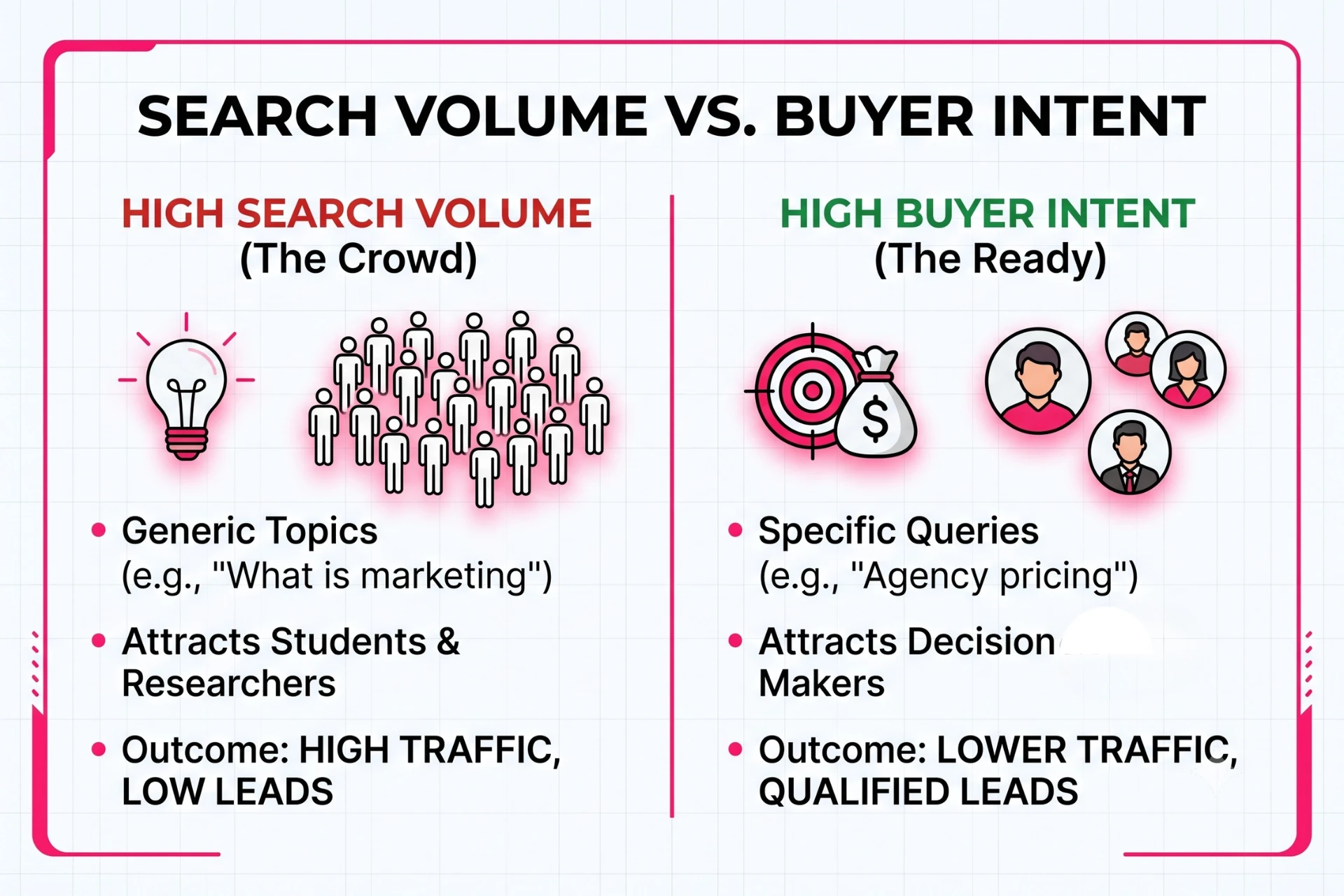
Image Source: Gemini 2026
The buyer journey is your content map
Awareness, consideration, and decision-stage content each require a different ask. Most brands publish almost exclusively at the awareness level and then wonder why their content marketing efforts do not convert.
Awareness content highlights a challenge or idea for the first time. It grabs interest and helps you look trustworthy. At this point, keep the ask simple: subscribe to a newsletter, read a related post, or return later.
Consideration-stage content supports would-be customers as they weigh their options and compare solutions. This is where a lead magnet or gated asset makes sense, since the reader is interested enough to exchange their contact info for something helpful.
It’s also when decision-makers tend to be most open to industry insights, side-by-side comparisons, and clear, honest explanations of how each approach works.
Decision-stage content is where you make the case for working with you specifically. Case studies, service explainers, and detailed process posts live here. The ask at this stage is direct: book a call, request a proposal, or get in touch.
If your editorial calendar is full of awareness content and light on consideration and decision pieces, you’ve built an audience, not a pipeline.
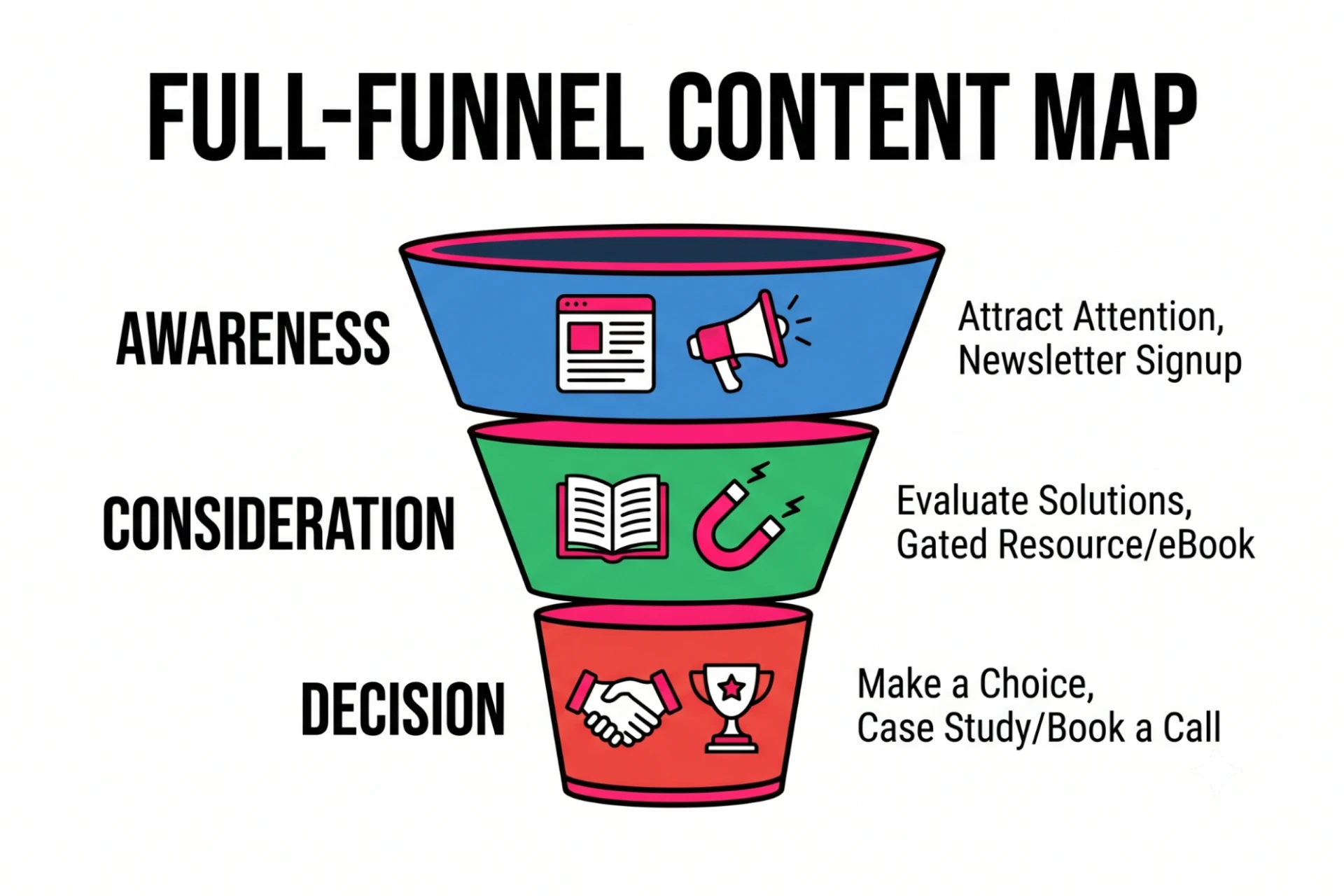
Image Source: Gemini 2026
CTAs are not a formality
One of the clearest signals that a content strategy was not built for effective lead generation is where the CTA lives. If your call to action is a single line at the very bottom of a long post, it’s an afterthought, and it will perform like one.
Strategic CTAs are placed where the reader's interest is highest, not where it’s most convenient to add them. That might be mid-post, after a point that resonates. It might be a contextual aside that connects the topic directly to a service you offer.
The CTA also needs to be specific. "Contact us" is not a CTA. "Get a free content audit" is. The more clearly the ask connects to what the reader just consumed, the better your website conversion rate will be.
Lead generation forms and landing pages
Here’s where many otherwise solid content strategies technically fall apart. You can have the right content, the right CTA, and the right audience, and still lose the lead because the form or landing page creates unnecessary friction.
Lead generation forms should be short. Research consistently shows that keeping lead gen forms to three to five fields significantly improves completion rates. HubSpot’s analysis of over 40,000 landing pages found that conversion rates decrease as the number of form fields increases, with multi-line text fields and drop-down boxes having the steepest negative effect. Ask for what your sales team actually needs at this stage, not everything you might want to know later. You can qualify further in the follow-up.
Focused landing pages designed around one clear offer usually beat generic “Contact Us” pages for capturing leads. When someone clicks a CTA in a blog post, they should land on a page that matches the exact promise of that CTA, not a homepage that forces them to hunt and restart their journey.
Including social proof like customer testimonials, reviews, and short case studies on these pages adds trust and credibility, helping turn simple form fills into true marketing-qualified leads.
Lead generation forms embedded directly in high-intent blog posts, not just linked to from them, can also meaningfully boost conversion rates, particularly at the consideration stage.
Internal linking is a lead pathway
Most marketers understand that internal linking supports search engine optimization. Fewer think about it as a buyer navigation tool.
When someone reads a blog post and clicks through to a relevant service page or deeper resource, they’re telling you something. They’re interested enough to keep going. That behavior is the beginning of a qualified lead, and your content marketing strategy should be designed to encourage it at every stage.
Every post should include a clear pathway. Where do you want an engaged reader to go next? A well-placed internal link to your blog writing services or a relevant case study is not pushy.
It’s helpful. It answers the question the reader is already asking.
Social media as a lead generation channel
Social media platforms are not separate from your content lead gen strategy. They’re an amplification layer for it.
Sharing blog content across social media channels drives qualified traffic back to your highest-intent posts. But social media lead generation goes beyond simply posting links.
Lead gen forms embedded natively in social media platforms, particularly LinkedIn for B2B brands, allow potential customers to submit their contact details without ever leaving the platform, significantly reducing friction.
Social media posts that directly address your target audience's pain points and link to gated resources are consistently among the best lead-generation strategies for content-driven brands. The key is alignment: the social content, the blog post, and the landing page all need to speak to the same buyer persona at the same stage of their journey.
Lead scoring: Not all leads are equal
Lead scoring is a method for prioritizing leads based on their likelihood to convert. A visitor who reads three blog posts, downloads a gated resource, and visits your services page is a very different prospect from someone who landed on a single awareness post via a social media share.
Both are leads. Only one is a hot lead worth prioritizing.
Implementing even a basic lead scoring system helps your sales team focus on the most promising prospects and allows your SEO team to identify which content is driving the best lead quality, not just the most traffic.
Lead qualification does not have to be complicated. Start by defining what a marketing-qualified lead looks like for your business, and work backward from there to understand which content touchpoints are producing them.
Image Source: Gemini 2026
FAQs about effective lead generation
Key takeaways
Turn your blog into a lead generation engine
If your content is performing in search but not converting to clients, the strategy needs a commercial rebuild, not just more posts on the calendar.
At The Influence Agency, we build content strategies with revenue outcomes in mind from the start. That means knowing which topics to target, how to structure content for the full buyer journey, and how to turn a well-written blog post into a genuine lead generation asset.
If you’re ready to make your content work smarter, let's talk about what that looks like for your brand.