



Through the management of technical SEO, on-page optimization, content strategy, link building, and performance tracking, an SEO agency boosts your website's prominence in search results. The objective is to generate high-quality organic traffic that grows steadily and translates into tangible business expansion.
If you’ve asked someone to explain SEO services and walked away with a vague answer about "rankings" and "algorithms," you’re not alone.
Search engine optimization is one of the most misunderstood services in digital marketing. The terminology is dense, the timelines are long, and too many SEO companies have made a career out of keeping their work invisible.
Vague deliverables and reports filled with disconnected metrics often leave brands frustrated and budgets drained. This leads to a persistent, fundamental question: What’s the actual role of an SEO company?
If you’re a marketing lead, CMO, or founder wondering if an SEO partnership is a justifiable investment, this guide provides a transparent, plain-language breakdown of the core services and practical workflows involved.
What is an SEO agency?
An SEO agency is a professional service provider that helps businesses improve their online visibility in search engines like Google. The work spans technical website health, content strategy, keyword research, link building, and ongoing performance tracking.
A good SEO company doesn’t just move rankings. It builds a sustainable foundation for organic traffic that continues to work long after the initial investment.
Where paid advertising stops the moment your budget runs out, organic traffic gained through a strong SEO strategy compounds over time. That is the core value proposition, and it’s why so many growth-focused brands prioritize it.
Technical SEO: The foundation everything else is built on
Before any content gets written or any keyword gets targeted, a legitimate SEO agency starts with a full website audit. Technical SEO is the process of making sure your site can be properly crawled, indexed, and understood by search engines.
In practice, this means diagnosing the issues search engine bots encounter when accessing your pages. Broken links, crawl errors, duplicate content, and poor site architecture all prevent your pages from being indexed correctly.
Page speed and mobile optimization are also part of this layer. Google's Core Web Vitals measure loading speed, interactivity, and visual stability, and sites that fail these benchmarks are at a ranking disadvantage regardless of how good their content is.
Schema markup is another technical SEO component. By adding structured data to your pages, you help search engines understand what your content is about, unlocking rich results like FAQ panels and sitelinks on search engine results pages (SERPs).
Technical SEO is rarely glamorous, but it’s the work that makes everything else possible. An SEO firm that skips straight to content without auditing your site's technical health is building on an unstable foundation.
On-page optimization: Making every page work harder
Once your site is technically sound, the next layer is on-page optimization. This is where your SEO strategy meets your content.
Keyword research and targeting
Experienced SEO companies start with keyword research: identifying the specific terms your audience types into search engines and mapping those terms to the right pages on your site.
SEO professionals use tools to analyze search volume, search intent, and competition levels before deciding which target keywords to prioritize.
Audience types intent > Volume, Intent, Competition > Topic Maps to Page
In practice, keyword research shapes which pages get created, how existing pages get restructured, and which terms appear in your headings, body copy, and metadata.
Content structure and metadata
On-page SEO involves optimizing the elements on each individual page: your H1 and H2 headings, body content, internal links, image alt text, and meta descriptions. Each of these signals tells search engines what a page is about and how relevant it is to a given query.
A well-structured page with clear headings, naturally placed relevant keywords, and a compelling meta description will consistently outperform a page that ignores these fundamentals, even if the underlying content is strong.
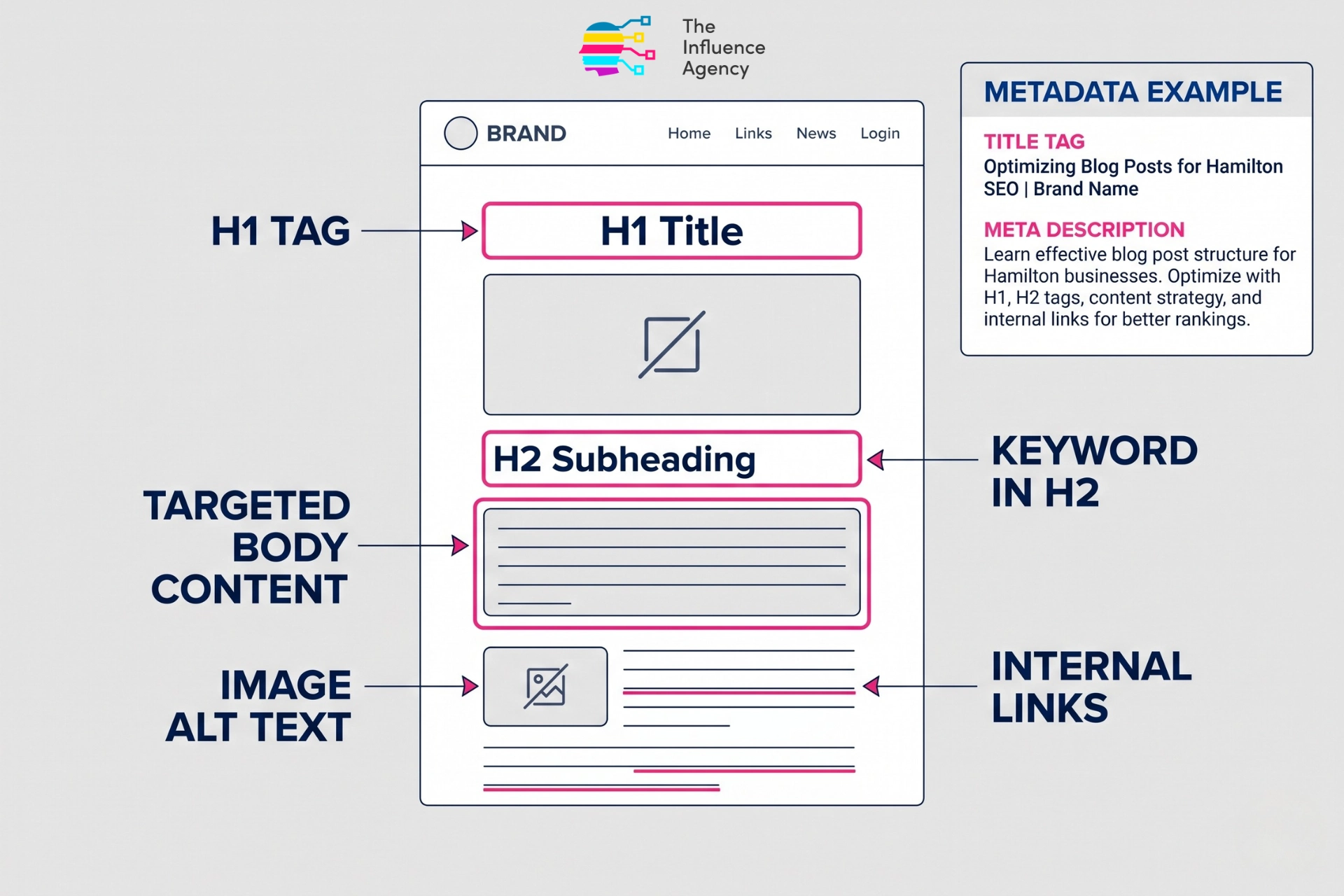
Image Source: Gemini 2026
Content marketing and blog writing
Ranking for competitive keywords takes time. Content strategy is how SEO companies accelerate that process by systematically building your topical authority.
This isn’t about publishing blog posts for the sake of volume. A strong content strategy starts with identifying which terms your target audience searches for that you do not currently rank for.
From there, an effective SEO strategy maps those gaps to a content calendar, with each piece written to rank for a specific query, answer it with depth, and link back to your core service pages.
Search intent matters here. A good SEO agency does not just target high-volume keywords. It targets keywords where the search intent aligns with what your business offers, so the traffic you earn actually converts. You can read more about how our content marketing services support long-term SEO growth.
Done properly, a content strategy compounds. Each new piece supports the others, builds more topical authority, and attracts more organic traffic over time. It’s one of the highest-leverage investments a business can make in its search engine visibility.
Link building and off-page SEO
Search engines treat links from other websites as votes of confidence. The more authoritative sites that link to yours, the more Google trusts your content. This is the core logic behind off-page SEO, and link building is one of the most labor-intensive parts of what SEO companies do.
Reputable SEO agencies earn links through digital PR, outreach, guest posting on relevant publications, and creating content that other sites genuinely want to reference. High-quality backlinks from authoritative websites signal to search engines that your site is a trustworthy resource, which directly improves your search engine rankings.
What link building isn’t: buying links from low-quality directories. Black-hat tactics can produce short-term ranking movements followed by penalties that take months to undo. When evaluating any SEO firm, ask specifically where your links will come from and request examples of past placements. A credible agency will have no problem showing you.
Learn More: 5 Popular platforms for link acquisition
Local SEO: Visibility where it counts
For businesses that serve specific geographic markets, local SEO is a distinct and critical layer of the work. This includes optimizing your Google Business Profile, building consistent local citations, managing online reviews, and targeting location-specific keywords that drive foot traffic and local leads.
Many SEO companies offer local SEO as part of a broader package. If your business relies on customers in a specific city or region, make sure any agency you evaluate has demonstrable experience in this area.
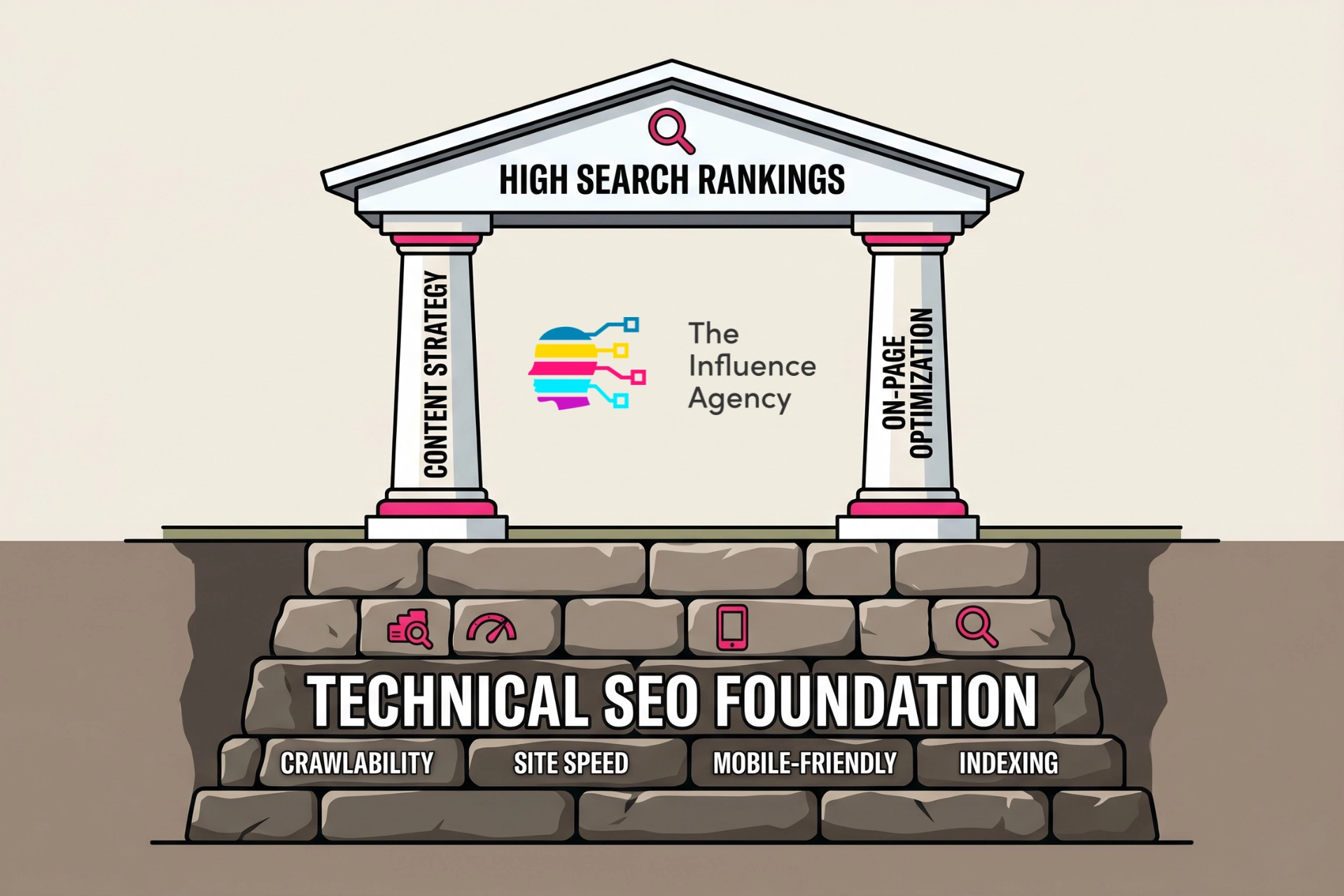
Image Source: Gemini 2026
Reporting and performance tracking
This is where a lot of SEO agencies lose credibility, and where good ones earn it.
A serious SEO campaign comes with reporting and analytics that connect work to outcomes. That means tracking keyword rankings over time, monitoring organic traffic through Google Analytics and Google Search Console, measuring click-through rates (CTRs), and reporting on conversions driven by organic search. SEO tools like these provide the data layer that allows SEO experts to continuously refine strategy and demonstrate ROI.
Ask any agency you're considering: what does your monthly report look like, and how do you tie your SEO plan to business results? If the answer is vague, that’s a red flag.
At its core, an SEO agency's job is to get your business in front of the people searching for the products or services you offer. The way we do that comes down to four things:
- Making sure your website's foundation is technically solid so customers have a seamless experience
- Ensuring your content speaks the same language as your customers when they search
- Earning endorsements from credible websites and communities that are relevant to your industry
- Translating all of that into clear, actionable reporting so you always know what's working
It's more science than magic, and a good agency will always show you the work.
FAQs about hiring an SEO agency
What do SEO companies actually do?
SEO companies improve your website's performance in search engines through technical audits, on-page optimization, content creation, link building, and reporting. The goal is to increase organic traffic and improve search engine rankings to drive measurable business results.
What does SEO strategy actually do for my business?
SEO increases your website's visibility in search engine results pages, which drives more qualified traffic to your site. Unlike paid ads, organic traffic from a successful SEO strategy compounds over time, meaning the results keep building without ongoing ad spend.
Are SEO services still relevant in 2026?
Yes. Search engines remain one of the primary ways people discover businesses online. SEO is evolving, with AI-powered search experiences and answer engines changing how results are displayed, but the fundamentals of technical health, quality content, and authoritative links remain as important as ever.
How do I know if an SEO firm is actually delivering results?
Look for transparent reporting that tracks keyword rankings, organic traffic, and conversions over time. A good SEO company will connect its activity directly to business outcomes, not just movement in abstract metrics.
Key takeaways
Ready to talk about your search strategy?
If you've been unclear on what you would actually be getting from an SEO partner, that clarity matters before you sign anything. The right SEO agency will welcome the questions.
Our SEO services at The Influence Agency are built around transparency, strategy, and results you can measure. Whether you're starting from scratch or trying to understand why your current SEO plan isn't working, we're ready to have that real conversation.
Reach out to our team to talk through where your search presence stands today and what it could look like six months from now.
No jargon, no runaround; just a straight answer and a plan to match.