



GEO (generative engine optimization) and SEO (search engine optimization) both shape your search presence, but optimize for different outcomes. SEO ranks your pages in search results. GEO gets your content cited in AI-generated answers. Optimizing for both gives your brand an edge.
Something fundamental is changing about how people find information online. When someone types a question into Google today, they’re increasingly likely to get a direct answer at the top of the page generated by AI, before they ever see a single blue link. They might not click through to any website at all.
This isn’t a future scenario. It’s already happening, and it’s accelerating. For brands that have spent years building their search presence through traditional SEO, it raises a practical question: if AI is doing the answering, where does your brand fit into that picture?
That’s where generative engine optimization, or GEO, comes in.
What is generative engine optimization?
Generative engine optimization (GEO) is the practice of optimizing your content so that AI-powered generative engines, like Google AI Overviews, ChatGPT, and Perplexity, are more likely to reference, cite, or surface your brand in their generated responses.
The concept of GEO arose as AI-driven answers began to supplant standard search results for an increasing number of user queries. In 2024, experts from the Allen Institute for AI, Princeton, and Georgia Tech introduced GEO in a research paper.
Their study investigated how authoritative signals, source quality, and content structure influence a website's likelihood of being cited in AI-generated outputs. Since its academic debut, the term has rapidly transitioned into a staple of modern digital marketing strategy.
Where traditional SEO is about ranking in a list of links, GEO is about being included in an answer. That’s a meaningful shift, and it changes what you need to optimize for.
How do generative engines work?
Generative engines are powered by large language models (LLMs) trained on enormous datasets. Unlike traditional search engines that match keywords to pages using deterministic algorithms, generative AI uses natural language processing to interpret user intent and synthesize answers by drawing on multiple sources simultaneously.
In other words, a generative AI tool does not point you to a page like a search engine. It reads across many pages and writes you an answer. Whether your brand's content gets used in that answer depends on how clearly, accurately, and authoritatively it’s written.

Source: Canva
GEO vs SEO: What are you optimizing for?
The answer depends on what you’re trying to achieve and where you want to show up.
What traditional SEO optimizes for
Success in traditional SEO means earning a high position on a search engine results page. The goal is to get a user to click your link. Your search rankings depend on signals such as keyword relevance, high-quality backlinks, page speed, meta descriptions, and technical SEO factors like site structure and crawlability.
SEO focuses on making your page visible and attractive to search bots so they index it correctly, and to users so they choose to click. Keyword research, on-page optimization, and link authority are the core levers.
What GEO optimizes for
In GEO, success means being cited, paraphrased, or referenced inside an AI-generated answer. The user may never visit your website. What matters is whether AI engines treat your content as a credible, clear, and relevant source worthy of inclusion.
GEO focuses on making your content legible and extractable to generative engines. Structured content, conversational tone, direct answers to user queries, and factual precision all carry more weight here than they typically do in traditional SEO metrics.
What signals does SEO and GEO reward?
Traditional SEO leans heavily on technical factors, link authority, and keyword placement. GEO rewards different things: content clarity, factual depth, question-based keywords, authoritative sourcing, and content that directly addresses the question a user is actually asking.
A page that ranks well in traditional search may still be invisible in AI-generated answers if it’s written in vague, promotional language. The inverse is also true. Well-structured, authoritative content can be regularly cited by generative engines even without massive backlink volume.
The user experience is different
The shift in user experience is more profound than it might first appear. While traditional search relies on a user clicking a title or meta description, GEO allows AI tools to weave your brand directly into a synthesized response.
In this environment, your content automatically creates a brand impression, serving as the answer itself rather than just a snippet designed to earn a click.
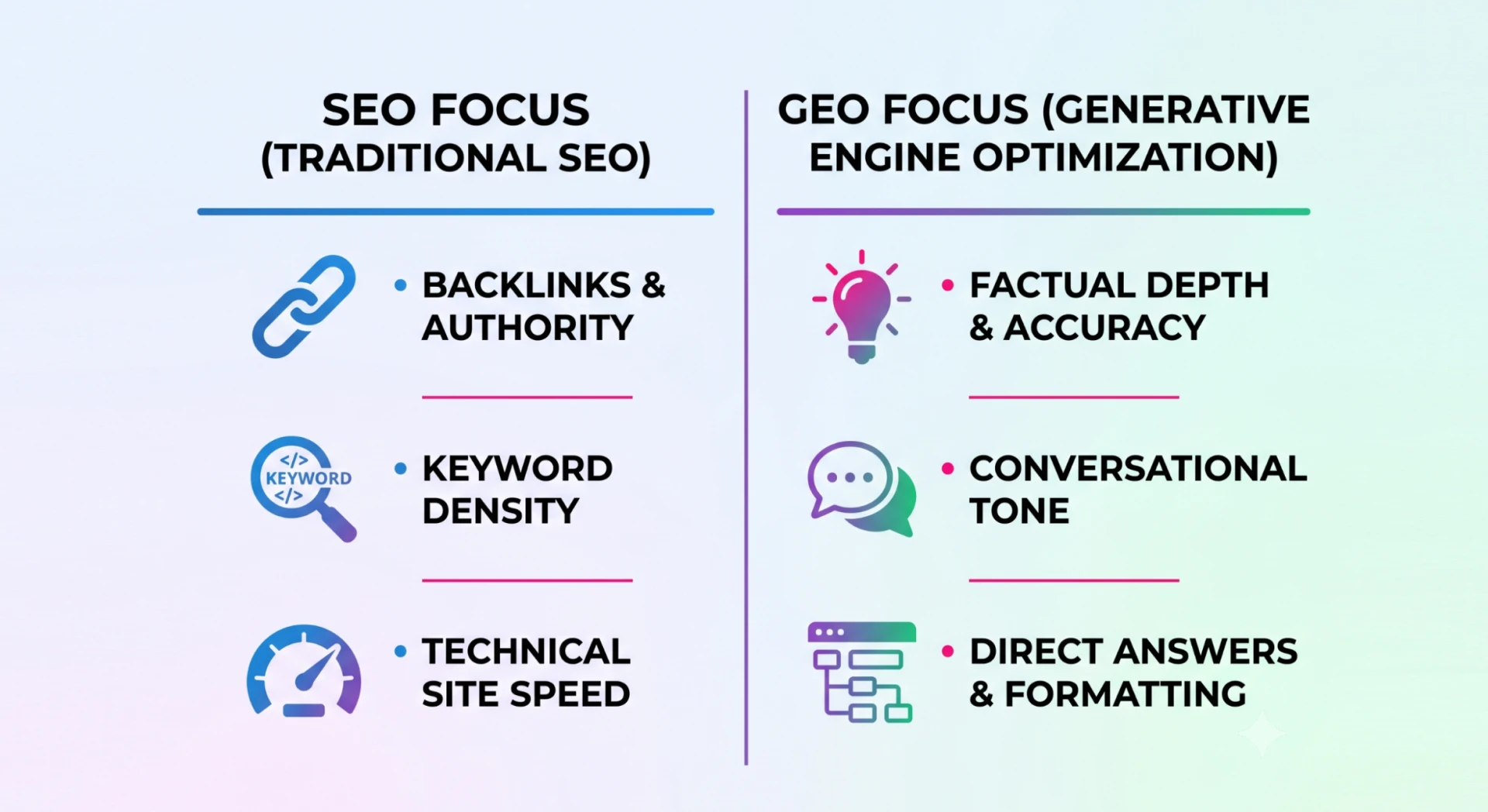
Image Source: Gemini 2026
Where GEO and SEO overlap
SEO and GEO share a common foundation: creating authoritative, structured content that clearly answers users’ queries. This overlap means they’re not competing disciplines. In most cases, they reinforce each other, good news for brands that have already invested in search.
Understanding where the two share the same principles helps you avoid treating them as separate strategies.
The shared foundation
Digital content that is legible and valuable to AI systems relies on the same core strengths as high-quality SEO: authoritative prose, clear heading structures, well-organized pages, and swift technical execution. Brands with a robust SEO legacy have a significant head start in the transition to GEO.
Beyond that, both strategies prioritize topical authority. By maintaining a steady stream of comprehensive content within its niche, a brand demonstrates expertise to both traditional search algorithms and generative AI platforms.
Where they diverge
SEO and GEO reward different signals: SEO often focuses on technical SEO, keyword density, and link building. GEO optimization shifts the emphasis toward content clarity, factual precision, and structured content that AI-driven search engines are designed to extract from.
There’s also a difference in how you measure success. Traditional SEO metrics such as rankings, organic traffic, and click-through rates are well-established. AI visibility is harder to track right now, though that is changing as the discipline matures.
And if you want to understand how AI is reshaping search more broadly, our breakdown of Answer Engine Optimization (AEO) and why your brand needs it covers the shift in depth.
Why GEO matters for your brand right now
GEO matters right now because search behavior has already changed, not just something predicted for the future. It’s still an emerging discipline, so the measurement tools are less mature than those for traditional SEO, and best practices continue to evolve.
Adopting GEO practices now means getting a step ahead of the curve.
Search behavior is already shifting
Google AI Overviews now appear for almost 50% of queries, particularly informational ones. AI assistants like ChatGPT and Perplexity are handling over 2.5 billion combined searches daily. Brands that are not represented in those AI-generated answers are simply absent from a growing portion of the conversation.
Early movers have an advantage
GEO positions itself as an early-mover opportunity. The brands that start creating content with AI readability in mind now will be better positioned as generative AI search continues to expand. Waiting until GEO is mainstream means competing for ground that others have already claimed.
It strengthens your overall digital strategy
Content optimized for generative engines tends to perform better across all modern search formats, including traditional results, featured snippets, answer boxes, and voice search. Investing in GEO-ready content is not a bet on one channel. It’s a structural improvement to your entire content strategy and your brand visibility across the board.
For a closer look at how AEO fits alongside GEO in the broader answer-first search landscape, explore our post on AEO vs SEO: what's the difference and do you need both?

Source: Canva
What early GEO optimization looks like in practice
Early GEO optimization comes down to a handful of content habits: writing clearly, structuring for AI readability, and leading with answers.
For brands just getting started, GEO does not require a complete overhaul. It’s more about shifting how you think about content quality and structure. Here are the high-level principles to start with.
Write for clarity and conversational tone
AI tools favor content that answers questions plainly. Use a conversational tone and short sentences. Write the way people actually ask questions, not the way a keyword tool tells you to phrase them.
Vague, promotional writing is less likely to be cited by generative engines.
Use structured content and formatting
Structured content with clear H2 and H3 headings, bullet points, and short paragraphs helps AI engines parse and extract your content efficiently. Answer boxes and AI overviews frequently pull from well-formatted pages.
Schema markup is another layer worth exploring as GEO matures.
Lead with the direct answer
Do not bury your key point. State it clearly at the top of a section, then provide supporting context. Generative engines are designed to extract direct answers to user queries. Content that front-loads the answer is more likely to be used.
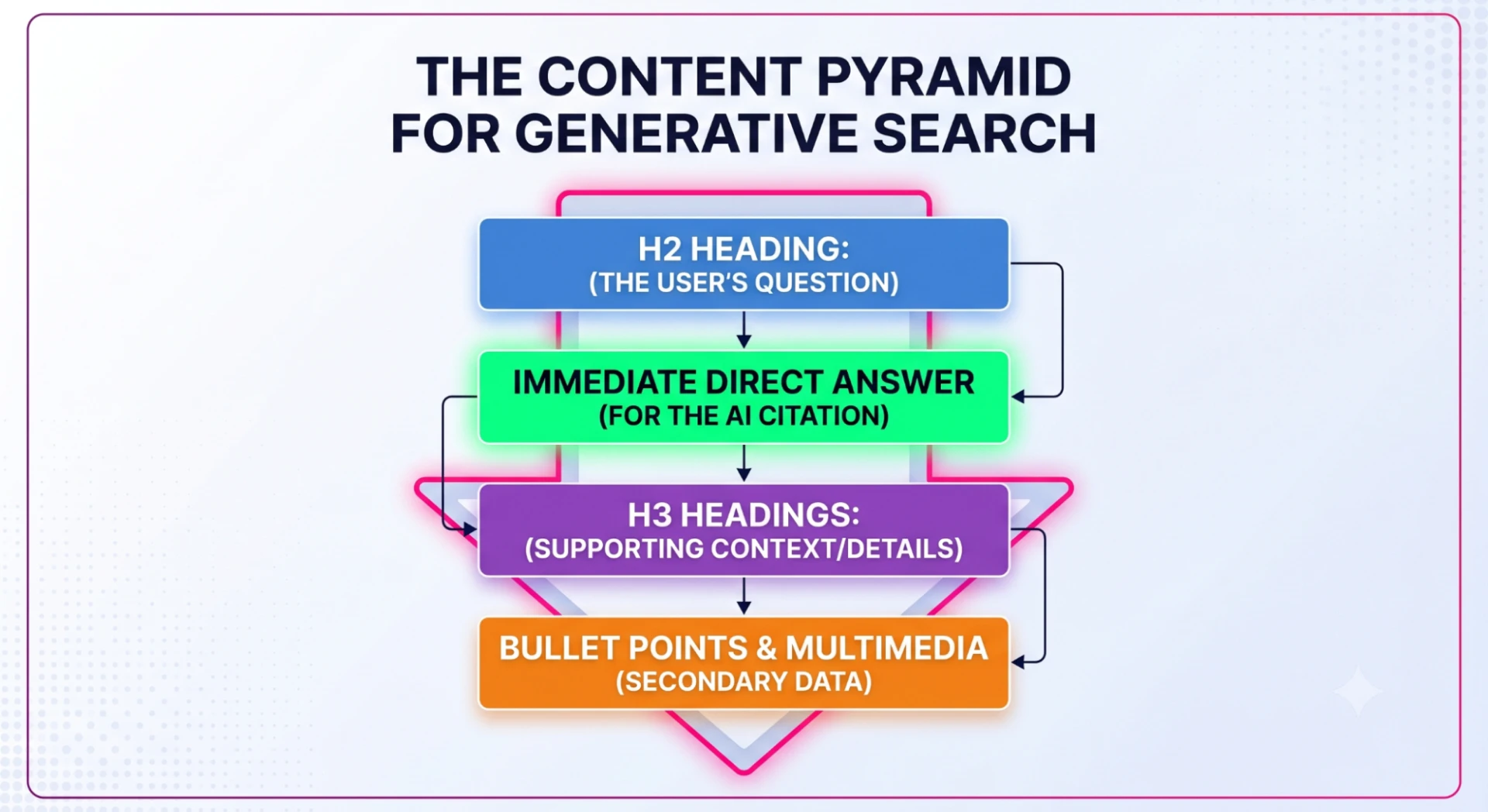
Image Source: Gemini 2026
Use question-based keywords
Question-based keywords, such as "how does X work" or "what is the difference between X and Y," mirror how people search with AI tools and voice search. Incorporating them naturally improves the chances that your content surfaces for those exact queries.
Build topical authority and earn brand mentions
Consistent, in-depth content on the topics your brand owns makes you a more reliable source for AI models to draw from. Being referenced by authoritative sources, whether in press coverage, industry publications, or expert content, increases brand mentions and signals to generative engines that your brand is worth citing.
Do not neglect alt text and multimedia
Alt text for images improves both accessibility and AI readability. Adding multimedia content like videos and infographics gives generative engines more formats to draw from when creating responses. Alt text under 125 characters, written descriptively, is a simple win.
FAQs about SEO and GEO
Key takeaways
Is GEO part of your brand's search strategy yet?
If you’re a brand-side marketer or founder trying to understand whether GEO belongs in your strategy, the honest answer is: it depends on your category, your content maturity, and how competitive your search landscape already is.
But for most brands, especially those investing in social media marketing, digital marketing, and SEO, the conversation is worth starting now.
Our team at TIA works with brands to assess where they stand in the evolving search landscape and build content strategies that perform across traditional and generative search.
Learn more about our generative engine optimization services and reach out to discover whether GEO should be part of your next move.
Search is no longer just a list. Make sure your brand is in the answer.