

Six brand activation examples that worked, from Coca-Cola’s named bottles to Red Bull’s space jump. Each breakdown covers what the brand built, why it landed, and the version a smaller budget can copy.
Most activations fail quietly. The pop-up shop looks good, the photos come out fine, and three weeks later, nobody can name what the brand was selling. The difference between that and an activation people still cite years later isn't budget. It's whether anyone decided, before the venue got booked, what the room was supposed to make someone do.
Below are six brand activation examples, from soda to enterprise software. Each made a single bet about its audience, and each bet shows up in the numbers. Every breakdown covers the objective, the build, why it worked, and the version a smaller brand can afford.
1. Coca-Cola turned packaging into the pitch
Coca-Cola's Share a Coke campaign swapped its logo for 150 of Australia's most popular first names in 2011, turning every bottle into an invitation. Research showed young Australians felt the brand wasn't speaking to them at eye level. A name on the label fixed that without a slogan doing the work.
More than 250 million named bottles and cans went out that summer, roughly eleven for every Australian alive because a can with your name on it is worth photographing, and one with a friend's name gives you a reason to share it, in person and on social media. The idea has since run in more than 70 countries.
The packaging was the media buy, and that's the part worth copying: put a name, a place, or an inside joke on products people already buy, and your target audience handles the sampling and sharing for you.
2. IKEA turned a store into a 100-person hotel for one night
IKEA turned its Essex store into a one-night hotel for 100 customers in 2011, after a Facebook group asking for an IKEA sleepover grew to almost 100,000 members. Guests arrived in pajamas for a bedtime story, a sleep expert, and a night in IKEA beds.
The event wasn't about hard-selling furniture. It let people experience the product where it matters, in bed, overnight, and turned the waitlist into the campaign. Being one of 100 out of nearly 100,000 is a story worth telling.
Scarcity plus a real use case beats scale, and all it takes is one location, a public waitlist, and a use case dramatic enough to earn its own headline.
3. Red Bull turned a stunt into a broadcast
Red Bull Stratos turned a skydive from the edge of space into the most-watched livestream YouTube had ever hosted. At 127,852.4 feet, the sky is black, and the air won't keep you alive. That's where Felix Baumgartner opened the capsule door on October 14, 2012, and stepped off, breaking the sound barrier in freefall live on Red Bull’s YouTube channel.
The world watched it happen: more than 8 million concurrent livestreams at the peak, a record for the platform at the time. Red Bull sold nothing on the broadcast.
Audiences came for the feat, not the sponsor, and left with the brand anyway. You don't need the stratosphere to create an activation people remember. You need one real feat that only makes sense because your brand exists, and then the discipline to get out of the way.
4. Salesforce turned a conference into a cultural event
Salesforce runs Dreamforce, its annual customer conference, like a festival. Nobody gets excited about enterprise software, yet roughly 45,000 people flew to San Francisco from more than 140 countries to attend in person.
The mechanic is casting. Dreamforce puts its own customers on stage rather than in the seats and builds the program around them: 1,500 sessions led by practitioners and industry experts, community spaces organized by role, and a headline concert that gives the week a reason to end. Customers show up for each other, and Salesforce gets to stand behind the room instead of in front of it.
Every one of those 45,000 attendees registered, picked sessions, and scanned into rooms. The festival is also the largest first-party data collection exercise Salesforce runs all year, and it’s voluntary, because people hand over their details to get into something they want to be in.
That’s the part a smaller brand can copy, and it doesn’t need a conference. A workshop series or an annual customer dinner works the same muscle. The test is whether your attendees would still come if you weren’t presenting.
5. Bondi Sands turned a hotel room into a set
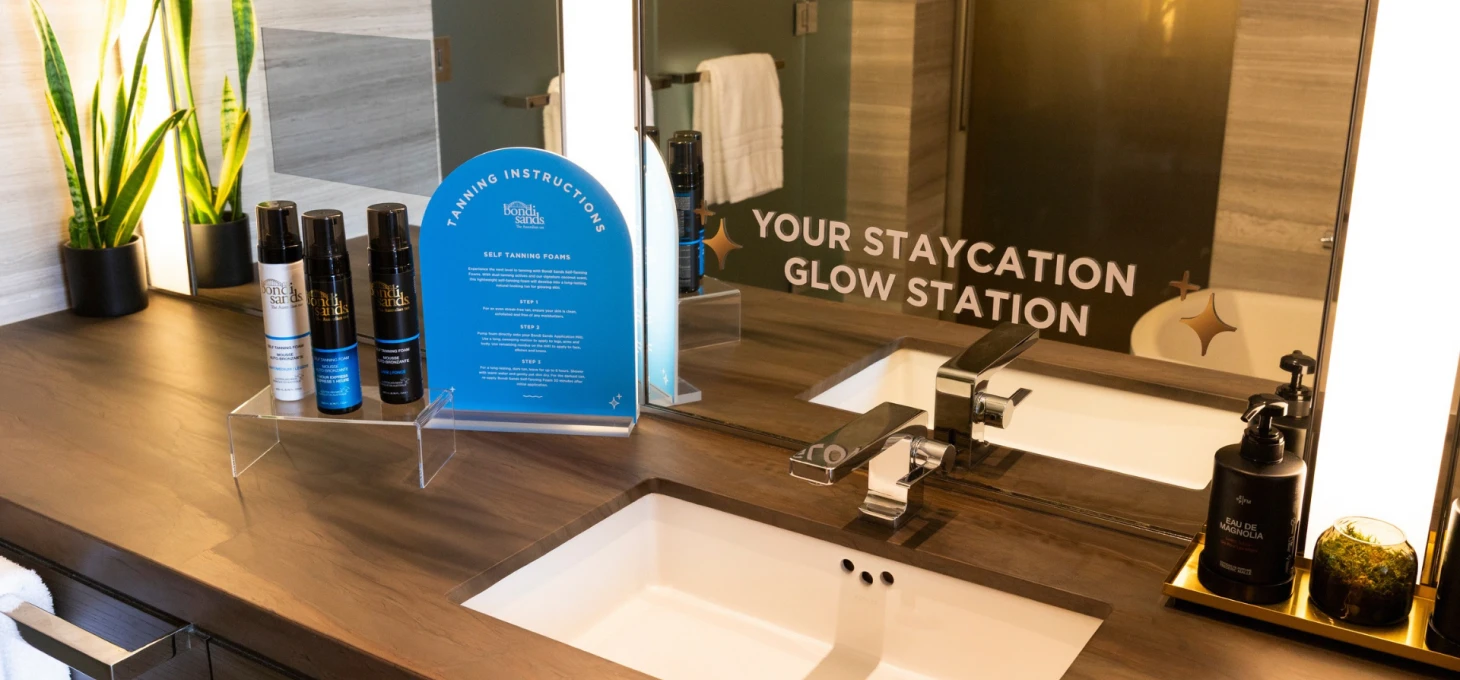
Bondi Sands launched in Canada by turning Four Seasons hotel rooms into branded suites and inviting creators to stay the night. The Australian self-tanning brand had a national retail launch coming and no Canadian audience yet.
TIA rebuilt the rooms as Bondi Sands suites, with bespoke branding, custom in-room merch, and personalized room service, then had English and French creators post from inside.
It's one of the sharpest experiential marketing examples in beauty. A sample gives a creator something to hold on to. A room invites them to stay, which is how a newcomer got treated like a destination.
The sleepover anchored a wider launch of influencer partnerships and paid amplification that generated more than 58 million impressions and 61,000 clicks at a $2.19 CPM (cost per thousand impressions). Skip the sample box and give creators a room to use the product. That's where the content comes from.
6. youtheory turned a launch into content infrastructure
youtheory introduced itself to Canada with sold-out launch events in Toronto and Montreal, each built to work like a content studio.
The US supplement brand was entering a crowded wellness category where shelf space wasn't the hard part; getting noticed was. TIA built the events around #ConfidentlyYou with custom signage, custom PR boxes, custom food and drinks, and content capture stations so every guest left with something to post.
The room wasn't decorated; it was engineered to leave the building. Sixty-seven creators attended the events, and the full launch program, including ambassador partnerships, paid social, and a tailored media buy, delivered more than 136 million impressions, reached 27.9 million Canadians, and produced 207 pieces of influencer content.
You don't need two cities or 67 creators. One corner of your event, built for people to create something postable, is enough. Encourage guests to leave something behind, such as an email address or an RSVP for the next event. Content generation belongs in the floor plan.
What these six brand activation examples share
None of them worked because a brand outspent its competitor. Each picked one thing its target audience wanted to engage with: personalization, scarcity, a feat worth watching, or a room engineered to produce its own content, and built everything around that single idea instead of a checklist.
That's the difference between brand activation campaigns that build lasting brand awareness and events that just get attended.
FAQ on brand activation examples
Key takeaways
Start with the idea, not the venue
Each of these brand activation examples started with one idea, not a venue. If you're weighing brand activation ideas against a launch date that isn't moving, settle that idea first. That's what our brand activations team locks down before anyone books a venue.