



To measure content marketing ROI, go beyond pageviews and track organic search traffic growth, keyword rankings, engagement metrics, conversion rates, and assisted conversions. These content marketing metrics connect your blog directly to business outcomes your stakeholders can evaluate and act on.
If your leadership team is asking whether the blog is "working," and your answer involves a screenshot of Google Analytics showing traffic is up, you’re in good company.
You’re also not answering the question.
Pageviews are easy to pull and easy to present. That’s exactly why so many marketers lean on them. But pageviews alone don’t tell you whether your content is generating pipeline, shortening sales cycles, or supporting any key metric that shows up in a real business report.
Learning how to measure content marketing ROI means moving beyond vanity metrics and building a simple framework that connects what you publish to the results your business sees.
This isn’t about making your analytics more complicated. It’s about making them more honest.
Why vanity metrics aren’t ROI
Pageviews and social media shares feel like performance data. They’re not. They’re reach data at best, and reach without conversion is just exposure.
A blog post that gets 10,000 pageviews from untargeted traffic and generates zero leads has not performed. A blog post that gets 800 pageviews from in-market buyers and contributes to three qualified sales conversations has outperformed it by every measure that matters to your business.
Social media posts that generate likes and shares have the same problem. They signal resonance, which has value in brand building, but resonance doesn’t appear in a revenue report.
Not every content marketer is starting from the same place. Some teams have robust analytics stacks; others rely on Google Analytics and a spreadsheet. The problem is rarely the tools. The problem is when vanity metrics get used as stand‑ins for outcomes they were never designed to represent.
Once you separate reach from results, you can build a measurement approach that holds up under scrutiny.
The content marketing metrics that matter
Here’s what earns a place in your report:
- organic search traffic growth
- keyword rankings
- engagement metrics
- lead generation and conversion rates
- assisted conversions
These numbers show whether your content is reaching the right people and moving them toward a decision, not just showing up.
Organic search traffic growth over time
Single-session traffic is noise. Organic search traffic measured over three, six, and twelve months is a signal.
What you want to see is a consistent upward trend in sessions from non-branded organic search, which tells you that your content marketing efforts are earning visibility for queries your potential customers are actively searching.
Month-over-month swings are normal. Direction over time is what matters.
Keyword rankings
Track where your target pages rank for their primary and relevant keywords, and watch those rankings change. A post climbing from position 18 to six over 90 days is a meaningful performance indicator, even before that ranking translates to significant traffic volume.
Google Search Console gives you impression and click data by query. That data tells you what your content is getting found for, how your click-through rate compares to competing results, and how often potential customers are choosing to engage with your content over a competitor's.
Consistently monitoring keyword rankings in Google Search Console is one of the simplest ways to demonstrate progress on search engine results pages to a skeptical stakeholder.
Engagement metrics
If people land on your blog and leave within 20 seconds, the content isn’t helping them.
Engagement metrics, such as time on page, scroll depth, and engagement rate in Google Analytics, serve as proxies for content quality and relevance. Bounce rate, the percentage of sessions without meaningful engagement, is another important signal.
These aren’t conversion metrics, but they answer a critical question: Are you earning attention or just collecting accidental visits?
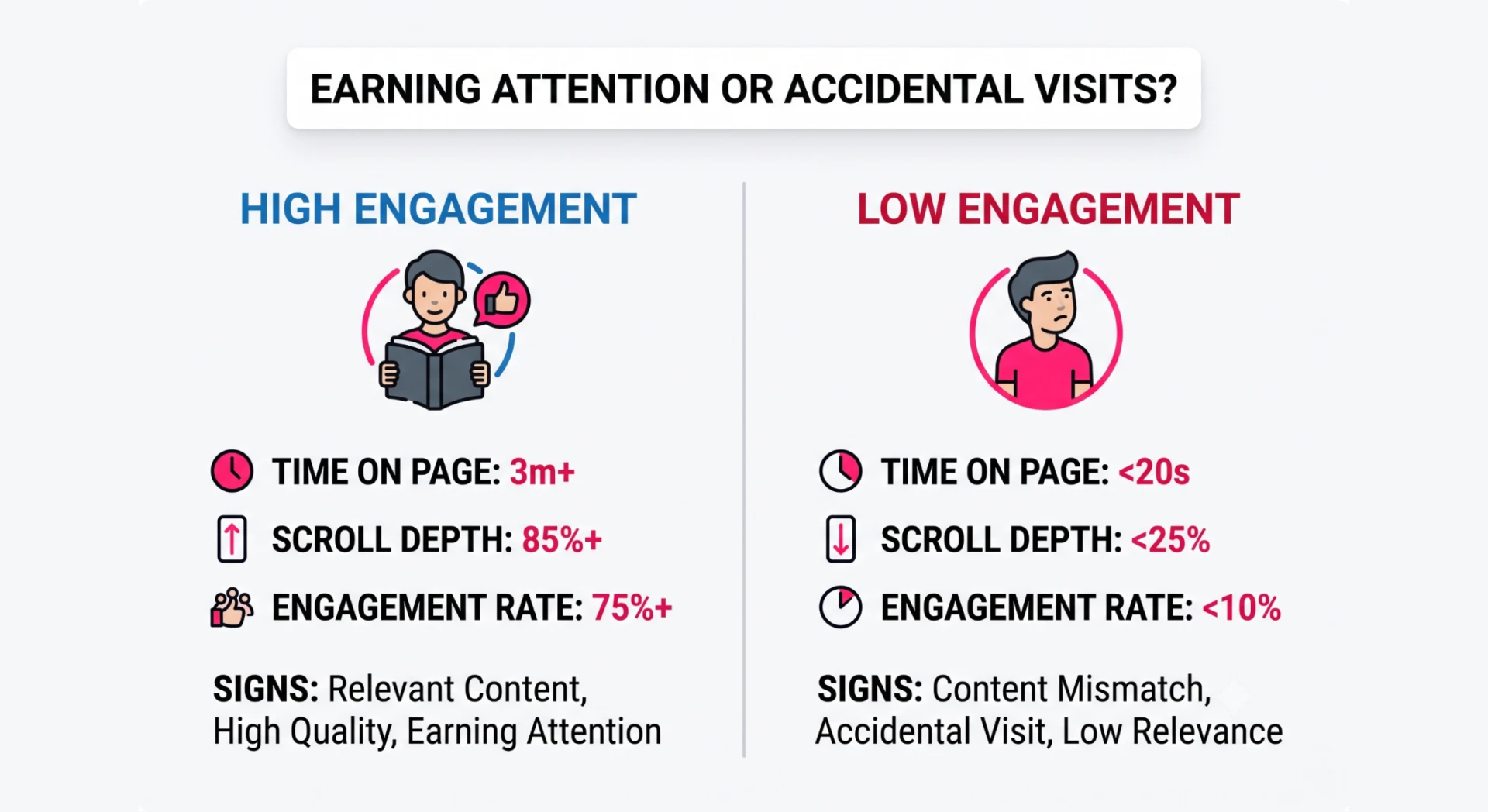
Image Source: Gemini 2026
High engagement metrics suggest your content is relevant to the audience finding it. Low engagement metrics suggest a mismatch between what people expected and what they found.
Lead generation and conversion rates
This is where most measurement frameworks fall apart.
Many brands don’t have a clear way to connect a new lead back to the blog posts that shaped their decision. At a minimum, you should see which pages a new contact visited before converting, and whether any of those were blog posts.
Practical starting points include:
- UTM parameters on content‑linked campaigns (tags that show which specific post drove a click)
- Form fields that capture lead source (“How did you hear about us?”)
- CRM fields that distinguish marketing‑qualified and sales‑qualified leads
Once you have those in place, you can calculate conversion rates from content‑driven traffic. That gives you a direct line between your content marketing program and its contribution to the pipeline.
It also lets you compare customer acquisition costs (CAC) between content and paid ads. This is usually where content’s efficiency advantage becomes clear: content marketing consistently costs less per lead than outbound channels while continuing to deliver results long after publication.
For a deeper look at how to turn blog readers into qualified contacts, our post on content marketing lead generation and turning blog traffic into clients covers the full funnel approach.
Assisted conversions
Most blog content doesn’t close deals on its own. It warms potential customers, answers early-stage questions, and builds trust across the customer journey. That means a direct attribution model will always undervalue it.
Assisted conversion reporting in Google Analytics lets you see how many conversions had a blog visit somewhere in the path, even if a blog post was not the final touchpoint. That data reframes the conversation from "the blog isn't generating leads" to "the blog is influencing leads before they convert," which is a much more accurate picture of how content marketing actually works inside a longer sales funnel.
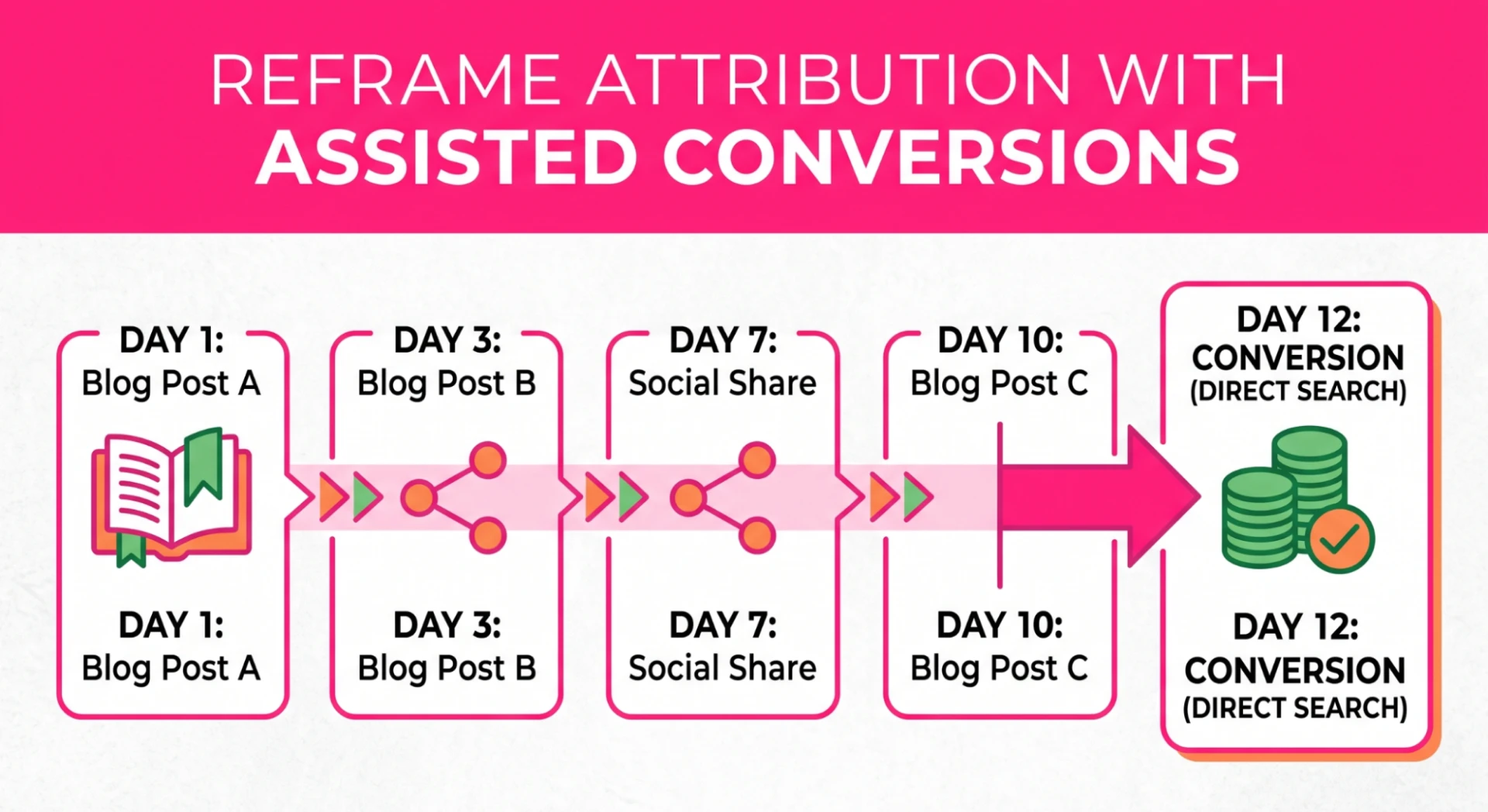
Image Source: Gemini 2026
How do I measure marketing ROI?
To measure content marketing ROI, subtract your total content investment from the revenue generated by that content, then divide by the investment cost.
The challenge is attribution: Most content marketing ROI is indirect and multi-touch. The most practical approach is to track assisted conversions, lead source data, and organic traffic revenue contribution together rather than looking for a single direct line from post to sale.
How to set up a simple measurement framework
To set up a content marketing ROI framework, set a baseline, track three to five priority posts, connect content to conversions, monitor backlinks, and report quarterly. No enterprise tools needed for this, just the web analytics you likely already have.
- Set a baseline. Pull your current organic traffic, top keyword rankings, and average engagement metrics before making any content changes. You can’t demonstrate revenue growth or improvement without a starting point to measure against.
- Pick three to five posts to track. Choose posts targeting your highest-value relevant keywords. Monitor their keyword rankings, organic traffic, conversion rates, and engagement metrics monthly. These become your proof-of-concept posts.
- Connect content to conversions. Set up conversion events in Google Analytics and ensure your CRM captures lead-source data. Even a simple form field asking "how did you hear about us" adds meaningful data points over time.
- Track backlinks. Domain authority grows through earned links, and content is your primary asset for acquiring links. Use a tool like Google Search Console or Ahrefs to track backlinks to your key content pages. These are long-term indicators of content authority and SEO performance.
- Report quarterly, not weekly. Content performance builds over time. Weekly reporting on SEO-driven blog content creates a false sense of urgency and misrepresents how organic search traffic actually compounds. Consistent quarterly reporting gives you the trend data that tells the real story.
If you’re working with a content partner, measurement infrastructure should be built into the engagement from day one, not retrofitted later.

Image Source: Gemini 2026
The role of content in longer sales cycles
Content plays its biggest role early, warming up buyers long before they’re ready to talk to sales, which is exactly why a direct attribution model undercounts it. B2B and considered-purchase brands often have sales cycles that run weeks or months, so the fix is to widen your attribution window rather than expect a single post to close the deal.
Tell that story with context when reporting. Work with your sales team to identify how often closed clients engaged with content before converting.
Show which posts appeared most frequently in pre-conversion customer journey paths. Frame the blog as part of a system that supports the entire marketing funnel, not a standalone channel expected to deliver leads in isolation.
Factor in content decay. Most blog posts reach their peak traffic within the first six to 12 months of publication. After that, without updates or link building, performance tends to decline. Build a refresh cycle into your content marketing strategy to maintain long-term ROI.
To understand how a strong content strategy connects to these longer cycles, our post on content strategy versus content marketing tackles where strategic planning ends and execution begins.
How to report content performance to stakeholders
Connect every marketing metric to a business outcome. Instead of "organic traffic is up 22%," say "we’re reaching more potential customers through search, which is expanding our top-of-funnel without additional ad spend."
Instead of "this post ranks on page one," say "this post is capturing demand for a term buyers use when they’re actively evaluating solutions, and it’s contributing to a strong sales pipeline."
Stakeholders don’t need a content report. They need a business case built around business priorities and sales revenue contribution. The right metrics, framed around business goals, are what content marketing uses to earn its seat at the table.
FAQs about content metrics
Key takeaways
Ready to build content that earns its keep?
If you’re consistently publishing and still struggling to prove your blog's value, the problem is usually upstream. Our content strategy services at The Influence Agency are built around measurable outcomes from day one, so your reporting tells a story leadership can act on.
Let's build a content marketing program that directly aligns with your business goals.