



Content marketing and content strategy aren’t interchangeable. Content marketing creates and distributes content, while content strategy is the framework that aligns that content with business goals, audience needs, and the way each piece connects to drive lasting, compounding results over time.
If you’ve talked to more than one agency about your content, you’ve probably heard both terms thrown around like they mean the same thing. One agency pitches you a "content marketing plan," another offers you a "content strategy." Somewhere in between, you’re left wondering if you’re buying two different options or paying twice for the same one.
You’re not imagining the confusion. Content marketing vs. content strategy is one of the most commonly conflated pairings in digital marketing, and even people in the industry blur the line.
For the record, they’re not the same thing, and the distinction isn’t simply semantic. It affects where your budget goes, what you should expect to see in month one versus month six, and whether strategy and content marketing are working together toward your business goals or pulling in different directions.
For us at TIA, here’s the clearest way to think about it: content marketing is what you do. Content strategy is why and how you do it.
One without the other rarely works the way you want.
What content marketing actually is
Content marketing is the creation and distribution of relevant and valuable content designed to attract, engage, and convert a target audience. These include:
- blog posts
- social media posts
- email marketing
- video advertisements
- print materials
If it’s created to reach people across distribution channels and move them toward a profitable customer action, it falls under content marketing.
Most brands are already running content marketing efforts in some form. Someone on the team writes blog posts because "we should be blogging." Someone else manages social media platforms because the brand needs a presence there. A lead magnet gets built because a competitor has one.
Each piece of content might be well-made and reasonably useful on its own. But if you asked why that specific piece exists, who it was built for, and what it’s supposed to do next, the answer is often a shrug.
That’s not a failure of execution. It’s a gap upstream, and it’s the gap that a content strategy is supposed to close.
What content strategy truly is
Content strategy is the framework that governs everything content marketing produces. It’s the blueprint for content creation and answers the questions that should come before a single word is written:
- What are our business objectives?
- Who, specifically, is our target audience?
- What does that person need to know before they become a customer?
- How does this piece connect to the last one, and to the one after it?
Content strategy encompasses the entire content lifecycle, from planning and creation to governance and eventual retirement of outdated material. It aligns content with business goals and audience needs, rather than treating content as a series of one-off assignments.
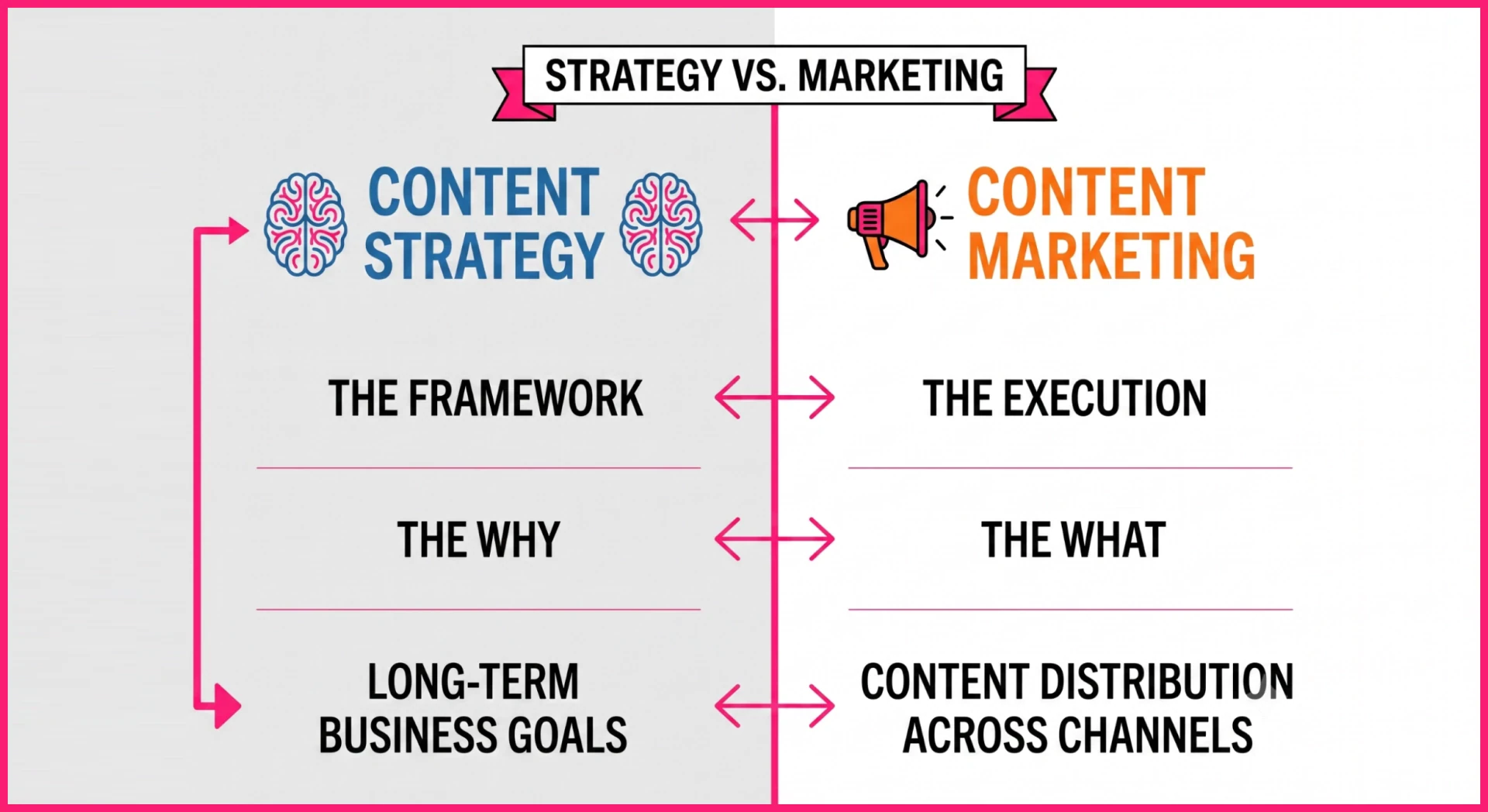
Image Source: Gemini 2026
You can have one without the other, but only in one direction
While they run in close circles, you can absolutely have content marketing without a strategy.
Most brands do.
They publish consistently, hit their posting cadence, and the content itself might even be good at the sentence level. It just doesn’t add up to anything larger than the sum of its parts.
What you can’t have is a content strategy that never turns into content marketing execution. A strategy that lives in a slide deck and never becomes blog posts, social content, or digital marketing campaigns is merely a document. The whole point of the framework is that it feeds directly into the content that gets made, so a strategy without execution is just as incomplete as content marketing without a strategy, only in the opposite direction.
The two are meant to work as a single system, not as two options you choose between.
Why skipping the strategy layer costs more than it saves
Brands that skip straight to content marketing without a strategy often notice the same pattern. They’re publishing regularly, but growth in website traffic, leads, or audience engagement has stalled or is inconsistent month to month. Nothing seems to build on anything else, because there was never a plan for how new content should connect to older content or capture emerging content trends over time.
Without a strategy, you get a pile of individually fine, usable content instead of a system that gets more valuable the longer it runs.
It also tends to show up as wasted spend inside marketing departments. Teams end up producing content that nobody was searching for, that doesn’t match what the sales team hears from prospects, or that duplicates a topic already covered months earlier because nobody was managing content closely enough to catch it.
The building blocks of a working content strategy
A successful content strategy is built from three ongoing practices: audience personas, an editorial calendar, and regular content audits. Together, they keep content creation aligned with business goals instead of running on assumptions.
Audience personas
Before any content is made, a content strategist defines who it’s for. Audience personas guide content creation so it resonates with target markets instead of speaking to a generic, undefined reader. At The Influence Agency, we write content specifically for your audience. It’s baked into our process.
Editorial calendars
An editorial calendar ensures timely content publication and keeps content production organized across contributors and channels. It’s also where a content marketing strategy becomes concrete, turning broad goals into a schedule of specific pieces.
Content audits
In content marketing, content audits help maintain content quality and relevance by identifying three things: content that’s still performing, content that needs updating, and content to retire.
Well-organized content management systems make this process easier. A strategist can quickly see what’s been published, when, and how it’s tagged.
What it looks like when strategy and marketing work together
When the two align, every piece of content has a clear audience and a clear job to do. Blog posts link to each other in ways that make sense, guiding readers deeper into a topic rather than dead-ending. Content built earlier in the funnel feeds naturally into content built for conversion, rather than existing in separate, disconnected lanes.
Just as important, the marketing team producing the content knows why each piece exists before they start writing it. That clarity shows up in the final product. Readers can feel the difference between high-quality content built around a plan and content built to fill a calendar slot.
Picture two skincare brands publishing blog content every week. One produces posts based on whatever a team member feels like writing that month, with no throughline: a review roundup here, a trend piece there. The other has a strategist mapping each post to a stage in the customer journey, from "what ingredients should I avoid" content for new shoppers to comparison content for people ready to buy.
A year in, the first brand has 50 blog posts and roughly the same traffic as when they started. The second has 50 posts that build on each other, rank for a growing cluster of related terms, and continue to pull in traffic long after publication.
Both posted the same number of blogs and invested the same amount of time. The only difference is that one brand built a system, and the other filled a calendar. That gap is what a content strategy is for.
That’s not just a feeling. In CMI’s most recent B2B research, 74% of marketers whose content strategy improved this year credit the gain to refining the strategy itself, not new budget or tools.
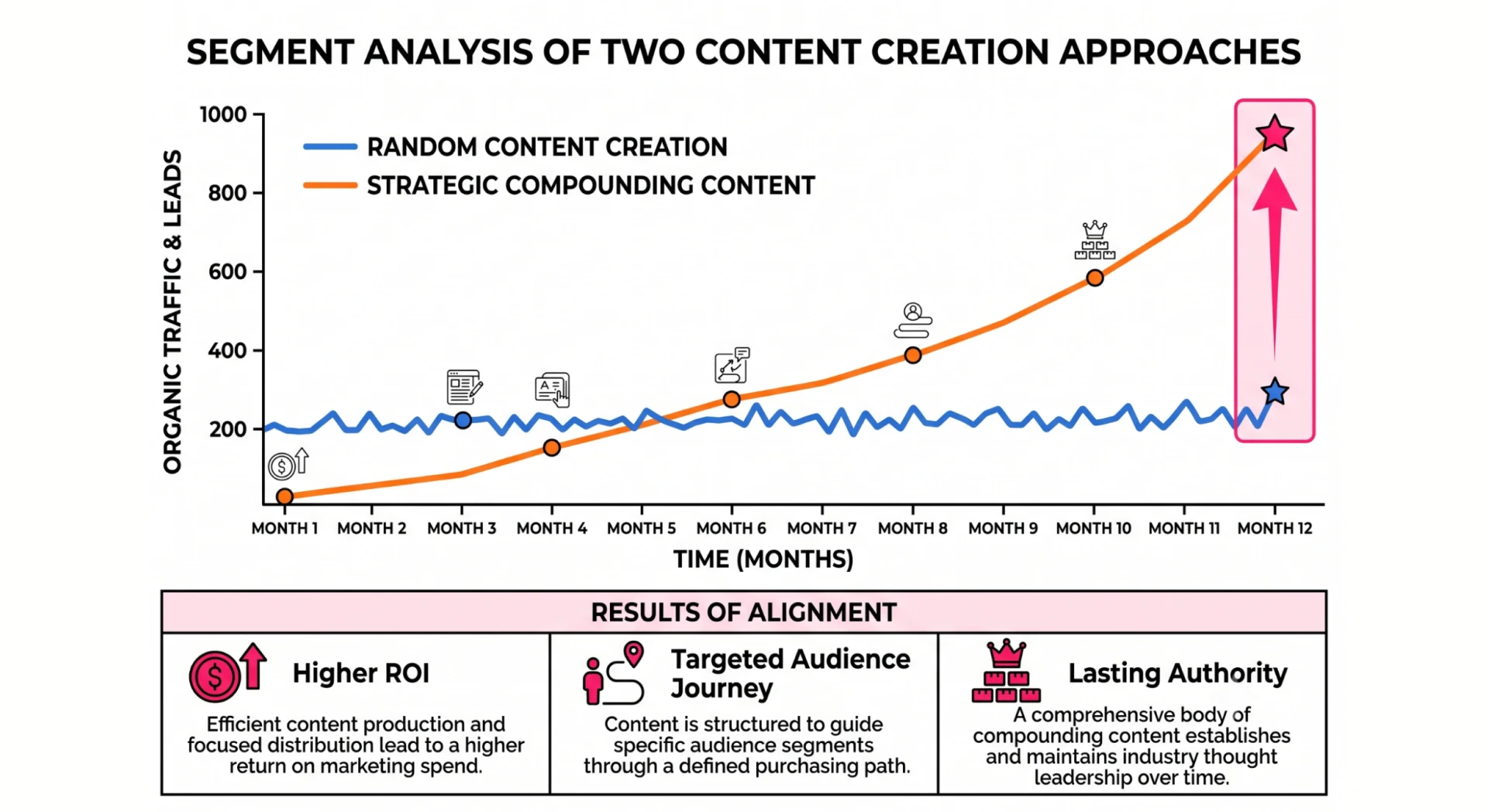
Image Source: Gemini 2026
FAQs about content strategy vs content marketing
Key takeaways
Start with the framework, not the calendar
If you‘ve been publishing content for a while and it doesn’t feel like it’s building toward anything, the problem is rarely the writing itself. It’s more likely that there’s no content strategy underneath it to decide what gets made and why.
That’s the layer we build first. Learn more about our content strategy approach before you invest another dollar in content marketing that has nowhere to go.
Once the framework’s in place, the content you create stops being a stream of individual pieces and starts being a system.
Your content deserves better than another entry in the content graveyard. Give it a strategy, and watch it go somewhere.