
.webp)

Organic traffic drops hit differently when you can't explain them. Brand marketers can recover lost visibility by auditing content quality, fixing technical SEO issues, building topical authority, and optimizing for AI-powered search. Each cause has a specific, actionable fix.
You log into Google Analytics on a Tuesday morning. Nothing has changed. No site migration, no new campaigns, no obvious explanation. But the graph is pointing in the wrong direction, and it has been for weeks.
This is one of digital marketing’s most confusing issues, and it happens more often than brands, including us at TIA, admit. You can usually identify why organic traffic dropped. Once you know the cause, you can take clear steps to restore organic website traffic.
Why your organic traffic dropped in the first place
Organic traffic typically drops for one of five reasons: an algorithm update, AI Overview displacement, technical SEO issues, content decay, or lost backlinks. Each cause needs a different fix, and using the wrong one can waste time or make the problem worse.
Start by narrowing down which applies to you. Open Google Search Console and Google Analytics together, and check your impressions, clicks, average position, and which pages are most affected. The pattern you see will point to one of the five causes below.
Algorithm updates quietly reshuffled your search rankings
Google has more than 200 ranking factors and updates its algorithm thousands of times each year. Major core updates can shift search rankings across entire topic areas, even if you haven’t changed anything on your own website.
Compare the timing of your traffic drop with known algorithm update days in Google Search Console. If they match, your content may have been caught in a quality reassessment. To fix this, conduct a thorough content quality audit: identify thin or outdated pages, combine content where needed, and demonstrate real expertise across your topic areas.
Quick, minor edits rarely move the needle after a core update. Search engines are evaluating the depth and trustworthiness of your content as a whole, not just individual pages.
AI Overviews are absorbing your clicks
Even if your site ranks well in search results, you might still lose organic traffic to Google's AI Overviews, which show synthesized answers directly on the results page. For informational searches, users often get what they need without ever clicking through to your site.
There’s no need to panic, but it’s important to adapt. Brands that organize their content with clear, direct answers, well-structured headers, and strong, authoritative sourcing can still capture search traffic even when users do not click. We cover how to do this in the AEO optimization section below.

Source: Canva
Technical SEO issues are suppressing your pages
Sometimes the issue has nothing to do with your content. Broken links, crawl errors, slow page speed, and indexing problems can quietly hurt your organic search performance without any obvious warning signs.
Run a technical audit using Google Search Console or dedicated SEO tools like Ahrefs or Screaming Frog. Pay close attention to core web vitals, which measure how fast your site loads, how interactive it is, and how visually stable it appears.
These are confirmed ranking factors for search engines, and since Google uses mobile-first indexing, a poor mobile experience can seriously damage your search rankings across your entire site.
Fix broken links, resolve crawl errors, and make sure your HTTPS is properly configured. Site speed is a critical ranking factor: fast-loading pages reduce bounce rates and signal quality to search engines.
While you’re auditing, review your meta descriptions and meta title tags as well. Well-written meta descriptions improve click-through rates (CTRs) from search results, which signals relevance back to Google.
Structured data and schema markup can also enhance search result listings with rich snippets, making your pages stand out even before a user clicks.
Your high-quality content has decayed
Content decay means that a blog post or landing page that once ranked well becomes less relevant over time. This happens as competitors publish stronger content, topics evolve, or user intent shifts. Older content built around high search volume rather than genuine user intent is especially at risk.
For each underperforming web page, ask yourself: Does this still fully answer what someone searching this keyword wants to know in 2026? Search engines regularly reassess content quality, and pages that once earned strong positions can slip when fresher, more comprehensive content enters the picture.
High-quality content isn’t a one-time investment. Evergreen content can drive organic traffic over time, but only if you keep it updated, accurate, and aligned with current search queries.
"Most brands read a traffic drop as a signal to publish more,” says Nick Monardo, Performance Strategist at The Influence Agency. “It almost always means the opposite. Your highest-leverage page is the one that used to rank on page one and slipped, not the 20 posts you haven't written yet. Fix what already earned its position before you build anything new."
You lost backlinks you were counting on
Backlink profiles shift constantly. If a high-authority site removes a link to your content, or a site that was linking to you loses authority, your search rankings may drop as well. Google prioritizes sites with high-quality backlinks because they act as votes of confidence from authoritative sites.
Use SEO tools like Ahrefs to check for lost links in the same period your website traffic declined. Watch for spammy links pointing to your site, too: toxic or spammy links can hurt your authority just as much as losing good ones.
Ethical link building, such as guest posts on reputable industry sites, avoids shortcuts like buying links or using private blog networks. Regularly audit your backlink profile to identify and disavow toxic links before they drag your rankings down.
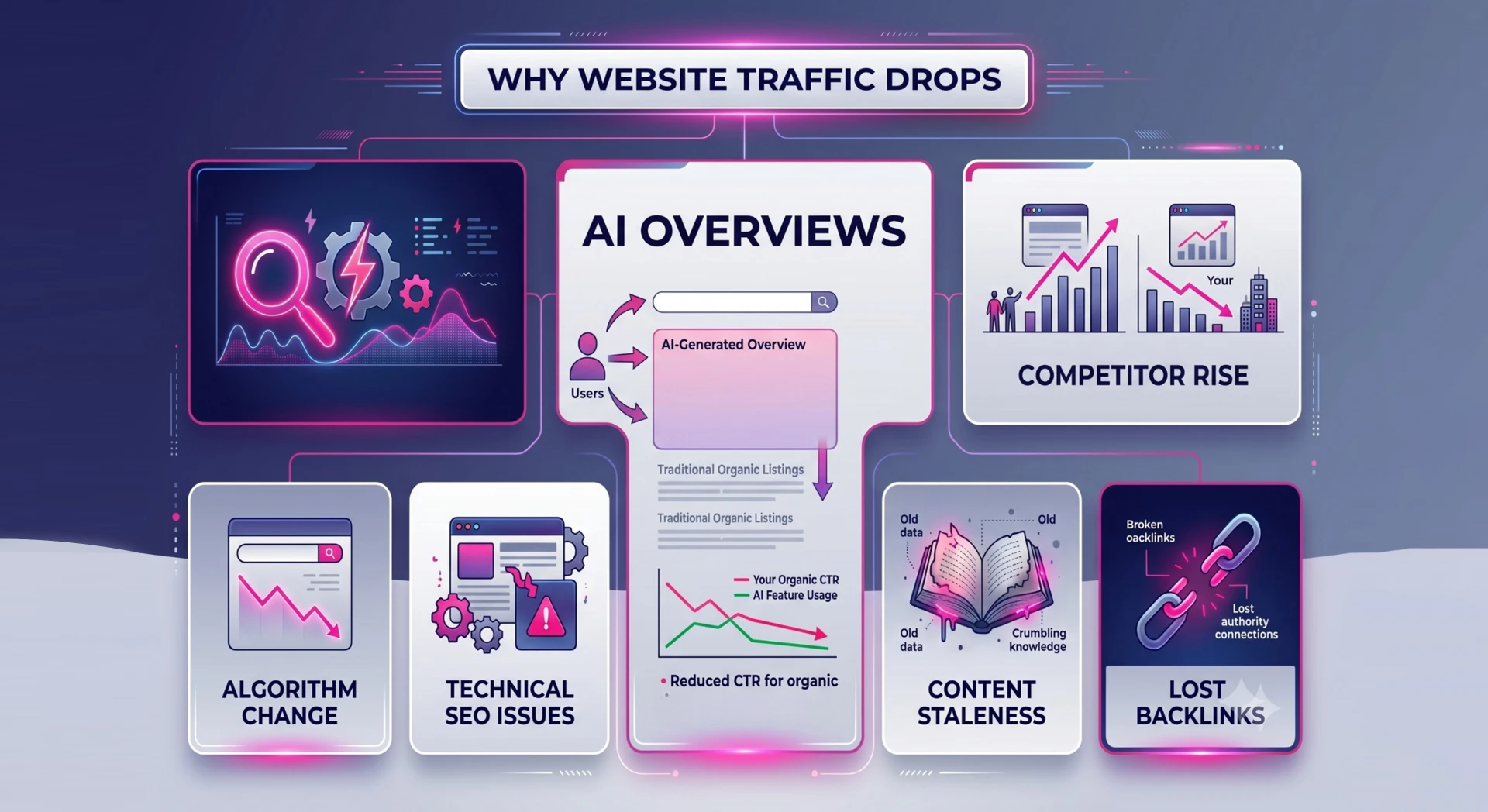
Image Source: Gemini 2026
How to increase organic traffic: The recovery framework
Recovering website traffic requires a systematic approach. Once you’ve identified the root cause, you can build a targeted plan. The steps below outline the highest-leverage actions for driving consistent traffic to your website over the long term.
Start with a content marketing quality audit
Before adding anything new, review what you already have. Use Google Search Console or Google Analytics to identify your lowest-performing pages, then sort them into three groups: blog posts and pages to update with more depth and current data; pages to consolidate with stronger related content; and pages to remove entirely.
For this, updating underperforming content is often faster and more effective than starting from scratch, especially for pages that once ranked on page one but have since slipped. These are your highest-leverage recovery targets.
Focus on producing quality content that fully matches user intent, incorporates relevant long tail keywords naturally, and answers questions your competitors have not covered.
Strong headlines matter more than most marketers realize. Research from Semrush suggests more descriptive headlines (10 to 13 words) drove twice the traffic of short ones, and listicle-style headlines outperformed other formats by 80%.
Ensure the meta title accurately reflects the page content and puts your target keywords near the front. Update your meta descriptions alongside the body content for every page you touch.
Do proper long-tail keyword research before you create content
One of the most common reasons brands lose ground in organic search is creating content without solid keyword research. Knowing which search queries your audience uses, what search volume those terms carry, and what user intent sits behind them is what separates content that ranks from content that gets ignored.
Your keyword research should prioritize intent alongside volume, as well as long tail keywords and broader primary terms. Long-tail keywords may have lower search volume individually, but they’re more relevant, face less competition, and typically convert better because the people searching for them know exactly what they want.
A blog post targeting a specific long-tail keyword will often outperform one targeting a high-volume, crowded head term.
Use Google Search Console to find queries where you already have impressions but low clicks. These are search queries with relevance signals but weak positioning. Often, updating the related web page is all it takes to move from page two to page one and capture significantly more traffic to your website.
Source: Canva
Build topical authority, not just individual posts
Search engines reward sites that demonstrate deep, comprehensive expertise across a subject area, not just a single strong page surrounded by thin or unrelated content. In this case, building topical authority means creating a cluster of interconnected blog posts and pages that cover a topic from multiple angles, with a strong pillar page at the center and supporting blog posts linking back to it. Keyword research informs which supporting posts to build and in what order.
Internal links are one of the most underused levers for organic growth. They distribute authority across your site, help search engines understand how your pages relate to each other, and guide users toward relevant content that keeps them engaged longer.
Check your internal links during each page audit, and aim for descriptive anchor text that tells both users and search engines exactly what the linked page covers. Avoid using the same anchor text on multiple pages; make sure every internal link points to a page that genuinely helps the reader.
It’s one of the most reliable ways to increase organic traffic over time: Topical authority builds trust with search engines rather than chasing individual rankings.
Optimize for AEO and AI-powered search with schema markup
AEO, or Answer Engine Optimization, means structuring quality content so that AI-powered search engines can accurately find and surface it for relevant queries. To do this effectively:
- Start each section with a direct answer rather than a long preamble
- Use H2 and H3 headings that mirror real search queries
- Add schema markup to every new blog post you publish
- Include rich snippets where applicable
Schema markup is increasingly important as a ranking factor. It can enhance how your pages appear in search results, improving click-through rates and overall search traffic even when your ranking position stays the same.
Rich snippets, FAQ schema, and structured data all signal to search engines that your content is well-organized, trustworthy, and easy to parse.
Expand your traffic sources strategically
The most resilient traffic strategies pull from video, social, paid, local, and email in addition to organic search. Brands that depend on a single channel are disproportionately exposed when search engines roll out major algorithm updates.
Video content is an increasingly valuable traffic channel. YouTube functions as a search engine in its own right, and video results appear regularly in Google search results. Repurposing a blog post into a short video or embedding video content into key pages can expand your reach across multiple search surfaces and drive more website visitors without more ad spend.
Social media platforms can drive meaningful referral traffic when content is promoted with strong visuals and relevant hashtags. Posting native articles on LinkedIn builds authority and sends visitors back to your site. User-generated content, including reviews, testimonials, and community posts, boosts SEO and builds trust with visitors.
Encourage customers to create user-generated content by making it easy to share and tag your brand. With 52% of shoppers discovering products on social media, organic social engagement remains a genuine traffic driver.
Paid advertising, including Google Ads, can support your organic efforts during a recovery period by maintaining visibility while your search rankings rebuild. Think of paid traffic as a temporary bridge: it keeps traffic to your website stable while your long-term organic growth strategy gains traction.
For brands with a local presence, local SEO is a high-value and often underleveraged channel. Keep your Google Business Profile accurate and up to date, build local citations, and target location-specific search queries. Local searches tend to drive highly relevant traffic that converts at stronger rates than broad organic traffic.
Email marketing is another channel that consistently underperforms its potential. A strong email list drives consistent website traffic without relying on search algorithms. Email marketing typically achieves 3.25% click-through rates globally and 4.77% in North America, and campaigns to engaged, segmented subscribers can easily drive roughly 300+ clicks per send.
Regular newsletters with clear calls to action and personalized sends improve both open and click-through rates. If you’re not actively driving subscribers back to your content through email, you’re leaving traffic on the table.
Fix your technical foundation before anything else
Core web vitals, mobile-friendliness, page speed, and crawlability all need to be in good shape before you invest heavily in new content creation. Recovery content will underperform if technical issues are not resolved first.
Prioritize: fixing broken links across your site, improving core web vitals scores, resolving duplicate content through canonical tags, and submitting updated sitemaps after significant content changes.
Use Google Search Console or dedicated SEO tools to quickly identify and fix broken links. Broken links bleed authority and create a poor experience for both users and search engine crawlers. Internal links and broken links should both be reviewed in the same crawl, so nothing gets missed.
Lastly, a mobile-friendly site is essential for good search rankings. Google's mobile-first indexing means that search engines use the mobile version of your site to evaluate and rank your content. If your site performs poorly on mobile devices, your organic traffic will reflect it.
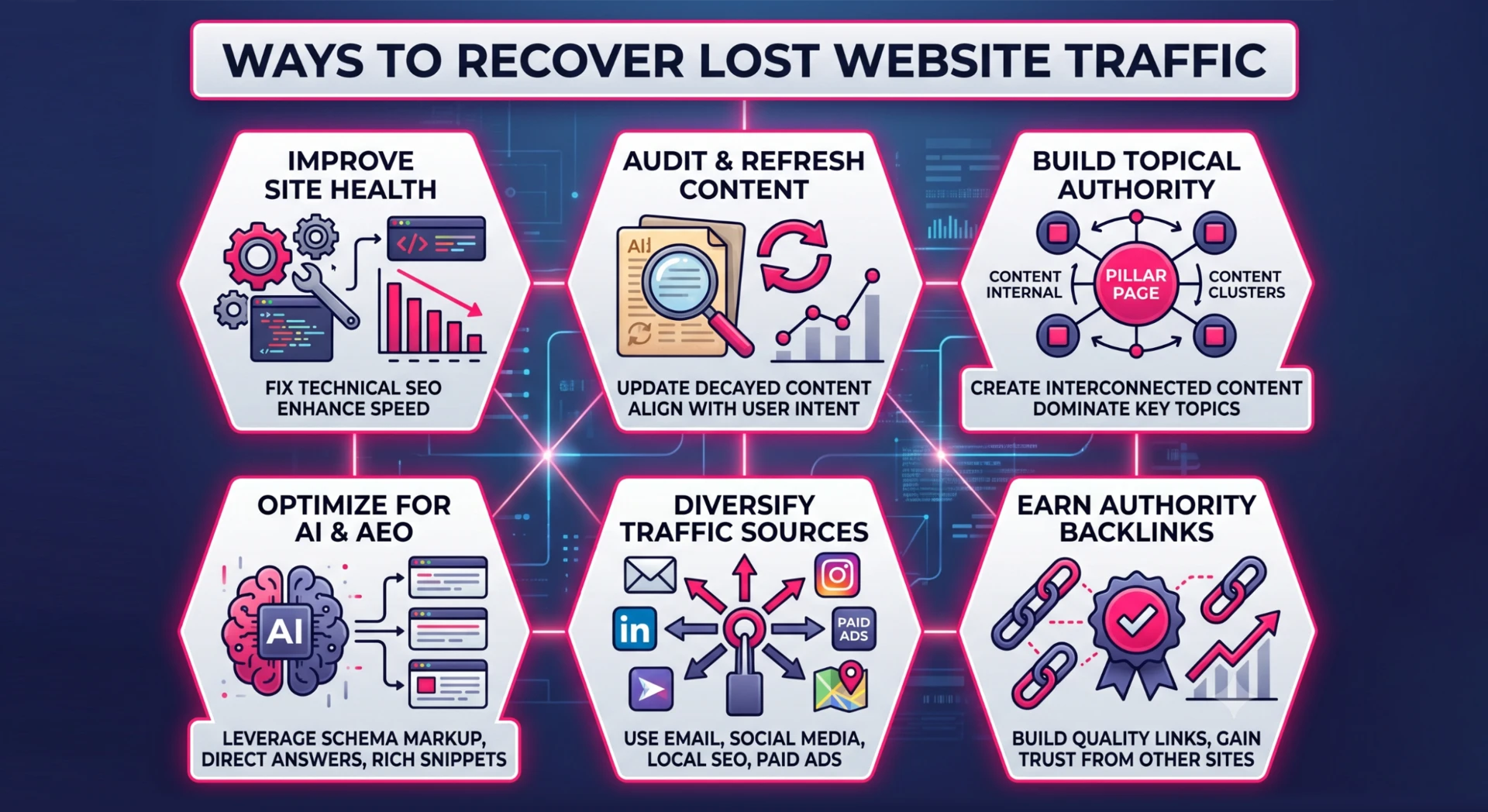
Image Source: Gemini 2026
FAQs about how to drive traffic to your website
Key takeaways
Ready to recover your organic traffic?
A drop in website traffic is a signal that something needs attention, not a permanent problem. Brands that recover fastest are those that identify the real issue and follow a clear SEO strategy, rather than making quick, reactive changes without a framework.
Drive traffic to your website with an approach built for the way search engines work today. Our SEO services at The Influence Agency cover everything from technical audits to content strategy and AEO optimization. We build organic search presence that holds up through algorithm changes and AI-driven shifts in how people search online.
The graph goes up from here; let's get your traffic moving again.