


The customer journey has evolved into a complex, multi-channel experience shaped by data, personalization, and changing expectations. Effective customer journey marketing helps brands understand customer behavior, optimize touchpoints, and create seamless experiences that drive loyalty, retention, and long-term growth.
The customer journey no longer follows a straight line. Today’s customers move fluidly between platforms, devices, and moments of influence before ever making an initial purchase.
Social media, search engines, online reviews, influencer content, and brand websites all play a role in shaping how customers interact with a product or service. As a result, customer journey marketing has shifted from funnel-based thinking to a more holistic approach rooted in understanding customer needs and behavior.
This shift requires a modern marketing strategy that supports both potential and existing customers while creating experiences designed to exceed customer expectations at every touchpoint.
What the customer journey touchpoints look like today
The modern customer journey today reflects an interconnected ecosystem of customer touchpoints where customers interact with brands across multiple marketing channels over time.
- From initial awareness through social media and content discovery to deeper research and comparison, people often revisit the same touchpoints multiple times before making an initial purchase.
- Throughout the customer journey, peer validation through online reviews, influencer content, and creator recommendations serves as customer feedback influencing customer behavior and decision-making, offering valuable insights into perception and trust.
- Engagement continues well beyond conversion, with post-purchase interactions influencing customer experience, repeat purchases, and long-term brand loyalty. Each interaction contributes to how customers perceive a brand.
When these moments feel disconnected, friction increases. When intentionally aligned, you create clarity, confidence, and higher customer satisfaction throughout the entire journey.
Why customer journey marketing matters more than ever
Customer expectations have never been higher.
Audiences expect relevance, speed, and personalization across every interaction. When marketing efforts fail to address real pain points or overlook key customer touchpoints, customers disengage quickly.
Here’s how effective customer journey marketing helps brands:
Growth no longer comes from isolated tactics or "one-off" hacks. Real-world success depends on aligning your marketing strategy with customer behavior to support customer success and consistently exceed customer expectations throughout the full journey.

Image Source: AI-Generated
The modern customer journey stages and key phases
While every journey is unique, most customer journeys follow recognizable journey stages. These stages represent key elements of the customer journey, helping marketing teams craft relevant messaging and experiences for potential and current customers.
1. Initial awareness
At this stage, potential customers become aware of your brand for the first time. This may happen through:
- social media ads
- influencer content
- organic search
- shared content
The goal here is not immediate conversion but relevance, achieved through market research and clearly defined customer personas that reflect real customer needs and motivations.
Brands that succeed here understand their target audience and introduce their product or service in a way that feels natural and valuable.
2. Consideration and evaluation
During consideration, customers actively compare options. They may revisit your website, engage with social media content, read blog articles, or watch influencer reviews.
Customer experience, brand credibility, and how well brands address pain points heavily influence this stage. That’s why clear messaging and consistent storytelling across marketing channels are critical here.
3. Initial purchase
The initial purchase represents a moment of trust. Customers expect a frictionless experience that reflects everything they have already seen and heard about your brand.
Strong CRO strategy, intuitive website design, and aligned messaging help remove barriers at this stage. By simplifying the path to purchase, you aren't just closing a single sale; you’re creating a positive "memory" of the transaction.
This ease of use transforms a one-time buyer into a loyalist inclined to recommend, return, and repurchase because your brand represents the path of least resistance.
4. Post-purchase and retention
The customer journey continues well beyond checkout.
The post-purchase phase is often where the real profit is made: the first sale gets a customer through the door, but the experience immediately following that sale determines whether they stay for the long haul.
Part of that experience is how you show up when things go wrong. Customers can be forgiving, but not when they're left in the dark. Proactively communicating through a status page during an outage or disruption can turn a potential churn moment into a genuine trust-builder.
Post-purchase experiences influence customer loyalty, repeat purchases, and long-term customer lifetime value. By nurturing the relationship after the transaction, you transform a one-off buyer into a brand partner.
This constant presence keeps your brand top of mind, making the decision to return an easy, automatic choice.

Image Source: AI-Generated
What is the role of customer journey mapping?
Customer journey mapping shows how customers interact with a brand at each stage of their journey, revealing changes in their needs and expectations. This information helps your brand plan strategically and provide solutions when your audience needs them most.
In closer detail, customer journey mapping helps brands:
- Streamline processes and reduce friction: Customer journey mapping helps you identify friction points across key customer touchpoints, making it easier to streamline processes and improve efficiency throughout the journey.
- Improve internal alignment and execution: By visualizing the full customer journey, teams across marketing, sales, and support gain a shared understanding of the customer experience, improving collaboration and internal processes.
- Align marketing teams around shared goals: Customer journey mapping aligns marketing teams around consistent messaging, priorities, and success metrics. In turn, campaigns work together as part of a unified marketing strategy.
- Reveal customer behavior patterns: Journey mapping connects data across marketing channels to uncover patterns in customer behavior, preferences, and decision-making, enabling more effective personalization and optimization.
- Improve satisfaction and long-term loyalty: By highlighting where customer expectations are not met, journey mapping helps brands improve customer satisfaction, maintain relationships over time, and build lasting loyalty.
Customer journey maps empower brands to dive deeper than surface-level fixes. Make impactful, data-informed improvements that elevate the entire customer experience throughout their journey.
How to transform raw data to improve customer experience
Stop guessing where customers drop off. Use a structured mapping flow to identify real opportunities.
With the data from this "mapping engine," your team can:
- Visualize multi-channel interactions: Track customer movement across social media, websites, email, and in-store touchpoints.
- Monitor evolving customer states: Understand how specific needs, expectations, and behaviors change from awareness through to retention.
- Map the emotional journey: Pinpoint "delight moments" (highs) and critical pain points or drop-off risks (lows).
Customer data, personalization, and the modern customer journey
Today’s customer journey spans websites, social platforms, CRM systems, email, and paid media. Customer data is what connects those touchpoints, giving brands a clear view of how audiences discover, evaluate, and convert.
When collected responsibly at key moments, data helps brands:
- Strengthen market research and audience insights
- Understand real customer behavior across channels
- Personalize messaging by journey stage
- Improve decision-making through smarter journey analytics
This data-driven approach allows marketing teams to optimize every step of the experience from first interaction to long-term loyalty. The results? More relevant messaging, stronger leads, and better overall performance.
Brands that prioritize thoughtful personalization aren’t only reactive to change; they’re built to evolve with their customers.
Where do influencers and social media fit?
Social media and influencer marketing are no longer limited to top-of-funnel awareness. Today, influencers support multiple journey stages by building trust, educating audiences, and reinforcing brand credibility.
For example, a fitness creator may introduce a wellness brand through a real workout, share how it fits into their routine, and later answer follower questions after using it. By the time someone is ready to buy, the influencer has already reduced uncertainty and validated the decision through real experience rather than promotion.
This is why influencer marketing works best when integrated into a broader customer journey strategy rather than executed as a standalone tactic.
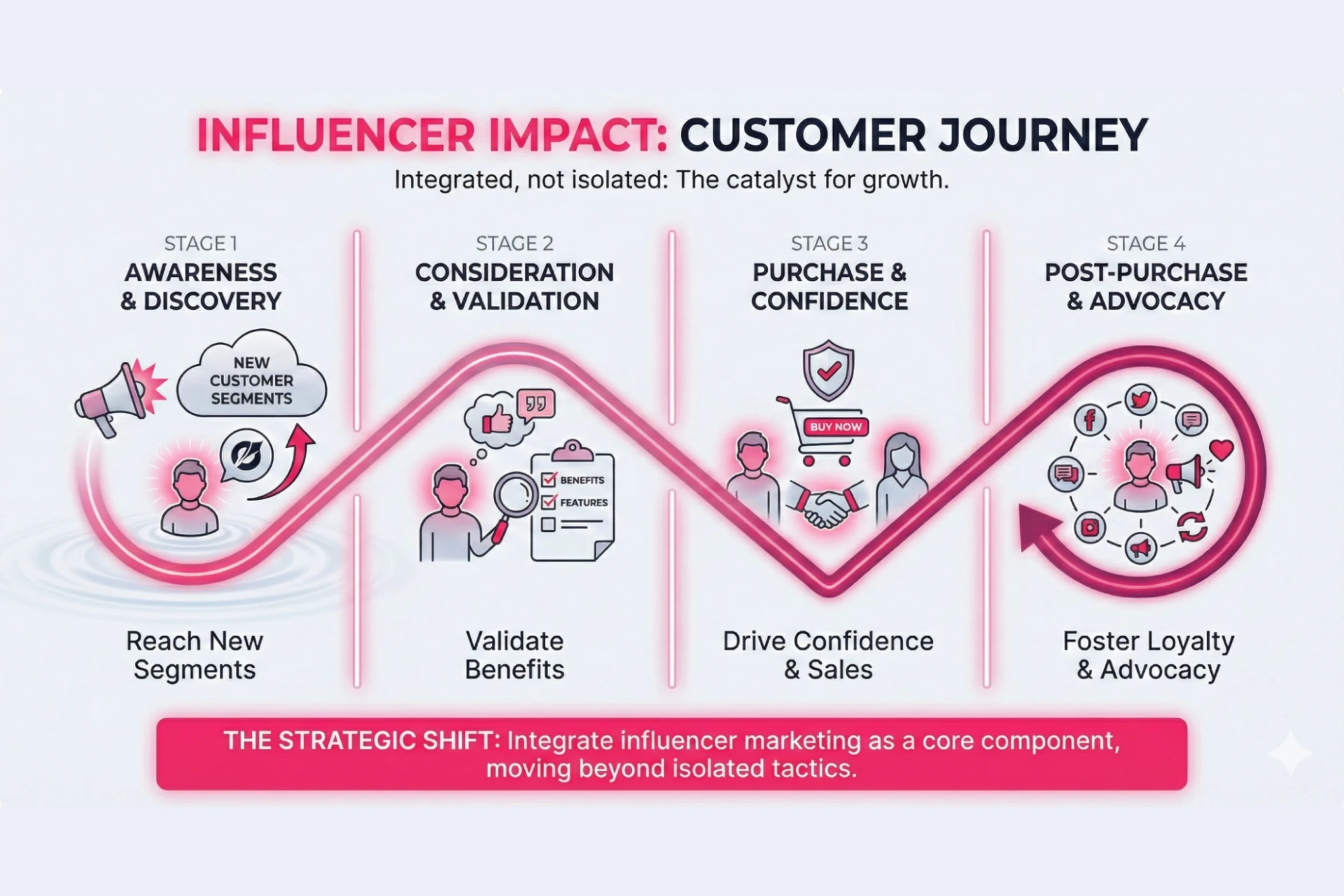
Image Source: AI-Generated
Why align marketing teams around the customer journey
One of the biggest challenges brands face is internal misalignment. When marketing, sales, and customer service teams operate in silos, the customer experience becomes fragmented.
A journey-first approach flips the script: instead of organizing around products or departments, teams align around what the customer is trying to achieve at each stage. When every function works from the same customer timeline, silos naturally break down.
In short, it replaces disconnected tactics with a unified strategy. The brand speaks with one voice, and the customer feels understood, not "processed."
How to measure success across the customer lifecycle
Success in customer journey marketing is not defined by a single conversion or a single purchase moment. Instead, it’s measured across the full customer lifecycle, from initial awareness and early engagement through repeat purchases, referrals, and long-term customer loyalty.
This broader view helps brands understand how marketing efforts influence relationships over time rather than focusing only on short-term results.
By prioritizing these long-term outcomes, brands move beyond quick wins and build sustainable growth rooted in stronger customer experience and lasting relationships.
Key takeaways
Customer journey FAQs
Bridge the gap: Turning touchpoints into turning points
The evolving customer journey reflects how modern consumers discover and engage with brands. As explored throughout The Influence Agency Yearbook, success today comes from understanding cross-channel behavior and designing seamless, human experiences at every stage.
Brands that invest in customer journey mapping, data-driven insights, and integrated strategies are better positioned to build lasting relationships and measurable growth. We have the expertise to lead you through this change.
Our 2026 Yearbook dives into digital marketing, influencer strategy, SEO, and conversion optimization in today's age. For tailored guidance, let our award-winning experts help you.
Reach out today, and let's talk next steps for your brand in the world of evolving customer journey.