


When choosing a digital marketing agency, ask about reporting, asset ownership, and how success is measured, then vet their reputation through case studies and client longevity. Watch for vanity metrics and vague promises so you can confidently choose the right agency.
Choosing a digital marketing agency is harder than it should be. Every agency's website says the same things: results-driven, full-service, data-backed, a true partner. A few conversations later, and they all start to blur together.
If you’ve already been burned once, by a marketing agency that promised the world and delivered a monthly report full of vanity metrics, you’re probably approaching this decision with a healthy dose of skepticism.
That skepticism is a good instinct. It's also backed by data. A joint study by the ANA and the 4As found that as recently as 2016, the average client-agency relationship lasted just 3.2 years, a sign of how often that early excitement turned into a mismatch. The good news is that the same study found tenure has since climbed to nearly seven years, proof that brands that ask the right questions upfront end up in relationships that actually last.
At The Influence Agency, we’re sharpening that skepticism into a framework. We’ll walk through the role of a marketing agency, what a full-service marketing agency does, the questions to ask before signing anything, how to vet an agency's reputation, the red flags that should make you pause, and the green flags that tell you a marketing partner is worth trusting with your budget and your brand.
What’s the role of a marketing agency?
At its core, the role of a marketing agency is to help a business reach its target audience effectively, generate leads, and grow revenue without having to build an entire in-house marketing department from scratch.
A good agency partner brings specialized expertise, advanced tools, and a team that lives and breathes digital marketing full-time. For most business owners, that expertise is the entire point of hiring outside help. You’re not just outsourcing tasks; you’re gaining a marketing strategy tailored to your specific business goals, customer journey, and brand identity.
Not all marketing agencies play this role equally well. Some function as a true strategic partner, embedded in your business goals and accountable for outcomes. Others operate more like a vendor, executing tasks without ever connecting them to a larger marketing strategy.
This misdelivery is what ends most agency partnerships. The Setup Marketing Relationship Survey found that 48% of clients cite dissatisfaction with delivery as the top reason they part ways with an agency, ahead of budget cuts, team turnover, and every other factor on the list.
That’s real budget wasted on a partnership that was never going to work, and most of it was avoidable. Knowing how to choose a digital marketing agency before you sign is what closes that gap.
What does a full-service marketing agency do?
A true full-service digital marketing agency handles every part of a campaign in-house, without outsourcing pieces to a patchwork of freelancers or subcontractors. The term gets thrown around loosely, so it’s worth being precise about what it actually means.
That typically includes:
- Search engine optimization (SEO) and content marketing, to help your brand rank on search engines for the terms your customers are actually using
- Paid ads and paid advertising, including Google Ads and paid social, managed with clear accountability for ad spend
- Social media management and social media marketing, from community management to content creation across social channels
- Email marketing, connecting your other campaigns into a consistent customer journey
- Influencer marketing and public relations, connecting your brand with creators and media coverage that align authentically with your audience
- Web design and web development, so your website and landing pages aren’t the weak link in an otherwise strong campaign
A generalist digital agency should be able to speak fluently to all of these disciplines, even if your current engagement only covers one or two. If you’d like a deeper look at what one of these specific services involves on its own, we covered this in detail in our post on what an SEO agency actually does.
The real value of a full-service marketing agency is not just convenience, but strategic cohesion.
When your SEO, paid media, and social channels are all managed under one roof, your messaging stays consistent, and your data stays connected across multiple platforms.
You’re not stitching together insights from three vendors who have never spoken to each other.
The questions to ask before you sign
Ask about reporting, asset ownership, and how success gets measured before you sign anything. A good digital marketing services provider welcomes hard questions on all three. If a sales conversation gets vague or defensive the moment you ask about specifics, take note.
How will you report on results?
Ask to see a sample report first. A strong agency will show you dashboards tied to key performance indicators and real business goals, not just screenshots of engagement numbers. Ask how often you’ll receive reports, whether you’ll have dedicated account managers walking you through them, and whether you get access to raw data analysis or only curated summaries.
Who owns the assets we create together?
This is one of the most overlooked questions in agency contracts. Ask directly: if we part ways, do we keep the content, creative files, ad accounts, and website access? Some agencies build in dependencies that make it costly or difficult to leave.
You deserve full ownership of what you pay for.
How do you define and measure marketing success?
Every agency should be able to answer this without hesitation, and the answer should be specific to your business. A brand focused on lead generation needs different key performance indicators than a brand focused on brand awareness or ecommerce revenue.
If the agency gives you the same response they would give any client in any industry, that’s worth noticing.
What does onboarding look like?
Ask for a timeline. A thoughtful agency has a defined onboarding process, typically including a discovery phase, market research, an audit of your current digital presence, a strategy presentation, and a clear start date for active work. If they can’t describe this process, they likely don’t have one.
How to vet an agency's reputation
Vet an agency’s reputation with Google reviews and real case studies. Look at how long they keep their longest clients before you sign anything. Their reputation should withstand scrutiny.
Start with Google reviews and testimonials from previous clients, ideally ones in a similar industry or of a similar size to your own business. Ask for case studies with real, specific numbers, not just logos on a website. A reliable agency will be glad to walk you through what worked, what didn't, and why.
Also, ask how long the agency has worked with its longest-standing clients. Long relationships are usually a sign that the agency delivers consistent value over time, not just a strong first pitch.
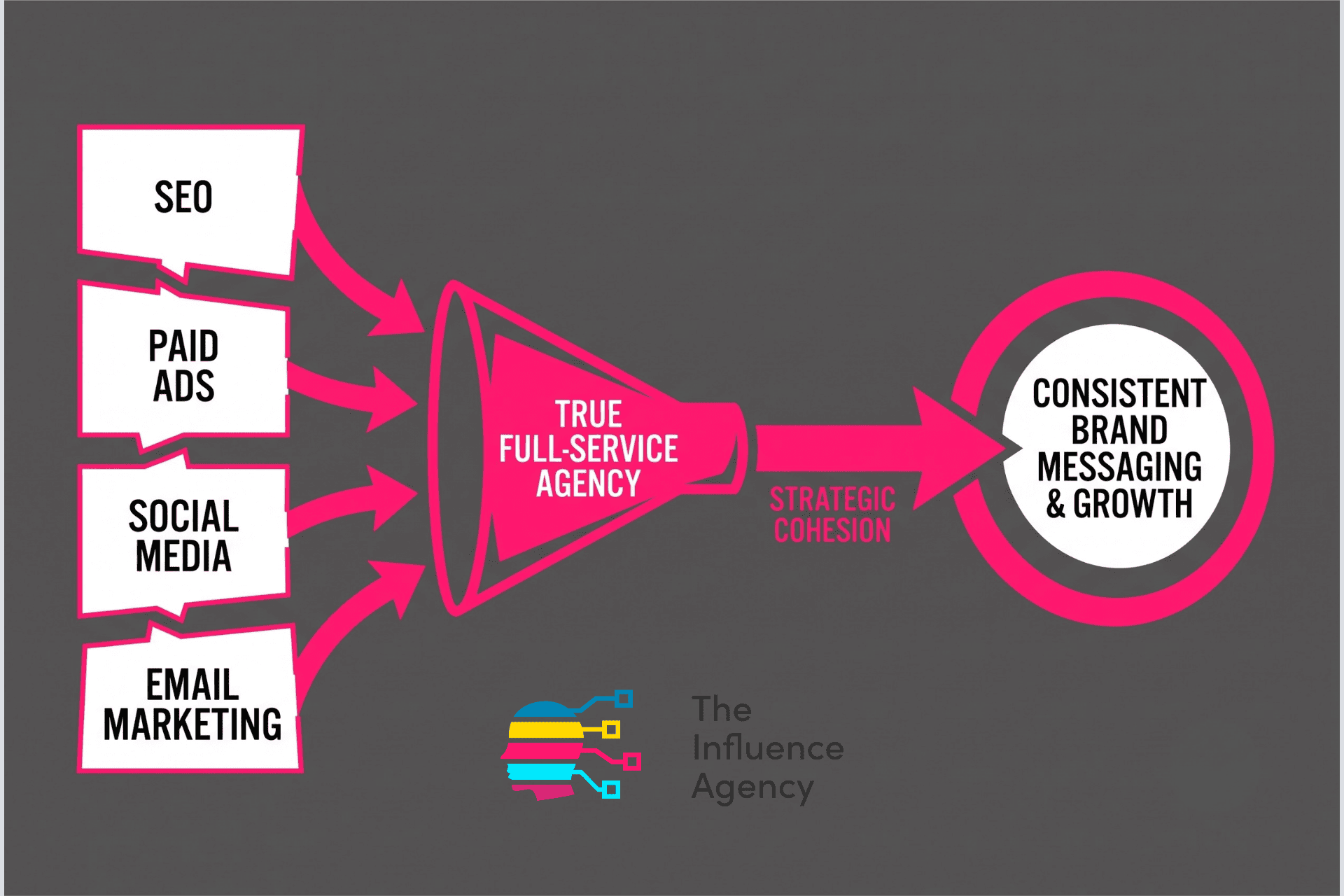
Image Source: Gemini 2026
Red flags to watch for in a digital marketing agency
Vanity metrics, vague reporting, no clear point of contact, and guarantees made too early are the clearest signs an agency isn’t ready to earn your trust. Some of them are easy to miss during a sales pitch, especially if you’re eager to get moving. Here’s what should give you pause.
- Vanity metrics presented as wins. Impressions, followers, and reach are easy numbers to report and inflate in a slide deck. They’re not inherently useless, but if they’re the primary metric an agency leads with, ask how those numbers connect to your actual business goals.
- Lack of transparency around spend or performance. If an agency is reluctant to show you exactly where ad spend is going, or how performance is tracked, that’s a significant concern. You should always be able to see what you’re paying for.
- No clear point of contact. If you’re not sure who to call when something goes wrong, or your questions get bounced among three different people with no clear owner, that’s a structural problem that will only worsen over time.
The best agencies assign dedicated account managers so you always know exactly who to reach out to.
- Promises that sound too specific too early. Be cautious of any agency that guarantees a specific ranking position, a specific number of leads, or a specific return on investment (ROI) before they’ve done any real discovery on your business.
Real strategy takes time to build. Confident-sounding guesses dressed up as guarantees are a red flag, not a sign of expertise.
- Outdated tactics dressed up as strategy. If an SEO pitch still leans on keyword stuffing or other tactics search engines have long since penalized, that’s a sign the agency has not kept up with emerging trends in the digital landscape.
Green flags in a digital marketing agency that build confidence
Real case studies, a defined onboarding process, and honest timelines are what should make you feel good about moving forward with a specific agency.
- Case studies with real, specific outcomes. Not just "we grew engagement" but numbers tied to actual timeframes, ideally with context about the client's starting point and the marketing strategies used to get there.
- A defined and transparent onboarding process. As mentioned above, a strong agency that has done this many times before will have a clear, repeatable process for getting started, not a vague promise to figure it out together.
- Honest conversations about timelines. Effective digital marketing takes time. SEO in particular is a long game. If you ask how long results will take and get a straight, sometimes underwhelming answer instead of an inflated one, that honesty is worth a lot. We wrote more about what realistic SEO timelines actually look like, a useful read if timeline expectations are part of your evaluation.
- Curious about your business. In early conversations, is the agency asking thoughtful questions about your customers, competitors, and marketing goals? Or are they mostly talking about themselves?
The best agencies start by understanding your business, not just selling you a package.
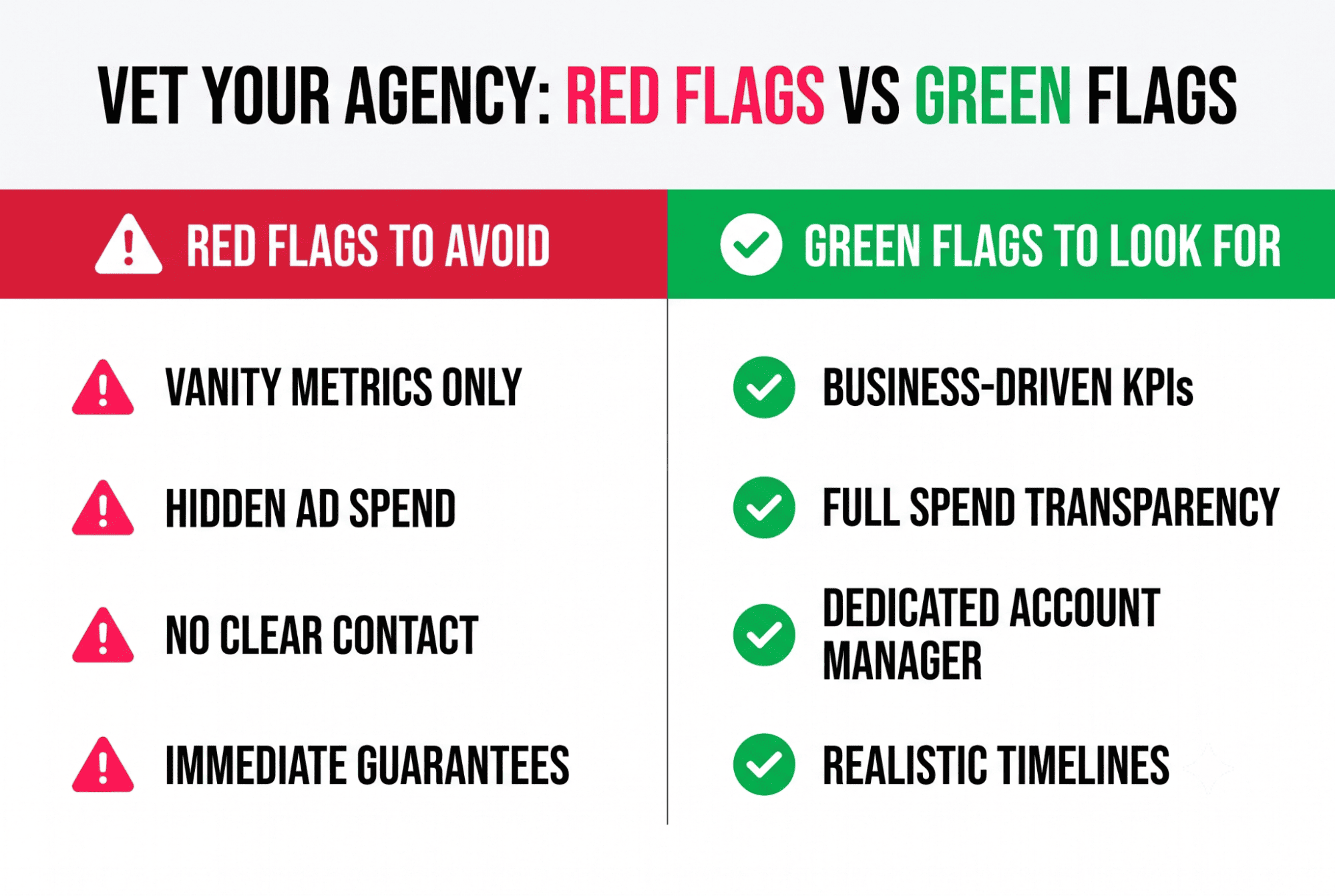
Image Source: Gemini 2026
Why specialization matters, & when a generalist is the right call
Not every business needs a full-service marketing agency. If you have a single, well-defined need, such as a specific paid advertising campaign or a rebrand, a specialist shop focused entirely on that discipline may serve your marketing needs better in the short term.
Most businesses, especially those without a large internal marketing team, benefit more from a generalist, full-service digital agency. Here’s why: your marketing efforts don’t operate in isolation.
Your content marketing informs your social media presence. Your SEO performance affects how your paid ads budget should be allocated. Your influencer marketing must align with your brand identity across every other channel.
The best agencies with true in-house expertise across disciplines can see these connections and act on them. A collection of disconnected specialists usually can’t, simply because no one has visibility into the whole picture.
If your content marketing is already driving traffic but not converting it into real leads, that disconnect between channels is often exactly the problem, something we unpacked in our post on turning blog traffic into clients.
FAQs about digital marketing agencies
Key takeaways
Make the next digital marketing agency the right one
Choosing the right digital marketing agency shouldn’t feel like a leap of faith. It should feel like due diligence, the same way you would evaluate any other significant business partner.
Ask about the role of a marketing agency in your specific growth plans. Ask the hard questions about reporting and ownership. Watch for the red flags. Look for the green ones. When you’re ready to talk to a marketing firm that welcomes this exact kind of scrutiny, because we’ve built our process to hold up to it, reach out to us at The Influence Agency.
We’d rather earn your trust with a clear answer than lose it with a vague one.