



Most brands want to know how long it takes SEO to work before committing. Expect early signals in months three to six, meaningful organic traffic growth by month six to twelve, and compounding SEO results well beyond that.
If you've asked an agency how long SEO takes and walked away with something like "it depends" or "results vary by industry," you weren’t given a “bad” answer. But you weren’t given a useful one either.
Vague SEO timelines are one of the most common frustrations brands have with their search engine optimization partners, and they're often the reason businesses either abandon the channel too soon or never invest with full confidence.
Why SEO takes as long as it does
Rather than a switch that can be flipped for instant results, search engine optimization is a signal developed over time. Google and other search engines perform ongoing evaluations of thousands of website data points, including:
- Site structure and technical organization
- Content alignment with specific search intent
- Overall domain authority
- References from other reputable sites across the web
When you start optimizing, you're entering a conversation Google has been having with your site since it was created. A new domain has almost no credit with search engines. An established domain with a patchy history may need to repair some of that trust before new SEO efforts gain traction.
Add to the reality that your competitors aren’t standing still. Every position in the search engine results pages is contested. Getting from page three to page one means displacing someone who already has high-quality backlinks, strong content, and domain authority working in their favor.
That doesn't happen overnight.
There's also the matter of indexing cycles. Even after content is published and on-page SEO is in place, search engines need time to crawl, process, and re-rank. Depending on your site's crawl budget and whether your XML sitemap is properly configured, that process can take weeks.
Learn More: On-Page SEO Checklist for Blog Writing
A realistic SEO timeline, phase by phase
Months 1 to 3: The groundwork phase, including long-tail keywords
This phase is foundational.
A strong SEO team should conduct a full technical SEO audit, resolve issues such as broken links, slow site speed, and crawl errors, build a keyword research framework, and begin creating or optimizing content around your target keywords.
None of these moves immediately improves search rankings. Think of it as clearing the path before running. On-page SEO improvements, fixing technical SEO issues, and establishing a content structure are the prerequisites for everything that follows.
What you should be measuring here is activity and infrastructure.
- Is your XML sitemap submitted and being processed?
- Are broken links and technical fixes being addressed?
- Is a keyword strategy taking shape around your audience's actual search intent?
If you can't answer yes to those questions after 90 days, that's a conversation worth having with your SEO specialists.
Months 3 to 6: Early signals
This is when you start to see the first indicators that your SEO efforts are connecting.
Impressions in Google Search Console may begin to rise. A handful of pages may appear in search results for lower-competition keywords and long-tail keywords. Organic search traffic may tick upward, even modestly.
These early signals matter because they confirm the strategy is sound and the content is being indexed. Don't measure this phase against your ultimate traffic goals. Measure it against movement.
Are Google Search Console impressions trending upward week over week? That's your clearest early signal.
Progress here is a leading indicator of what's to come. It's also the phase when Google Analytics becomes increasingly useful for tracking how organic visitors engage with your site once they arrive.
Months 6 to 12 and beyond: Compounding results
This is where search engine optimization starts to earn its reputation as one of the highest-ROI channels in digital marketing.
Pages that ranked 15th in month four may now rank seventh. Content that was indexed in month two may now be pulling consistent search traffic. Quality backlinks earned along the way compound the authority of newer pages, accelerating the SEO timeline for everything published after them.
By the 12-month mark, a well-executed SEO strategy should be showing meaningful organic traffic growth, movement in keyword rankings across multiple terms, and conversion data that justifies the investment. If you’re thinking beyond traditional rankings, generative engine optimization (GEO) becomes the next logical step.
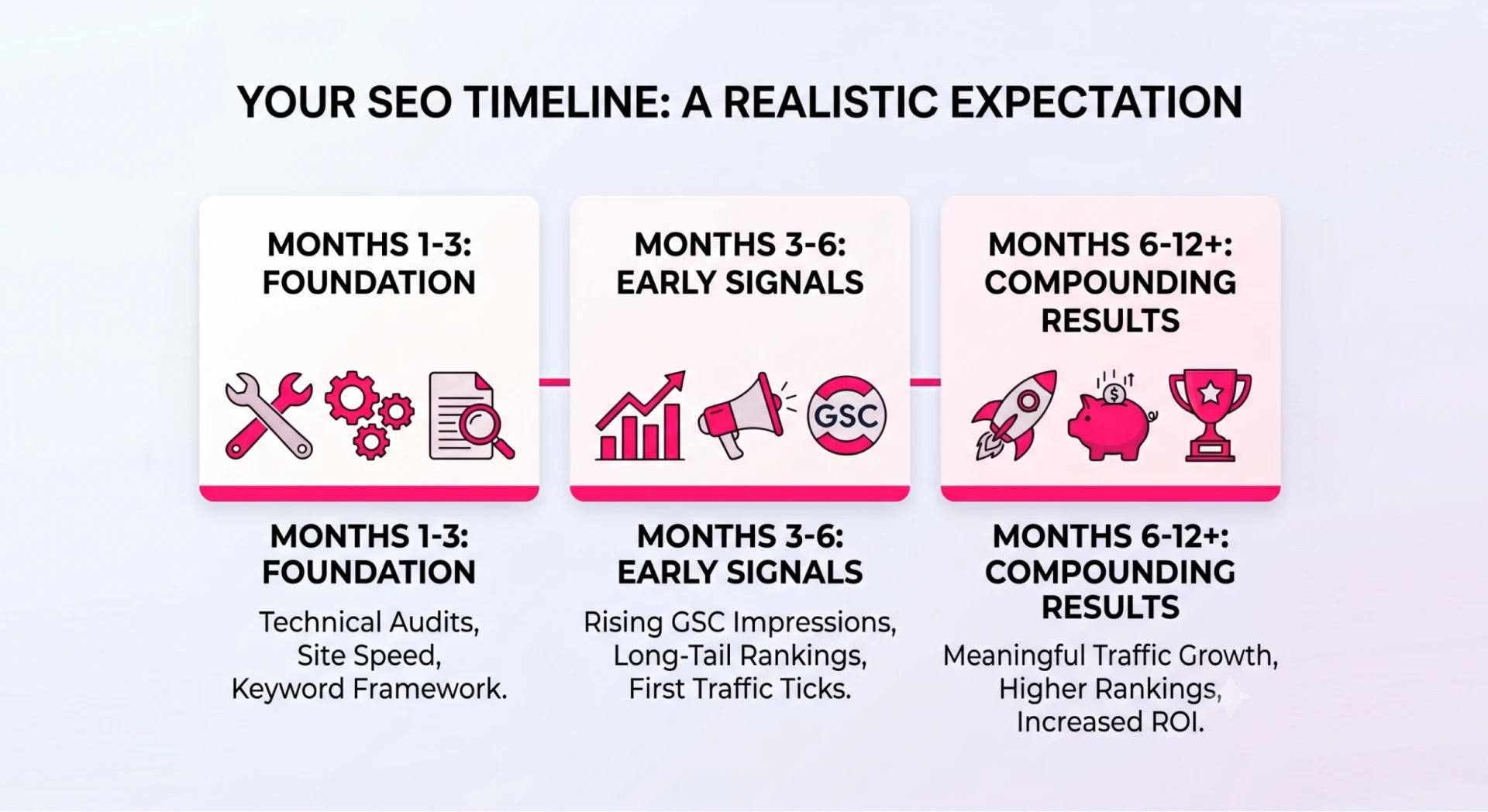
Image Source: Gemini 2026
What affects your SEO timeline specifically
No two SEO timelines are identical. These are the key factors that determine how fast or slow yours will move.
Domain age and authority
New websites start from zero. No crawl history, no backlink profile, no trust signals with search engines. Expect the first six months to be particularly back-loaded in terms of visible SEO results.
An established domain with a history of quality content and high-quality backlinks will typically see faster traction from new SEO efforts.
How competitive your niche is
Ranking for a broad, high-volume term in a crowded industry is fundamentally different from targeting specific long-tail keywords in a narrower market.
For example, local SEO campaigns often see faster results than national campaigns because keyword competition is lower and a well-optimized Google Business Profile can generate visibility relatively quickly.
High quality content volume
SEO needs material to work with. A site with 10 pages and minimal high-quality content will take longer to gain traction than one with a deep library of well-structured, SEO friendly content built around clear search intent and relevant keywords.
Content creation pace directly affects how fast your SEO timeline moves.
Technical health
A site with poor speed, broken links, duplicate pages, or an unsubmitted XML sitemap drags down every other SEO effort.
Resolving technical SEO issues is often the most impactful work in months one through three, and it's the kind of work that directly affects how quickly search engines can crawl and evaluate your content.
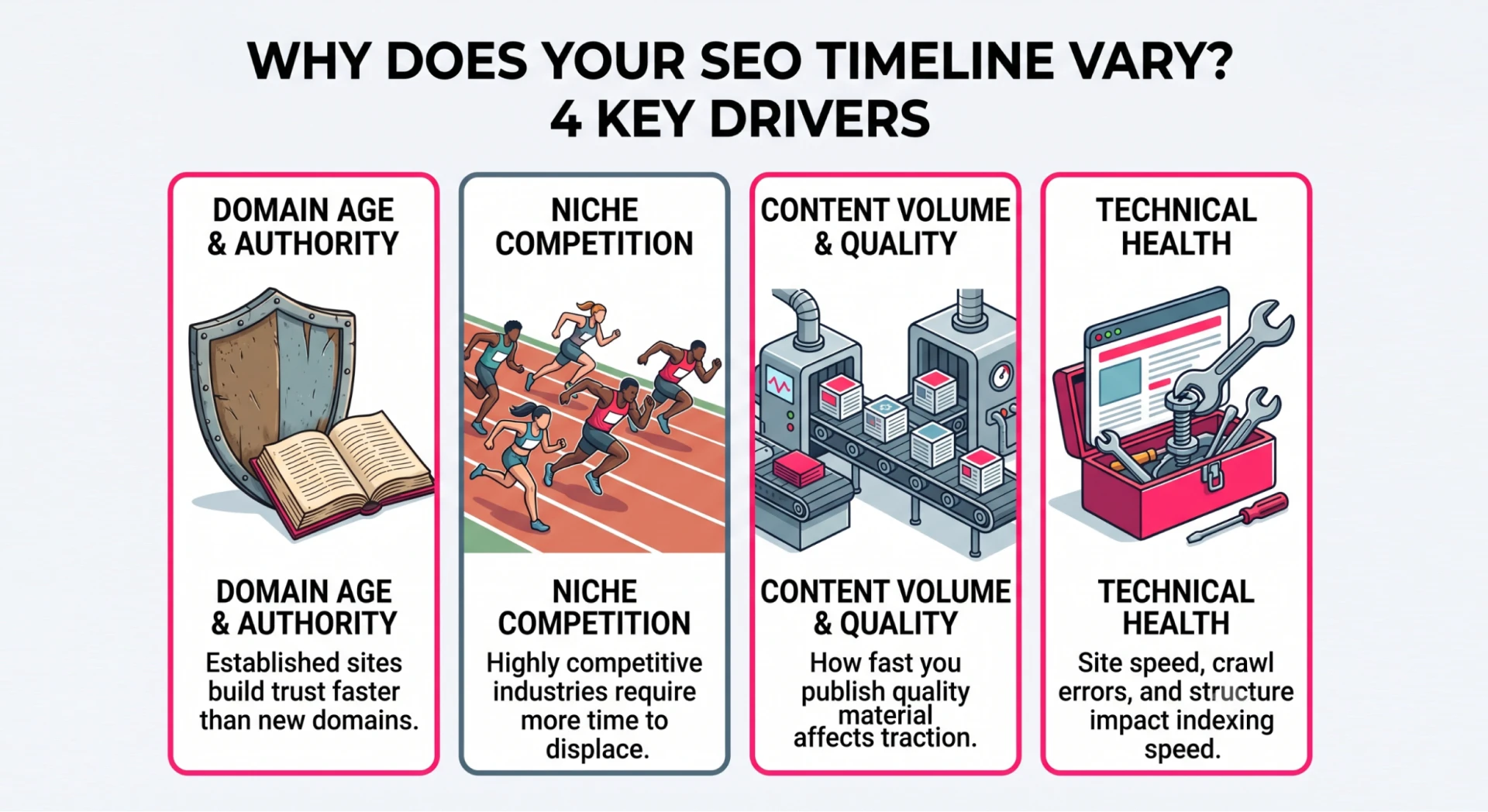
Image Source: Gemini 2026
What to track before your rankings move
Here’s the insight most brands don't get upfront: keyword rankings are a lagging indicator. They reflect work done weeks or months earlier.
Track these key performance indicators (KPIs) in the early months instead.
| Key Performance Indicator (KPI) | Platform / Tool | Why It Matters for Early-Stage SEO | Key Metrics to Track |
|---|---|---|---|
Search Impressions |
Google Search Console |
Earliest sign of visibility. Shows search engines are finding and surfacing your pages for relevant queries, even before users click through. |
Overall impression growth, new keyword appearances |
Crawl & Index Coverage |
Google Search Console |
Foundational health check. Confirms new and updated pages are indexed promptly. Rankings won't happen if search engines aren't crawling. |
Indexation status, crawl errors, sitemap updates |
Engagement Metrics |
Google Analytics |
User intent validation. Proves whether your content matches what visitors expected once they arrive on the page. |
Time on page, scroll depth, engagement and/or bounce rate |
Backlink Profile Growth |
Third-Party SEO Tools |
Authority builder. Signals growing trust as reputable sites reference your content, accelerating the ranking timeline for newer pages. |
Total referring domains, high-authority links |
Red flags to watch for when evaluating an SEO partner
If an SEO partner can’t walk you through what an SEO agency actually does in plain terms, that’s the first red flag.
Be skeptical of any SEO agency that guarantees first-page rankings within 30 or 60 days. Guaranteeing specific positions contradicts how search engines actually work, and any short-term result achieved through shortcuts like low-quality link building or thin content will eventually be penalized.
Watch for partners who go quiet after onboarding. A strong SEO team provides regular reporting through tools like Google Search Console and Google Analytics, flags issues as they arise, and adjusts the SEO plan in response to algorithm changes. If reporting means a monthly PDF with a few keyword rankings and nothing else, you're not getting the strategic clarity your investment deserves.
Finally, be cautious of SEO specialists who can't explain what they're doing in plain language.
FAQs about SEO strategy
How long does SEO take to work?
Most brands see early signals between months three and six, including rising impressions in Google Search Console and initial movement on long tail keywords. Meaningful organic traffic growth typically develops between months six and twelve, with compounding SEO results beyond that depending on competition, domain authority, and content volume.
Why doesn't an SEO strategy work faster?
Search engines evaluate authority, relevance, and user intent over time. Indexing takes weeks, competitors maintain existing search rankings, and foundational technical SEO work must be completed before content can perform. There are no shortcuts that produce lasting SEO results.
What’s a realistic timeline for SEO efforts on a new website?
New websites face a longer ramp-up because they lack a crawl history or backlink profile. Expect months one through six to be primarily foundational, with visible organic search traffic typically beginning around months six to nine with consistent SEO efforts.
What should an SEO agency be doing in the first 90 days?
A reputable SEO team should be conducting a technical SEO audit, resolving site speed issues and broken links, building a keyword research framework, and producing or optimizing content around your target keywords. Clear reporting through Google Search Console and Google Analytics should begin from day one.
What are the four stages of SEO?
The four stages of SEO are technical SEO, on-page SEO, content creation, and link building. Technical SEO fixes foundational issues like broken links and site speed. On-page SEO aligns pages with target keywords and search intent. Content creation builds topical authority. Link building earns quality backlinks from reputable sites to strengthen domain authority over time.
How to tell if SEO is working?
Track key performance indicators in Google Search Console and Google Analytics. Rising impressions, improving keyword rankings, growing organic search traffic, and a stronger backlink profile are all signs your SEO efforts are gaining traction. Rankings are a lagging indicator, so monitoring these signals early in your SEO campaign is the most reliable way to confirm progress.
Key takeaways
Choosing an SEO partner who operates with transparency
If you're evaluating agencies right now, the question to ask isn't "how fast can you get us results?" It's "what will we be measuring in month two, month six, and month twelve, and why does that matter?"
The answer to that question tells you a lot about how an SEO team thinks and operates.
That's how we work at The Influence Agency. If you want to understand what SEO can realistically do for your brand, explore our SEO services for a full breakdown of what a results-oriented strategy looks like in practice.
Reach out to our team to start the conversation.