
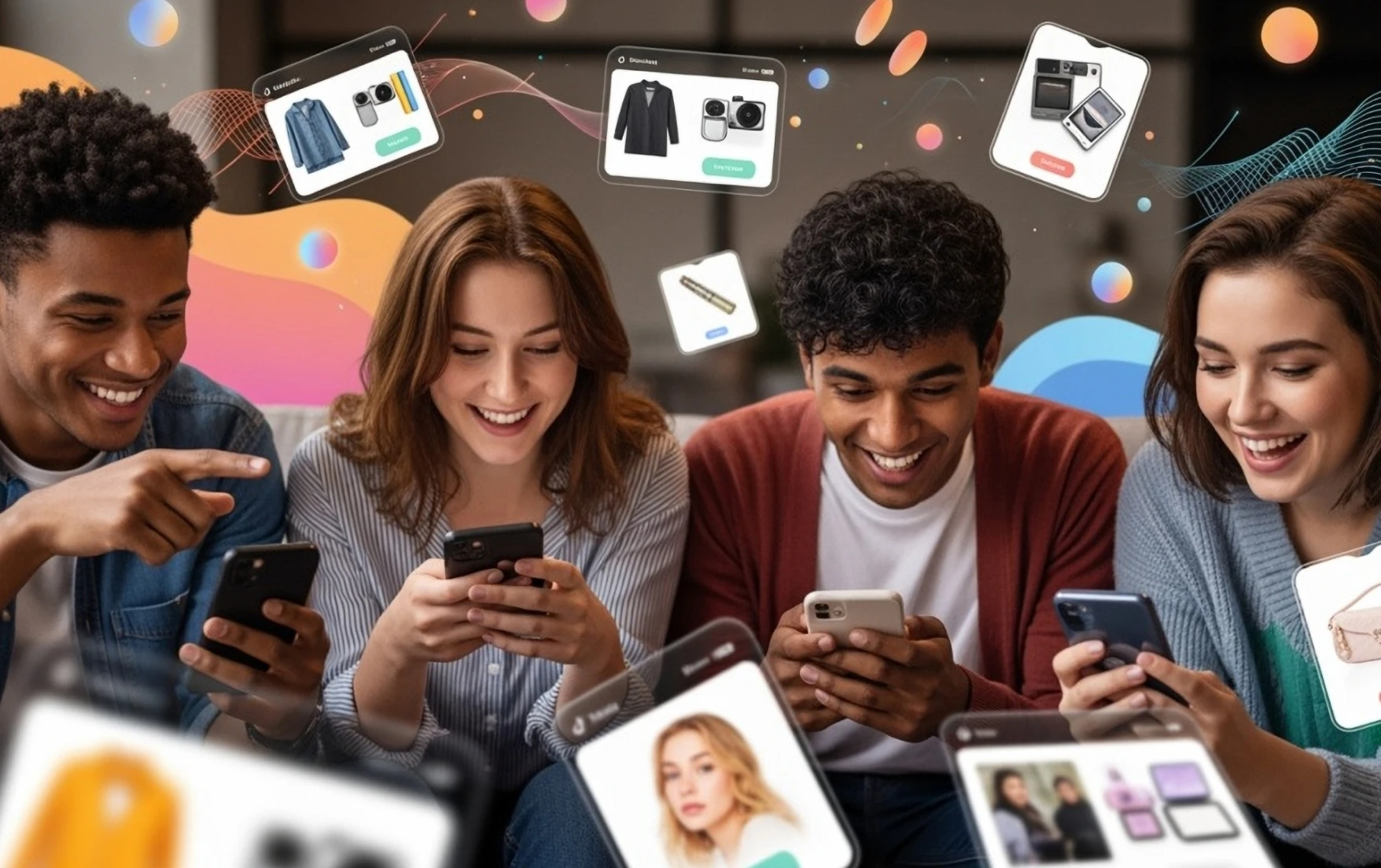

We surveyed 645 consumers across five generations and found that TikTok dominates product discovery at 63%, nearly double Google Search. Short-form video is the top content format at 73%. Here’s what the full funnel looks like (based on survey results from August 2025).
New first-party data from The Influence Agency’s Yearbook 2025 survey reveals that TikTok has overtaken every other platform for product discovery, and short-form video is the content format driving it all.
For years, “Just Google it” was the default answer to virtually any question. Need a restaurant recommendation? Google it. Comparing running shoes? Google it. Looking for the best moisturizer for oily skin? You already know.
But when we surveyed 645 consumers across five generations for The Yearbook 2026, our annual deep-dive into how Canadians discover, research, and buy, one stat stopped us in our tracks: 63.1% of respondents said they discover new products, services, and trends on TikTok.
Google Search? Just 38.1%.
That’s not a rounding error. It’s a 25-percentage-point gap between the platform everyone assumed owned discovery and the one that actually does. When we layered in the content-format data, the picture became even clearer: 73% said short-form video is the content type most likely to grab their attention during discovery.
If you’re a marketer still treating TikTok as a “nice to have” or a Gen Z playground, this data says otherwise. Here’s what our survey revealed about the modern product discovery process, and what it means for your business strategy.
The product discovery gap: TikTok vs. everyone else
When we asked respondents, “Where do you usually discover new products, services, or trends?” (select up to 3), TikTok dominated. Here’s how the top platforms stacked up:
A few things stand out. First, TikTok’s lead over Instagram is nearly 20 percentage points. Both are visual-first platforms, but TikTok’s algorithm-driven For You Page surfaces content from creators you’ve never followed, making it a true visual discovery engine rather than a feed of familiar faces.
Second, Google Search ranks fourth for discovery. That doesn’t mean Google is dying (we’ll get to its role in the research phase shortly), but that for the top of the funnel, social platforms, and TikTok in particular, have taken the lead.
Third, podcasts (25.6%) outpaced Facebook (25.3%) and influencer content (20.8%), suggesting that audio-first discovery is quietly growing alongside video.
Short-form video isn’t a trend: It’s the default
The next question we asked was: “What kind of content is most likely to grab your attention during discovery?” Again, we asked respondents to select up to three. The results were unequivocal:
Short-form video didn’t just win; it nearly doubled the second-place format. Critically, this wasn’t just a Gen Z preference in social media engagement. Our survey included respondents from Gen Alpha through Baby Boomers, with 47.9% being Millennials and 34% Gen Z.
When short-form video leads by this margin across a multi-generational sample, it’s no longer a demographic quirk, but the new standard for all social media users. For brands looking to capitalize on that shift, TikTok growth has become a key priority because greater visibility on the platform increases the chances of appearing in the discovery phase where consumer attention is now concentrated.
For brands, this has a practical implication: if your discovery strategy is still built around static images, long-form blog posts, or banner ads, you’re optimizing for a funnel stage that’s already shifted.
Google isn’t dead, it just moved down the funnel
Here’s where the story gets nuanced. When we asked, “When something piques your interest, where do you go to learn more?” the results flipped:
Google is still the number-one research destination, but it’s no longer the starting point. Consumers discover on TikTok (or Instagram, or YouTube), then turn to Google to validate what they’ve already found. The funnel has fundamentally restructured:
Notice that ChatGPT has already claimed 36.3% of the research phase, just a hair behind Google. This is a remarkable finding for a tool that barely existed in consumers’ purchase journeys two years ago.
Brands that aren’t thinking about how they appear in AI-generated summaries are missing an emerging channel.
Reddit and forum threads also deserve attention at 32.2%; consumers are cross-referencing TikTok discoveries with anonymous peer opinions, which feels like a trust-seeking behavior: “I saw it on TikTok, but is it actually good?”
What builds trust: It’s not what most brands prioritize
We asked respondents what builds their trust during the research phase (select up to three). The results challenge some common marketing assumptions:
Third-party reviews (46.2%) top the list, consistent with every trust study over the last decade. But look at what comes right after: clear pricing and policies (43.6%) and verified creator opinions (42.3%).
Consumers aren’t just asking “Is this good?” They’re asking, “Can I trust this brand to be straightforward with me?”
For brands investing heavily in influencer marketing (which, hi, is kind of our thing at The Influence Agency), this is validation that creator partnerships are a trust-building mechanism, not just an awareness play. But they only work when the creator’s opinion feels like verified customer feedback, meaning authentic, transparent, and based on actual product experience.
The conversion layer: Where purchases actually happen
After discovery, research, and trust-building, where do online shoppers actually pull out their credit cards?
Brand websites still dominate conversion at 68.2%.
This is the critical insight that completes the picture: TikTok owns discovery, Google validates research, but your website closes the deal. If your site isn’t optimized for conversion (fast checkout, clear pricing, and remember, 43.6% said that mobile-first experience builds trust), you’re leaking the demand TikTok generated.
TikTok Shop and Instagram Shop combined already capture nearly half of respondents (47.9%), which signals the growing power of social commerce platforms. At 19.4%, direct creator links are a quiet but meaningful conversion channel; nearly one in five people are buying through a link a creator shared, another win for influencer marketing.
What pushes people from “interested” to “sold” in product discovery
Our final funnel question asked: “What most often convinces you to convert when you’re already interested?” The top responses reveal what seals the deal:
Promos and product demos are in a virtual tie at ~47%. But the more interesting finding is that “seeing it in someone’s routine” (39.2%) is the third-most-powerful conversion driver. This is TikTok’s superpower in action: the “get ready with me,” the morning routine, the “what’s in my bag” video, capturing your target audience and putting them straight in the buying process.
Also notable: 22.9% cited a smart chatbot or AI assistant as a conversion factor in online shopping. Combined with the 36.3% using ChatGPT during research, AI is showing up at multiple stages of the customer journey, not as a replacement for human touchpoints, but as a complement to them.
The AI elephant in the room when it comes to product discovery
We also asked two questions about AI and personalization that round out the picture:
# 1. Have you used AI to make a purchase decision?
When asked if they’ve used AI (like ChatGPT) to help make a decision as a customer, roughly half said yes; 16% have asked for product recommendations, and 34% have used it to summarize or compare options.
Another 41.7% said “Not yet, but I’d consider it.”
Only a small fraction said they don’t see the value or don’t know how. This tells us that AI-assisted purchasing isn’t a fringe behavior; it’s either a current practice or imminent intent for the vast majority of consumers.
#2. How do people feel about personalized content?
The reply came in at 62.5% saying “Love it; if it’s helpful, I don’t mind.” Another 30.7% were neutral, saying they “expect it now.” Only a small minority expressed skepticism or hostility toward personalization.
Translation: consumers aren’t creeped out by personalization; they’re expecting it. Brands that fail to deliver relevant, behavior-driven content are no longer just “playing it safe” but are falling behind.
Image source: Shutterstock
What this means for your marketing strategy
If you take one thing from this data, let it be this: the customer journey is no longer a straight line from search to purchase. It’s a loop that bounces between TikTok discovery, Google/AI validation, peer review cross-referencing, and brand-site conversion.
Here’s how to adapt your business objectives and existing systems or services directly:
1. Make TikTok your discovery phase engine
With 63.1% of the discovery phase happening there, TikTok can’t be an afterthought. Invest in short-form video that promotes products in context: routines, day-in-the-life content, and creator collaborations.
Think about TikTok SEO: leverage user-generated content and optimize captions and on-screen text for how people search on TikTok, not just how they browse.
2. Optimize for the research phase, not just discovery
Your brand needs to show up when someone Googles you, asks ChatGPT about you, or searches for you on Reddit. That means investing in SEO, building a presence in AI-generated responses (a discipline some are calling GEO, Generative Engine Optimization), and monitoring what’s being said in social media platforms and forums.
3. Build trust through transparency and creators
Clear pricing, honest creator partnerships, and third-party reviews are the trust trifecta. If your pricing is buried three clicks deep or your influencer content feels scripted, you’re working against the data.
4. Don’t neglect your website
For 68.2%, they still convert on brand websites. That means site speed, mobile experience, and checkout friction matter more than ever. TikTok generates the demand; your website needs to be ready to capture it.
5. Prepare for AI at every stage
From ChatGPT in the research phase to AI chatbots at conversion, consumers are integrating AI throughout their journey. Make sure your product information is structured, accurate, and accessible to AI systems.
The full picture for product discovery
TikTok is the new Google, at least for the top of the funnel. But the most important takeaway from our survey for your social commerce strategy isn’t about any single platform.
It’s that the consumer journey is now a multi-platform, multi-format, AI-augmented loop that demands brands show up everywhere, not just somewhere. We’re talking social media channels, forums, and AI answers, not just search engines.
The brands that win in 2026 won’t be the ones that bet everything on a single channel. They’ll be the ones who build a connected strategy across every stage and let the data guide them.
Methodology: Data in this post comes from The Influence Agency’s Yearbook Generation Survey 2025, conducted via Google Forms with 645 respondents across five generational cohorts: Gen Alpha (2010 or later), Gen Z (1997–2009), Millennials (1981–1996), Gen X (1965–1980), and Baby Boomers (1946–1964). Respondents were 40.6% female, 39.8% male, and 10.9% non-binary. Most questions allowed selection of up to three responses, so percentages do not sum to 100%.