


Brands fail at influencer marketing by chasing vanity follower counts, over-scripting creators, and measuring impressions instead of ROI. To fix it, successful brands partner with trusted nano influencers, prioritize unscripted authenticity, and build long-term relationships that drive real revenue.
You've seen the campaign: a brand partners with a content creator with 800,000 followers. The post goes live, and the result is a handful of comments, a blip in traffic, and zero lift in sales. The brand walks away convinced that influencer marketing doesn't work.
The real problem wasn't the channel. It was the execution.
After years of running influencer marketing campaigns across dozens of industries at The Influence Agency, we've watched the same mistakes play out again and again … and again. They're not random; they follow a clear pattern. If your brand has tried influencer marketing without seeing meaningful results, there's a good chance you've run into at least one of them.
Understanding the benefits and drawbacks of influencer marketing is a useful starting point, but knowing what the problems are doesn't automatically fix them.
The follower count trap (a.k.a. failure to embrace nano influencers)
The single most common mistake brands make is treating follower count as a proxy for value. A content creator with 500,000 followers sounds more impressive than one with 50,000, but follower count tells you almost nothing about whether that audience will care about your product.
What actually matters is audience fit. A fitness brand partnering with a lifestyle creator who occasionally posts workout content isn't going to move product. A niche creator with 40,000 deeply engaged followers who trusts her gear recommendations? That's a different story entirely.
The question isn't how many people follow a creator. It's how many of those people are the right people, and whether they actually listen when that creator speaks.
Nano influencers and mid-tier creators consistently outperform mega influencers on engagement and conversion. Their niche audiences are more specific, trust runs deeper, and recommendations feel more personal.
In fact, nano influencers average 2.53% engagement, compared to just 0.92% for mega-influencers. Chasing big numbers at the expense of audience alignment is one of the fastest ways to burn through the budget on influencer marketing efforts that deliver nothing to the bottom line.

Source: Canva
Not building long-term creator partnerships
Brands that dip into influencer marketing once, see middling results, and move on are making a structural mistake. A single post is not a campaign. It's a test run, and it's fairly unreliable.
Creator marketing works best when it mirrors how consumer trust actually builds. People don't buy from someone they've seen once. They buy from successful creators they've followed for months, whose opinions have been consistent, who have mentioned a brand multiple times, and clearly aren't being paid to pretend they love it.
Long-term creator partnerships generate stronger results than one-off campaigns. Data shows that 70% of brands are switching from one-off creator deals to sustained partnerships. Brands seeing real returns have figured out that a single activation is barely a handshake. Long-term partnerships allow creators to develop genuine familiarity with a product, which shows in their content.
By shifting to a structured creator program, brands stop treating influencer marketing as a media buy. Instead, they build the kind of consistent presence that actually moves audiences from awareness to intent.
Over-scripting kills the content
Handing a collaborator a word-for-word script undermines the very thing that makes influencer content work. People follow creators because of their voice, their POV, their way of framing a product or experience. Authenticity is what drives purchasing decisions.
HubSpot’s 2025–2026 Social Media Trends report shows that 76% of marketers say authentic, low-production, unscripted videos outperform highly produced alternatives. Audiences trust real content over slick productions, and many successful creators lean into this more deliberately than brands do.
A strong creative brief gives a content creator context, key messages, and any non-negotiable claims or disclosures. It does not tell them exactly what to say or how to say it. The creative execution belongs to the creator. That's what you're paying for.
Brands that struggle to let go of that control consistently get worse results from their influencer partnerships than brands that trust the people they've hired. The best marketers keep this front and center when creating a winning influencer marketing strategy.
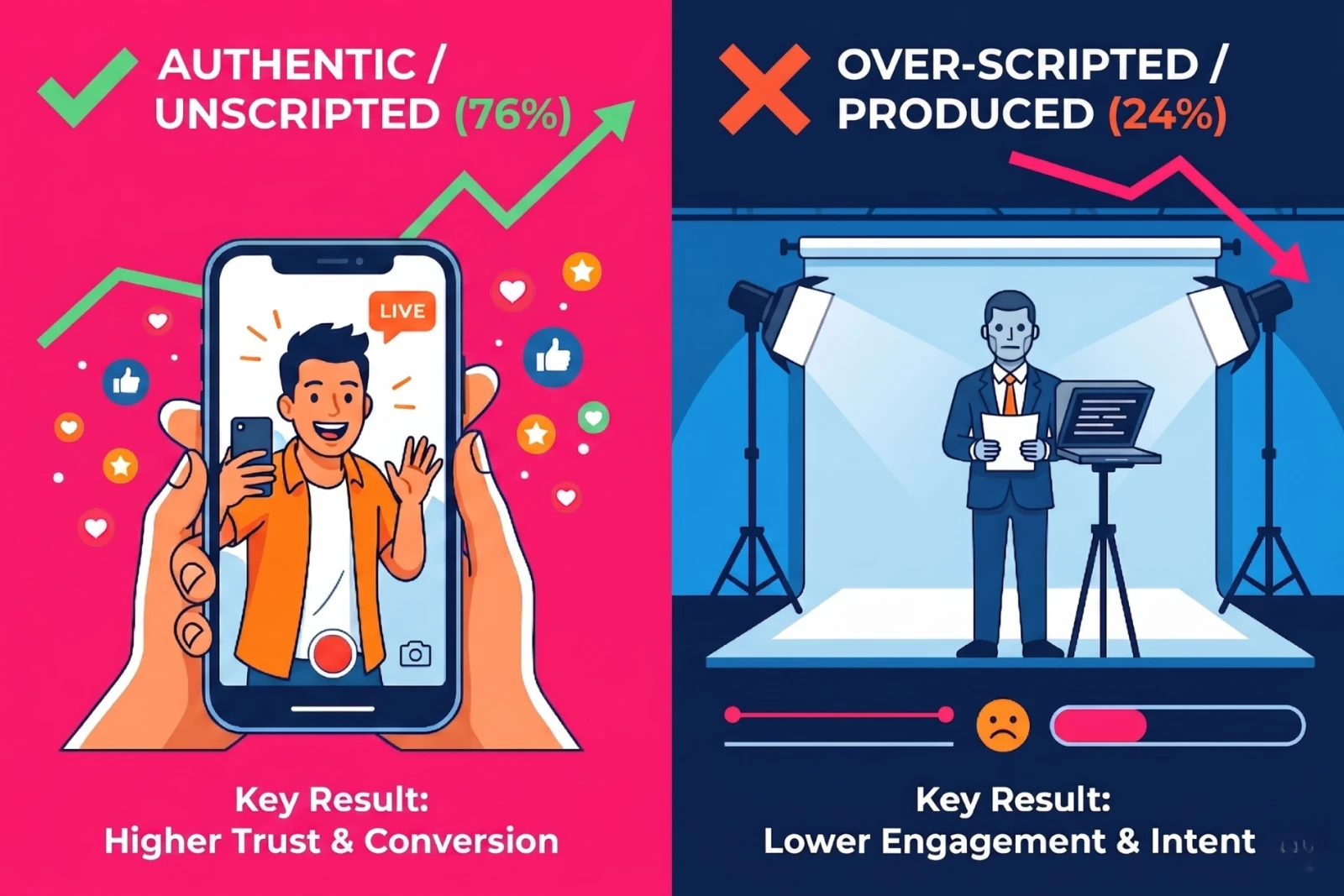
Image Source: Gemini 2026
Impressions aren’t outcomes
Reach and impressions are easy numbers to report. They're also largely meaningless if your goal is to grow revenue, generate leads, or drive direct sales. The top influencer marketing trends are all moving toward performance tracking and accountability.
Most brands celebrate influencer marketing campaigns based on impression counts that produce no measurable downstream impact. That's not a win; that's a vanity metric dressed up in a slide.
In 2026, 74% of brands are moving budget into influencer programs, measured by customer acquisition cost (CAC), average order value (AOV), and ROI. However, only 20% of brands currently track CAC, indicating a significant measurement gap.
To calculate your true influencer marketing ROI, use this formula:
The Influence Agency Case Study
The brands winning right now treat influencer marketing as a performance channel, not just a brand awareness exercise. We proved this firsthand when managing the "Makeover For Less" campaign for Lowe’s Canada. By bypassing generic brand awareness metrics and equipping niche home decor creators with trackable promo codes tied directly to checkout, we transformed social content into a direct revenue driver, achieving a 10% average engagement rate and an outstanding 8x ROI.
Platforms like TikTok Shop and YouTube Shopping are turning creator content into immediate sales, giving brands direct paths to checkout. On TikTok, ads starring a creator are 27% more likely to be remembered than standard social ads. That's the kind of campaign performance data that actually informs an influencer marketing strategy.
If you're not measuring what matters, you can't optimize. If you can't optimize, you can't improve. Influencer marketing ROI is entirely measurable when the right tracking infrastructure is in place.
The brands winning right now treat influencer marketing as a performance channel, not just a brand awareness exercise.
The brief you skip is the campaign you regret
Assuming a creator knows what your brand needs without telling them is a mistake that shows up in the creator content every time. Without a clear brief covering the target audience, key messages, and deliverables, the output is a guess.
Let’s say you’re a skincare brand that hires a creator with a loyal beauty audience. You send over the product and leave the rest open-ended. The creator posts a casual unboxing that never mentions the hero ingredient, skips your brand’s key claim, and tags the wrong product line.
The content goes live and can’t be pulled without burning the relationship. You’re left with a post that does nothing for the campaign and may even contradict what you’re trying to say.
None of that is the creator’s fault. They only worked with what they were given. It’s the brand's responsibility to clarify deliverables in the brief.
As the creator economy expands, influencer discovery becomes more complex across various social media platforms. More options mean more room for misalignment when expectations aren't clearly set. A thorough brief prevents reshoots, revision loops, missed brand guidelines, and influencer marketing efforts that miss the mark on cultural relevance.

Source: Canva
Aesthetics over audience trust
A creator with a clean, on-brand feed is appealing. But if their audience doesn't trust them on product recommendations, the aesthetics don't convert.
Audience trust is built through honesty, consistency, and selectivity. Most successful creators who only partner with brands they genuinely believe in protect that trust. Creators who post sponsored content constantly erode it.
When evaluating potential creator partnerships, look beyond the surface. Review past sponsored content. Check the comments. Ask whether that creator's audience engages meaningfully with brand partners, or whether those posts get ignored.
This is also where the influencer marketing trends around niche communities matter. Brands winning in the current creator marketing landscape are finding that deep relevance inside niche communities consistently outperforms broad reach. The creator economy rewards specificity.
FAQs about the influencer marketing industry
Key takeaways
Stop leaving results on the table
These mistakes are industry-wide, and they're costing brands real money across their marketing campaigns. Good thing they’re preventable.
Running successful influencer marketing campaigns requires experience, genuine relationships, and a clear-eyed approach to strategy. If your brand has tried the process but isn't seeing results, the problem is usually in execution.
That's what we fix. Our award-winning influencer marketing team at The Influence Agency has run successful influencer campaigns across industries, built genuine creator relationships, and delivered measurable revenue for brands worldwide that came to us frustrated with what they'd experienced elsewhere.
We know what works. More importantly, we know exactly why most influencer campaigns don't. If you're ready to run influencer marketing campaigns that actually perform, let's talk.