

Running an influencer marketing campaign takes more than picking a creator. Start with one clear goal, like sales or sign-ups, choose creators whose audience matches your buyers, write a simple brief, but leave room for their voice, and set tracking before launch, so you can prove results.
Most brands that come to us have already made their first mistake before we've looked at a single creator profile. They've decided that finding the right influencer is the campaign. The brief, the content, the timing, the measurement strategy, those feel like details. They're not.
They're the campaign. The creator is the vehicle.
If you've run influencer marketing campaigns and come away feeling like they underdelivered, this is usually where the disconnect started. If you're planning your first influencer campaign, understanding this changes everything about how you approach the process.
What do you want to happen?
Every high-performing influencer marketing campaign starts in the same place: a clear, honest answer to what success looks like to you. Not "more awareness" or "drive sales." Something specific, like reaching 25,000 new users in a defined demographic within 60 days, or converting first-time visitors at a target cost per acquisition.
Before we touch a roster at TIA, we make clients answer this question. Because your objective shapes everything that follows: campaign type, creator tier, measurement approach. Change the goal, and you’re running an entirely different campaign.
For instance, awareness campaigns need reach and resonance, which means working with macro- or mid-tier creators, platform-native content, and metrics like impressions and share of voice. Conversion campaigns need trust and action: micro or nano creators with a tight audience fit, trackable links, and a clear path from post to purchase.
Brief a creator with a massive following on a conversion-focused campaign without tracking infrastructure in place, and you'll get reach, not results.
That gap between what a campaign delivers and what a brand needs is one of the most common reasons influencer marketing underperforms. It’s rarely a creator problem, and almost always a clarity issue.
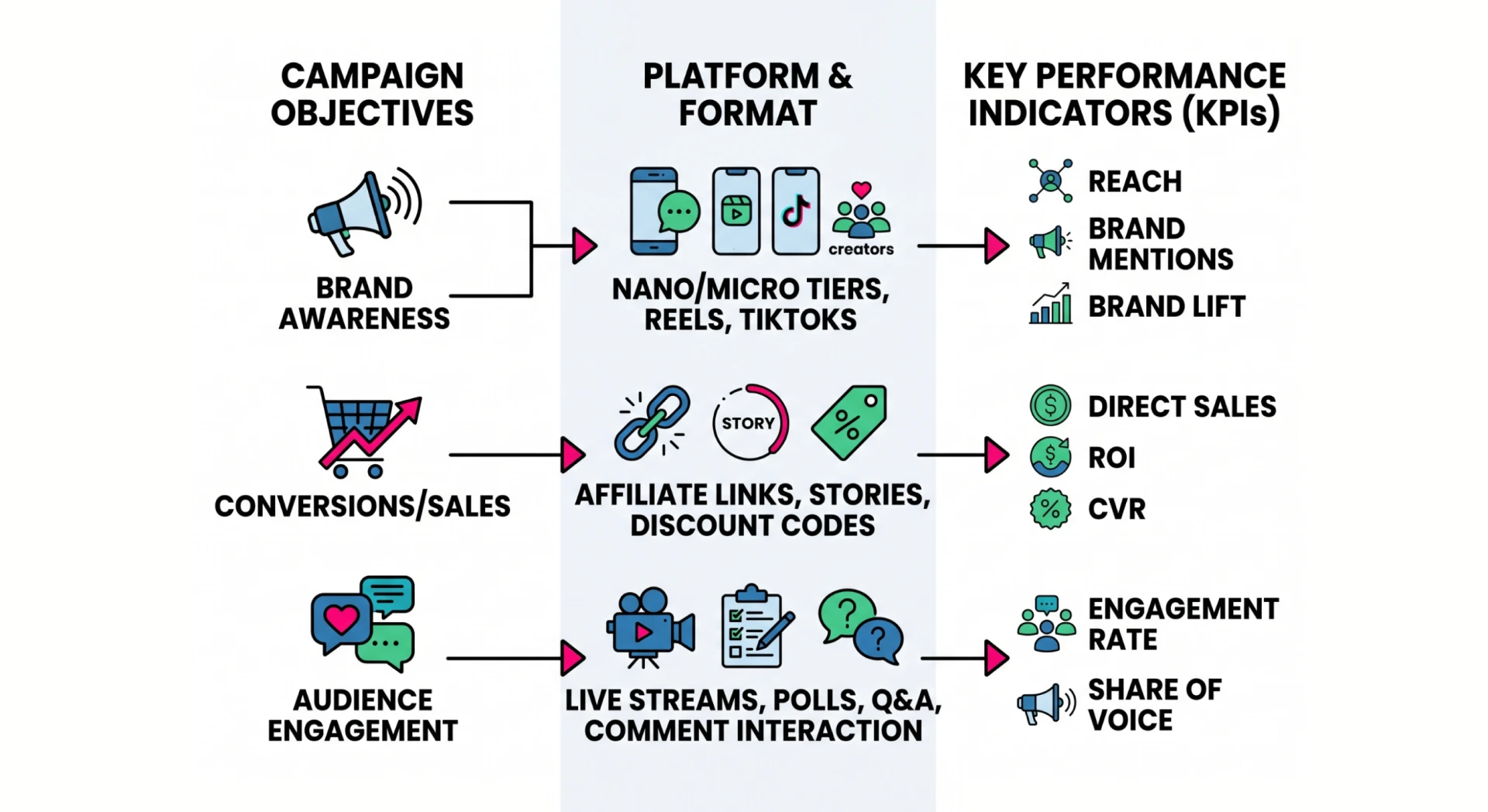
Image Source: Gemini 2026
What’s the right influencer tier for your campaign?
Once the objective is clear, creator selection can begin. Understanding the types of influencers available to you is the first step.
Nano influencers have between 1,000 and 10,000 followers. Micro influencers sit between 10,000 and 100,000. Macro influencers range from 100,000 to 1 million, and mega influencers, or celebrity influencers, have audiences above that. Each tier serves a different purpose depending on your campaign goals.
Nano and micro influencers often get the best engagement per follower. Nano influencers can reach up to 10.3% engagement on TikTok, while macro influencers often get under 1%. That gap isn’t random.
Smaller creators build tight, niche communities. Their followers trust them more. That trust usually drops as follower counts grow, though.
In 2024, brands increasingly favored nano and micro influencers because smaller creators often drive higher engagement. They also reach more niche audiences than larger accounts do.
At TIA, we evaluate suitable influencers on audience demographics, engagement quality, content consistency, and the trust they've built within a specific niche. We use influencer discovery tools to confirm follower authenticity and flag fake followers before any influencer partnership moves forward.
We also look at whether the creator's existing content aligns naturally with your brand values, not just whether the aesthetics match.
Audiences are sophisticated. They know when something doesn't belong, and forced partnerships are always obvious.
This is also why influencer marketing campaigns built on transactional one-off posts rarely build lasting equity. Long-term influencer partnerships consistently outperform single activations because the repeated association builds genuine credibility over time. Our influencer marketing services are built around that philosophy.
What campaign type are you actually running?
Not all influencer marketing campaigns look the same, and choosing the wrong campaign type for your objective is a fast way to waste budget.
- Sponsored content campaigns pay creators to produce promotional posts aligned with your brand's message.
- Product seeding means you send products to influencers with no requirement to post. This helps build organic awareness and more authentic content.
- Affiliate campaigns offer commissions tied to unique tracking links, making them well-suited for direct sales objectives.
- Giveaway campaigns prioritize engagement and follower growth.
- Ambassador programs involve ongoing influencer collaboration over months or years, building an association that functions more like a brand partnership than a placement.
The campaign type should follow directly from your objective. A product launch calls for something different than a sustained brand awareness play or a push into niche communities you haven't reached before.
A useful way to think about this structurally: engage across three influencer tiers, three content formats, and a three-phase rollout (pre-launch, launch, and post-launch). Not a rigid rule, but the underlying logic is sound. A single concentrated push fades fast.
Layered sequencing builds momentum and creates more touchpoints over time.
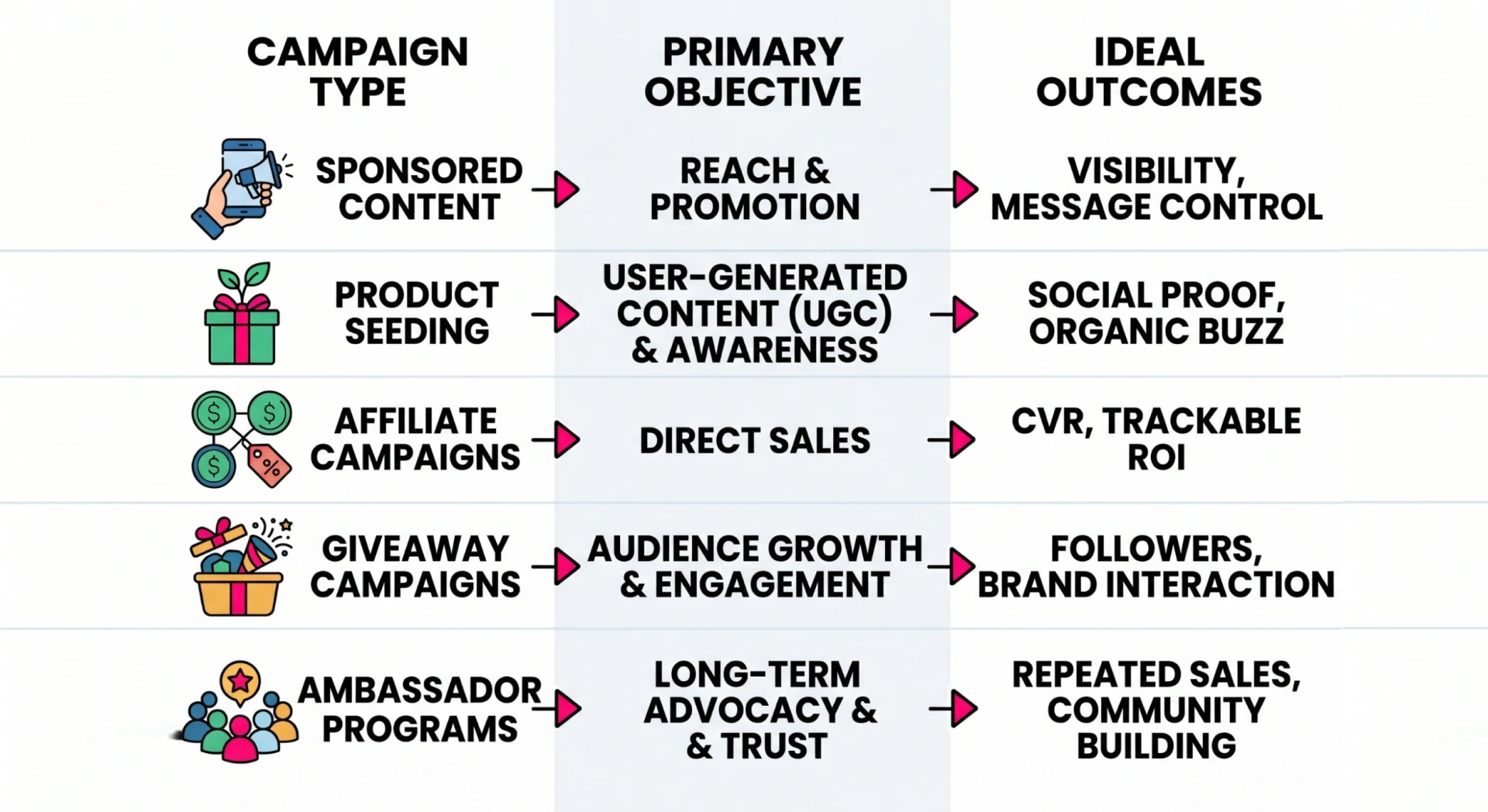
Image Source: Gemini 2026
The brief is where campaigns live or die
A good brief gives a creator context, direction, and room to actually create. A bad brief gives a creator a script.
When brands apply strict posting requirements, two things happen:
- The content looks like an ad, because it is.
- The creator's authentic voice, the thing that made their highly engaged audiences trust them in the first place, disappears.
You've purchased reach without the persuasion.
The brief needs to clearly cover the core message, the mandatory inclusions (such as product features, legal disclosures, and a call to action), the platform and format requirements, and the campaign timeline.
What it should not do is tell a creator how to speak, what to wear, or dictate the exact sequence of a video.
Creative freedom isn’t a risk. It's the point. The best-performing influencer content consistently comes from creators who were trusted to interpret the brief in their own voice. Brands that over-brief tend to get content that performs like traditional ads because it essentially is one.
This tension between brand control and creator authenticity is something we navigate on every campaign. For a broader look at where brands lose this balance, our perspective on what brands keep getting wrong about influencer marketing is worth a read.
Why timing and sequencing matter more than you think
A campaign launch shouldn’t be reduced to a single moment. It's a sequence.
High-performing influencer marketing campaigns are layered. A common approach opens with macro influencers to establish reach and context, follows with micro influencers speaking to more defined communities, and then amplifies with paid ads behind the best-performing organic content. Each layer builds on the one before it.
Timing matters too. Dropping all sponsored posts in a 48-hour window often saturates the moment without building momentum. Staggering content across one to two weeks creates multiple touchpoints, keeps the brand in the conversation longer, and gives the algorithm time to work.
The campaigns that look like a coordinated editorial wave consistently outperform the ones that feel like a simultaneous announcement. The same logic applies to content mix: not every touchpoint should be a hard sell.
Blending promotional posts with authentic creator content and community-driven moments produces a more credible campaign overall, and one that holds attention across a longer window.
For a closer look at how this plays out in practice, the top 10 influencer campaigns we've covered demonstrate what thoughtful sequencing and creator selection can deliver in measurable results.
Measuring what actually happened
Here's what a lot of post-campaign reports will show you: impressions, reach, likes, and saves.
Here's what they often won't show you: whether any of it moved your business.
Real measurement starts before the campaign does. That means implementing tracking mechanisms before launch, using UTM (Urchin Tracking Module) parameters on every link, and setting up custom promo codes to measure direct sales from individual influencers.
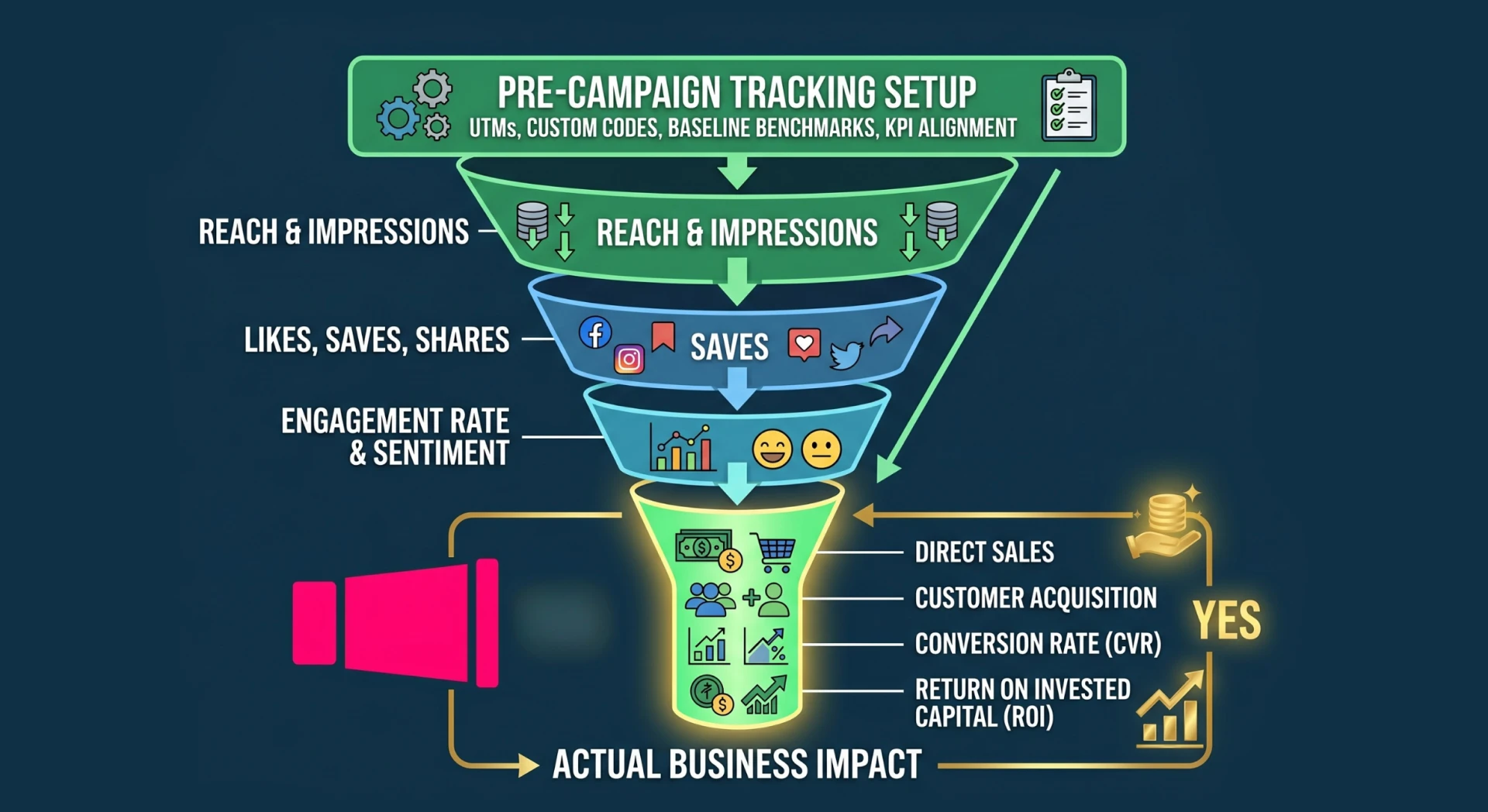
Image Source: Gemini 2026
Key performance indicators should be established in advance and aligned to your campaign type. Tracking engagement rates and campaign performance in real time lets you optimize spend before the window closes.
Campaign performance data from the influencer marketing industry supports this: Influencer marketing campaigns can yield an average of $5.20 for every $1 spent when executed with a clear strategy and proper tracking in place.
These outcomes do not happen without structure. Structure doesn’t mean more reporting after the fact; it means knowing which signals to read while the campaign is still running.
Engagement rate matters, but context matters more. A strong engagement rate on a highly targeted micro influencer post is a different data point than the same rate on a mass-reach creator post. Sentiment in comments tells you something that key metrics and follower growth numbers never will.
FAQs about how to run an influencer marketing campaign
Key takeaways
Ready to run a campaign that delivers?
Running influencer marketing campaigns well isn’t a one-time education. It's an ongoing practice built on relationships, data, and iteration. It means:
These are things that come from doing this work at scale, every day, across industries.
Brands that try to manage this in-house often do the tactical work without the strategic layer that makes it cohesive.
TIA has managed influencer campaigns across industries and creator tiers, from nano-influencer product seeding to multi-platform macro launches. We know what the data looks like when a campaign is set up correctly, and when it isn’t.
If you're ready to run your next influencer campaign with a team that knows what they’re doing, let's talk.
Great influencer marketing campaigns look effortless from the outside. That's kind of the whole point.