



Few have a blog content strategy. Without one, your content loses search visibility, misses conversion opportunities, and fails to support your service pages. A blog content strategy turns scattered posts into a system that drives real business results.
Most brands have a blog. A surprising number of them treat it like a filing cabinet: add content, close the drawer, repeat. The posts accumulate, the publication dates get inconsistent, and somewhere along the way, the whole thing starts functioning as proof that content is happening, rather than proof it’s working.
That distinction is the entire conversation.
A blog without a documented content marketing strategy is a liability dressed up as an asset. It consumes budget, takes internal time to manage, and quietly underperforms at every stage of the funnel.
The brands that get real return from their content marketing aren’t publishing more often; they’re publishing with intent. If you’ve been blogging without a content strategy, this post is for you.
(If you're already convinced and want the tactical walkthrough, our companion guide on how to build a content marketing blog strategy covers the execution side in depth. That post is fundamentally a DIY guide.)
A blog is either a revenue asset or it isn't
A blog isn’t merely a branding gesture, nor a way to show your audience that you're "active."
When built and managed with direction, a blog is one of the highest-ROI channels in your entire content marketing plan. It transforms consistent content creation into a compounding asset that drives organic website traffic, builds topical authority, and moves potential customers through your funnel.
When created aimlessly without content marketing tactics, you get the opposite: diluted authority, fragmented internal link structure, and search engine signals that your site lacks focus. Perhaps most critically, it generates traffic that has nowhere useful to go.
The gap between those two outcomes isn't talent or budget. It's a blog content strategy. Research consistently shows that brands with a defined, written content strategy outperform those without one.
In fact, companies with a documented content strategy generate 3x more leads than those without one, not because they're doing more, but because everything they do is connected to actual business goals.
“Writing without strategy rarely delivers the results a brand is after. Content that's deliberately mapped to audience needs and wants, and executed with precision, performs significantly better. This is where most brands misstep," says Alethea Spiridon, Associate Director, Content, at The Influence Agency.
What is an SEO content strategy?
At its core, a blog content strategy for search engine optimization (SEO) is the difference between publishing content that compounds in value over time and publishing content that disappears into the internet the week it goes live.
For a founder or marketing lead, that distinction has a direct dollar cost. Without one, your blog is generating spend without getting returns. Every post that fails to rank, fails to link to a service page, or fails to move a reader toward a decision is a budget that doesn't work.
A real blog content strategy connects what your audience is actively searching for with where your business needs them to go. That connection is what turns a content calendar into a conversion channel.
Choosing to create a content strategy for SEO is a business decision, and the brands that have made it are compounding a search advantage that gets harder to close the longer you wait.
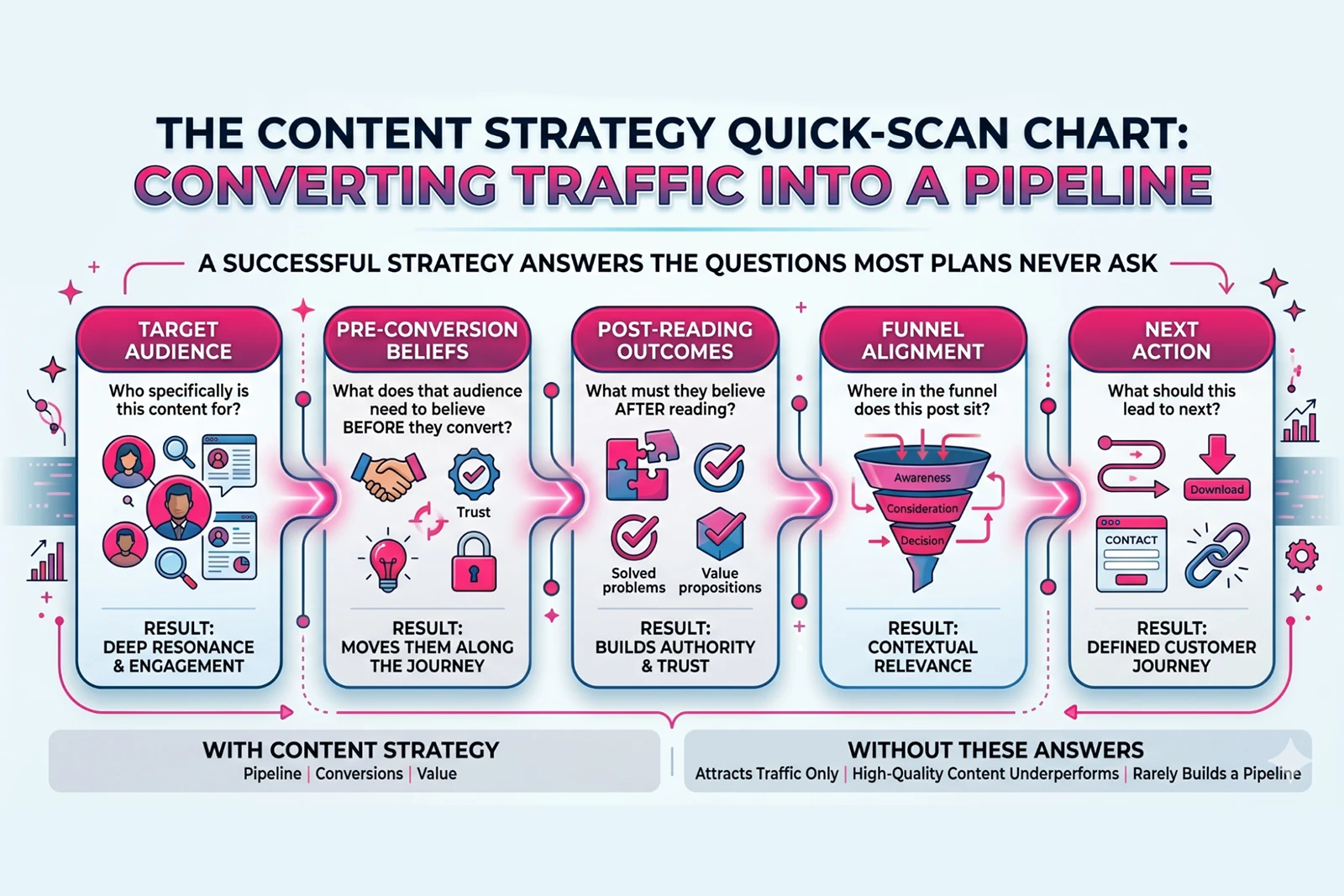
Image Source: Gemini 2026
What brands lose when they blog without a content marketing strategy
Aimless blogs published just to “be active” are costing you rankings, authority, and conversions. Here’s why a successful content strategy for SEO is a must for brands looking to rank.
Search visibility that compounds against you
Without a blog content strategy, your search visibility stalls and erodes. Publishing without direction sends mixed signals to search engines.
A post on one topic this month, something unrelated the next, a reactive piece because a trend surfaced in a meeting. Each post might be well-written, but the pattern tells search engines nothing coherent about your brand’s expertise, and incoherence doesn’t rank.
The brands pulling ahead in organic search are building around topical authority: a service page at the center, blog content that goes deep on related subtopics, and an internal structure that connects it all.
That architecture compounds over time and earns rankings that hold. Content published without that foundation does the opposite, and every post you add to a directionless blog makes the gap harder to close.
Internal links that go nowhere
Internal linking is one of the most underrated levers in organic search, and it’s one of the first things to break down when there’s no blog content strategy behind the digital marketing content.
If your blog posts aren’t mapped to your service pages, they can’t pass authority to them. If they’re not connected to each other, you’re missing the opportunity to guide readers deeper into your site and help users navigate toward a conversion.
Every post you publish without a clear linking plan is working in isolation, and isolated content doesn’t build pipelines. This structural problem compounds over time. The longer you create content and publish without a linking strategy, the more authority you’re leaving on the table.
Conversion paths that dead-end
Your content can rank, get read, and still generate nothing. That’s what happens when there’s no conversion architecture behind it.
Consider this scenario: a potential customer arrives through organic search, finds your post genuinely useful, and then has nowhere to go. There’s no clear next step, no obvious bridge to your service, and no framing that connects what they just read to a decision they need to make. They end up leaving because the post did half its job.
Content without a conversion path is expensive lead generation with no follow-through. A real blog content strategy maps every piece of content to a stage in the customer lifecycle, so that traffic has somewhere to go and readers have a reason to stay.
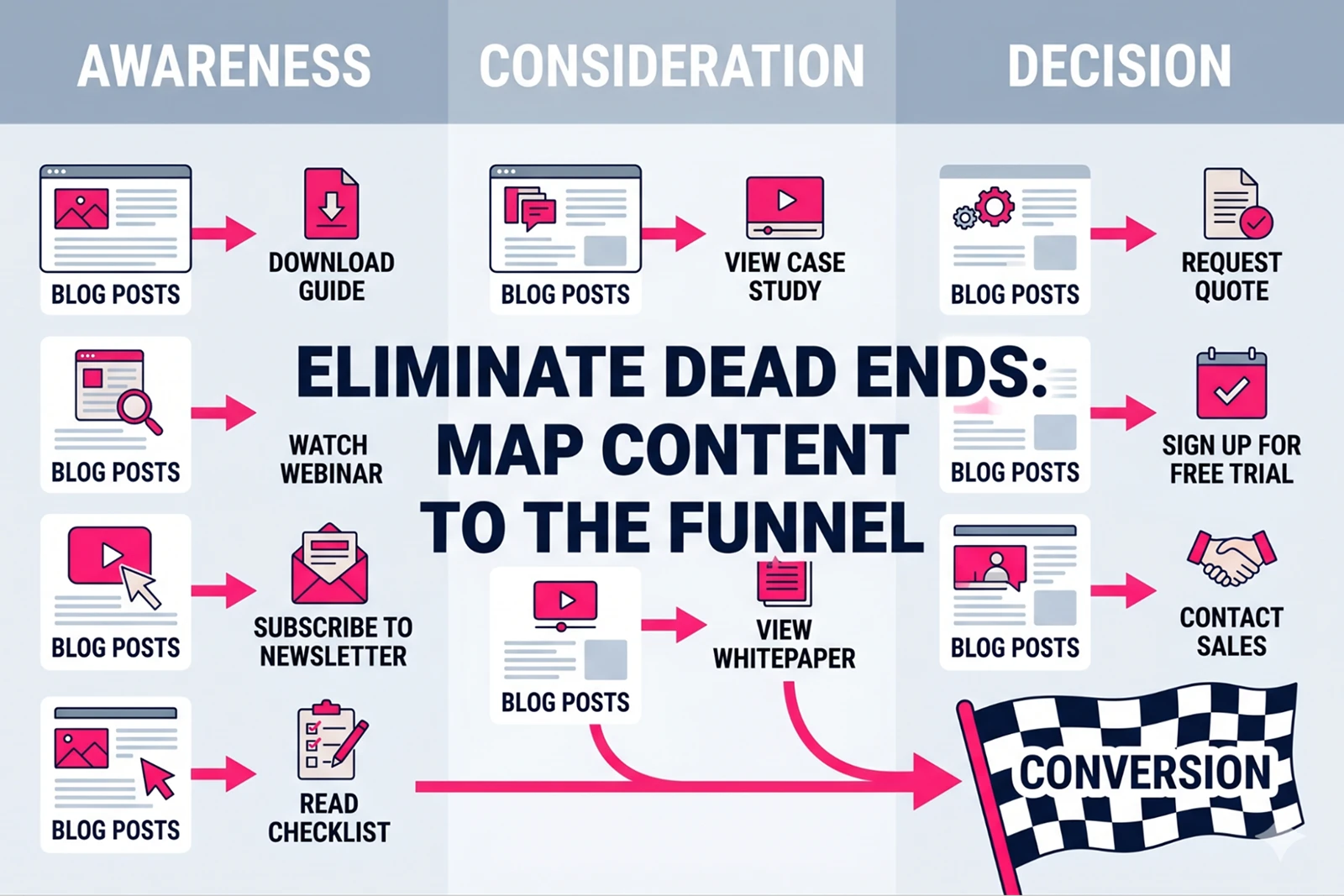
Image Source: Gemini 2026
What a real blog strategy looks like from the outside
A real blog content strategy starts with a clear answer to a question most brands have never formally asked: What is this content supposed to do?
Not "get traffic" or "improve SEO." Those are outcomes. The question is about function:
- Is this post meant to introduce a new audience to a problem they haven't named yet?
- Is it meant to move someone who already understands the problem toward a specific service?
- Is it designed to build authority around a keyword a competitor is targeting?
When every piece of content has a defined job, the blog becomes a system. Posts support each other and reinforce service pages by design. The content calendar reflects a deliberate distribution of topics across the funnel rather than a reactive content plan built around whatever seemed timely.
Most importantly, the whole operation is tied to overarching business objectives, not just content metrics. That alignment is what separates a blog that ranks from one that simply reports.
If your content team is underperforming, it’s not for lack of effort. It's because the strategy that would make their efforts count doesn't exist yet.
The true cost of waiting
There's a version of this conversation where you walk away thinking, "We'll get to it. We'll clean up the blog when things slow down.”
The problem is that every post you publish without a strategy is a post you'll have to reconcile later. Content debt accumulates, authority gaps widen, and the competitive distance grows. The brands investing in a coherent blog content strategy right now are compounding their advantage, while others are still planning to start.
But with search shifting, that gap is getting harder to close. Search results are no longer the only place for discovery. AI-driven tools are increasingly surfacing content directly in response to user queries. The brands getting cited are those with coherent, well-structured answer engine optimization (AEO) content built on a clear strategic foundation.
There’s no shortcut through that timeline, but there’s a faster way to start building it properly.
FAQs about blog content strategy
Key takeaways
Ready to turn your blog content calendar into something that works?
If some version of this is true for your brand right now: posts going out without clear intent, search rankings that aren't where they should be, and content that isn’t converting, that is exactly the gap our blog content strategy service is built to close.
We work with brands to build blog content strategies grounded in search intent, funnel architecture, and measurable business goals. Not a template, but a system built around your audience and your objectives.
That foundation also informs how we approach SEO and AEO, so that as search continues to shift, your content is positioned to earn visibility across both.
Not sure where to start? We’ll show you exactly where your brand stands and what it would take to close the gap.