


The death of search as we knew it is here. As AI-powered tools and social discovery redefine the digital marketplace, brands must look beyond traditional search engines. Discover how evolving consumer behavior requires proactive strategies to stay relevant today.
Search didn’t vanish; it simply moved upstream. AI systems, social feeds, and recommendation engines now surface answers before a query even exists, pushing discovery earlier in the journey and forcing brands to reimagine how they show up across the digital landscape.
The death of search as we once understood it doesn't mean we stop seeking information; rather, it signifies the conclusion of the "ten blue links" age.
The death of search as we knew it
Once upon a time, if you had a question, you’d Google it.
Now, TikTok, ChatGPT, or your smart speaker provides the answer before you even finish your thought. Traditional search meant typing keyword-based queries into search engines like Google, optimizing content for search algorithms, and hoping to rank in the top search results.
This model is fading fast as user expectations shift toward immediacy.
Today, nearly 80% of Google searches end without a click, a phenomenon known as zero-click behavior. Users increasingly find relevant content directly in snippets, AI summaries, or an answer engine, bypassing websites entirely.
This shift marks a transformation reshaping the digital marketing landscape. Users no longer want to hunt for information; they demand fast, direct answers delivered through AI-powered tools and generative AI that leverage machine learning and predictive analytics.
As consumer behavior evolves, so must marketers' strategies. The days of link building and optimizing for bots alone are over. AI technology anticipates user needs before they even know to ask, creating a new business landscape for small businesses and global brands alike.
It’s the death of search as we once knew it, and the future favors those who embrace this change rather than cling to outdated tactics.
Why is Google search dying?
The perceived "death" of Google search isn’t about a lack of users but about the utility of the old format.
Google searches are increasingly cluttered with ads and SEO-optimized fluff that fails to provide a deeper understanding of a topic. Consequently, people are increasingly turning to social media platforms and AI tools to find answers.
When users ask, "Are people moving away from Google search?" the answer is nuanced. People are moving away from the search engine interface, not from the act of searching. They’re shifting toward AI systems that can analyze vast amounts of data to provide actionable insights instantly.
To stay relevant, brands must offer meaningful information that these AI-powered systems can easily digest and recommend.
Rise of AI-powered discovery
You no longer need to search for content because artificial intelligence brings it directly to you. Platforms like ChatGPT, TikTok, and Instagram Reels are built to anticipate users' needs. AI-curated feeds present content based on user behavior and market trends, eliminating the need for a search box.
Google's AI Overviews (formerly Search Generative Experience, or SGE) further blurs the lines between searching and answering. It provides conversational responses without requiring users to scan a page of links. This is a growing trend that positions AI-powered discovery as the primary source of content discovery in the digital marketplace.
Visual search is another pillar of this evolution. Tools like Google Lens enable image-based searches, a powerful feature for Gen Z. Brands should optimize their product descriptions and imagery to ensure they are indexed by these AI systems.
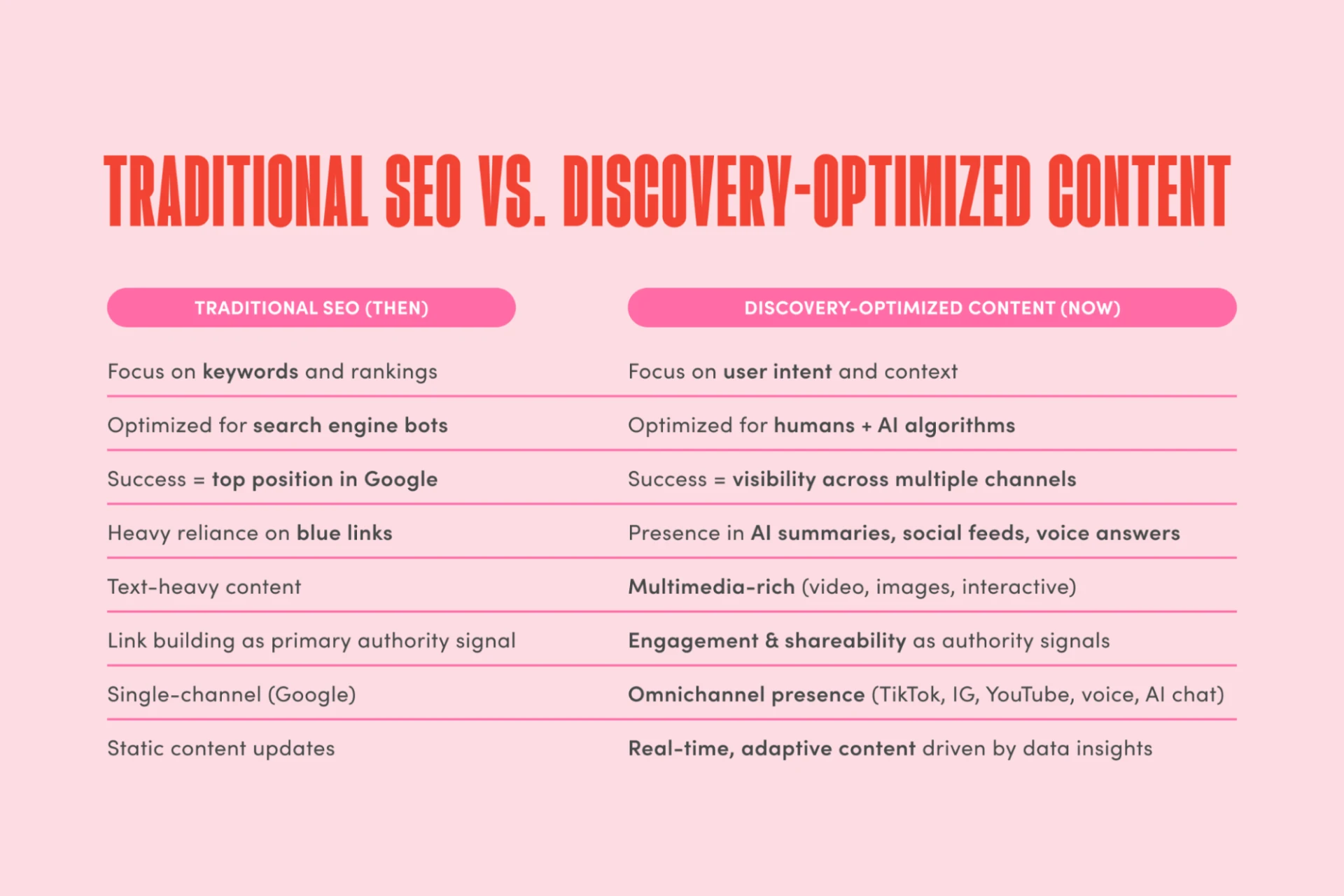
This is part of broader AI marketing trends that prioritize intent-driven content over simple keyword matching.
Discovery is proactive today.
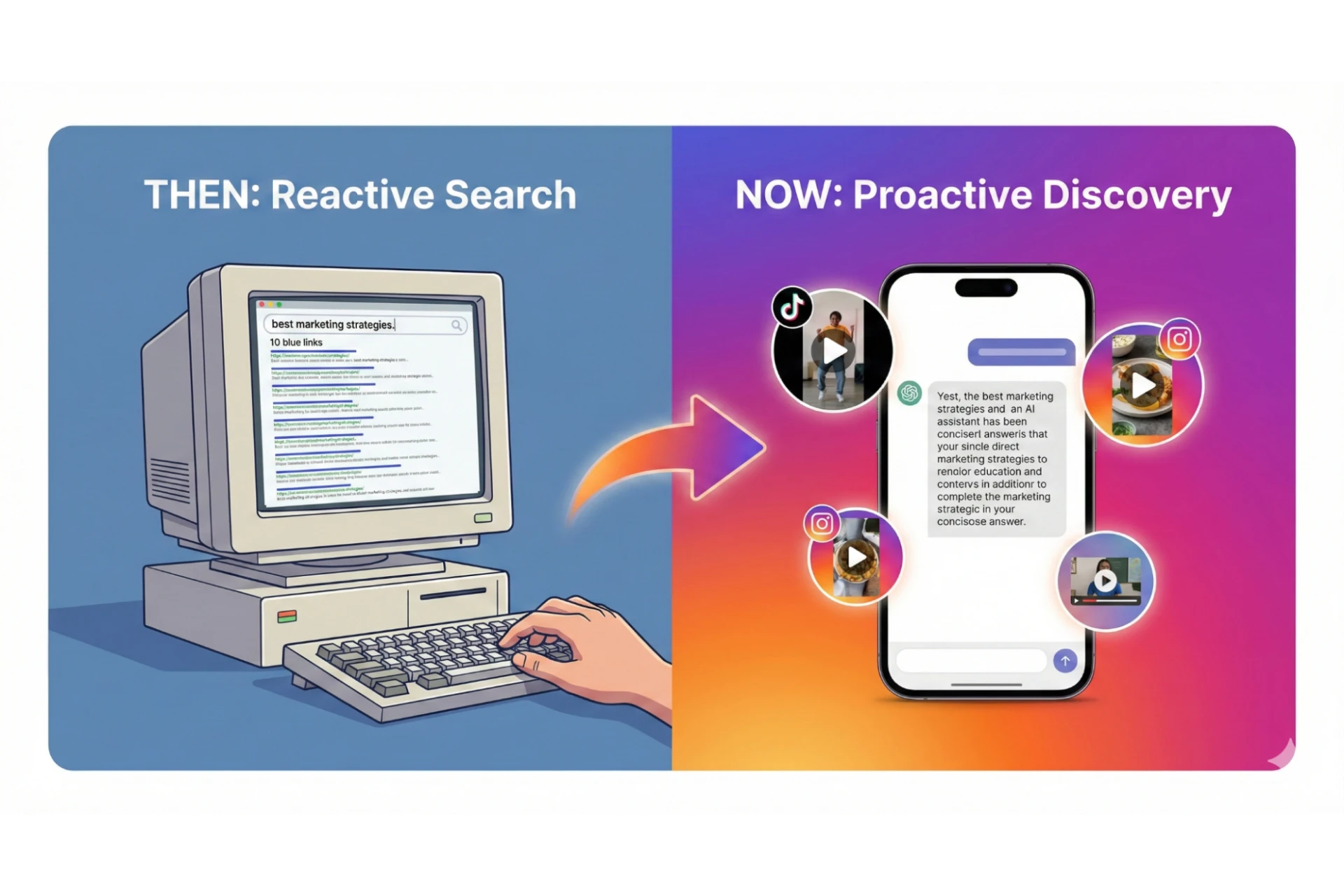
Image Source: AI-Generated
How do AI tools affect search and SEO?
Many marketers fear that SEO will be replaced by AI, but in reality, SEO is evolving. In 2026, AI continues to redefine how we categorize information. Is SEO possible with AI? Absolutely, but it requires a deeper approach.
What is AI doing for marketing?
It enables streamlined processes for content creation and data analysis. Marketers use AI-powered chatbots to handle customer experiences and customer feedback, while predictive analytics help them stay ahead of consumer preferences.
To remain competitive, your brand strategy must account for AI-generated content. While AI technology can produce vast amounts of text, the value remains in personal experiences and human-centric storytelling that AI systems can’t replicate.
This is how brands maintain a competitive advantage and a competitive edge.
Understanding the evolutionary consumer theory
To get through this change, we should take a look at how consumer behavior has changed over the years. The evolutionary consumer theory suggests that as our digital environment becomes more complex, our methods for gathering information become more efficient.
There are four primary types of consumer behavior to consider:
- Habitual Buying Behavior: Minimal involvement in the search process.
- Variety Seeking Behavior: High involvement but a desire for different personal experiences.
- Dissonance Reducing Buying Behavior: Seeking relevant information to justify a purchase.
- Complex Buying Behavior: Deep market research and comparison.
By understanding these stages, from initial awareness to the purchase history, brands can use AI-powered tools to target users with relevant content at the exact moment of need.
This fosters brand loyalty and drives long-term revenue growth.
Multichannel discovery is the new norm
Modern customer journeys span Google, Meta properties, newsletters, and virtual assistants. Optimizing for a single engine misses how people actually discover and decide. The mandate has shifted from search engine optimization to discovery optimization.
TikTok functions as a discovery engine and a creative sandbox. Meta turns interest signals into customer engagement. Even social media posts now act as a form of content marketing that feeds into the broader search ecosystem.
To future-proof your digital landscape presence, you must be visible where the conversations are happening.
Image source: Pexels
What this means for brand strategy
AI is revolutionizing how brands create and optimize content. While SEO does have a future, it must be data-driven and customer experience-focused.
To stay ahead, marketers should:
- Use data analysis to identify emerging trends early.
- Adopt AI-powered chatbots to provide instant, relevant information.
- Focus on content creation that provides actionable insights.
- Adjust their brand strategy to prioritize customer engagement.
The future of artificial intelligence in marketing
What’s the new AI trend in marketing? It’s the move toward hyper-personalization through AI-powered analytics.
What is the market trend in the AI industry? We’re seeing a shift where AI can identify market trends before they peak, allowing businesses to make informed decisions with key insights.
How is AI changing SEO in 2026? It’s making the digital marketplace more competitive. Brands that rely on vast amounts of low-quality AI-generated content will fall behind those who use AI tools to enhance their original brand strategy. The goal is to create a rabbit hole of value that keeps users engaged across all other platforms.
Search isn’t dead, it’s just everywhere
The future belongs to brands that anticipate needs, show up with substance, and make the next step obvious. Search still matters, but it lives across chat, feeds, inboxes, and engines at once. Discovery‑first strategies, anchored in loyalty, depth, and problem-solution clarity, will outperform other tactics.
This is why content has become such an important driver of discovery, Brown says.
“Some of my most effective results have come from organic/authentic TikTok posts that reach people as they're scrolling. The future of marketing isn’t about optimizing for search; it’s about optimizing for discovery. When brands combine real storytelling with smarter technology, they can be present before the customer even knows they’re looking. That's the key.”
We haven’t lost search, we’ve expanded it
Today’s discovery ecosystem is driven by AI technology, machine learning, and dynamic new formats. While the death of search is a popular headline, the truth is that we’ve simply entered a more sophisticated era of content discovery.
An August 2025 survey by The Influence Agency shows that Google is still the go-to resource for people in the ‘Learning More’ stage, with 55.7% turning to search first. Visiting a brand’s website comes next at 38.4%. It’s a clear reminder that even though discovery often begins on social media or through AI-powered tools, traditional search engines remain essential for helping people take the next step and make a decision.
The future favors discovery-first strategies that adapt to consumer behavior and user expectations. Search is still a powerful tool, but now it lives everywhere.

Image Source: AI-Generated
Successful marketers will adjust their brand strategy to create content that connects through market research and human key insights.
What can you do to stay ahead?
Here are the actionable insights marketers can take today:
- Optimize for platform-native search: Ensure your TikTok and Instagram content is searchable.
- Prepare for AI summarization: Use structured data and context-rich copy to help AI systems understand your value.
- Use predictive analytics: Anticipate user needs based on purchase history and consumer behavior.
- Embrace the omnichannel: Treat search as an ecosystem that includes social media posts, AI-powered chat, and traditional search.
FAQs about AI and the future of SEO
Key takeaways
By focusing on relevant content and leveraging AI-powered tools, your brand can thrive in the digital landscape of 2026 and beyond.
Want to ensure your brand remains visible as the search landscape shifts? At The Influence Agency, we excel at building SEO and paid media strategies that deliver maximum impact and results in the AI era. Let’s future-proof your digital presence together.