
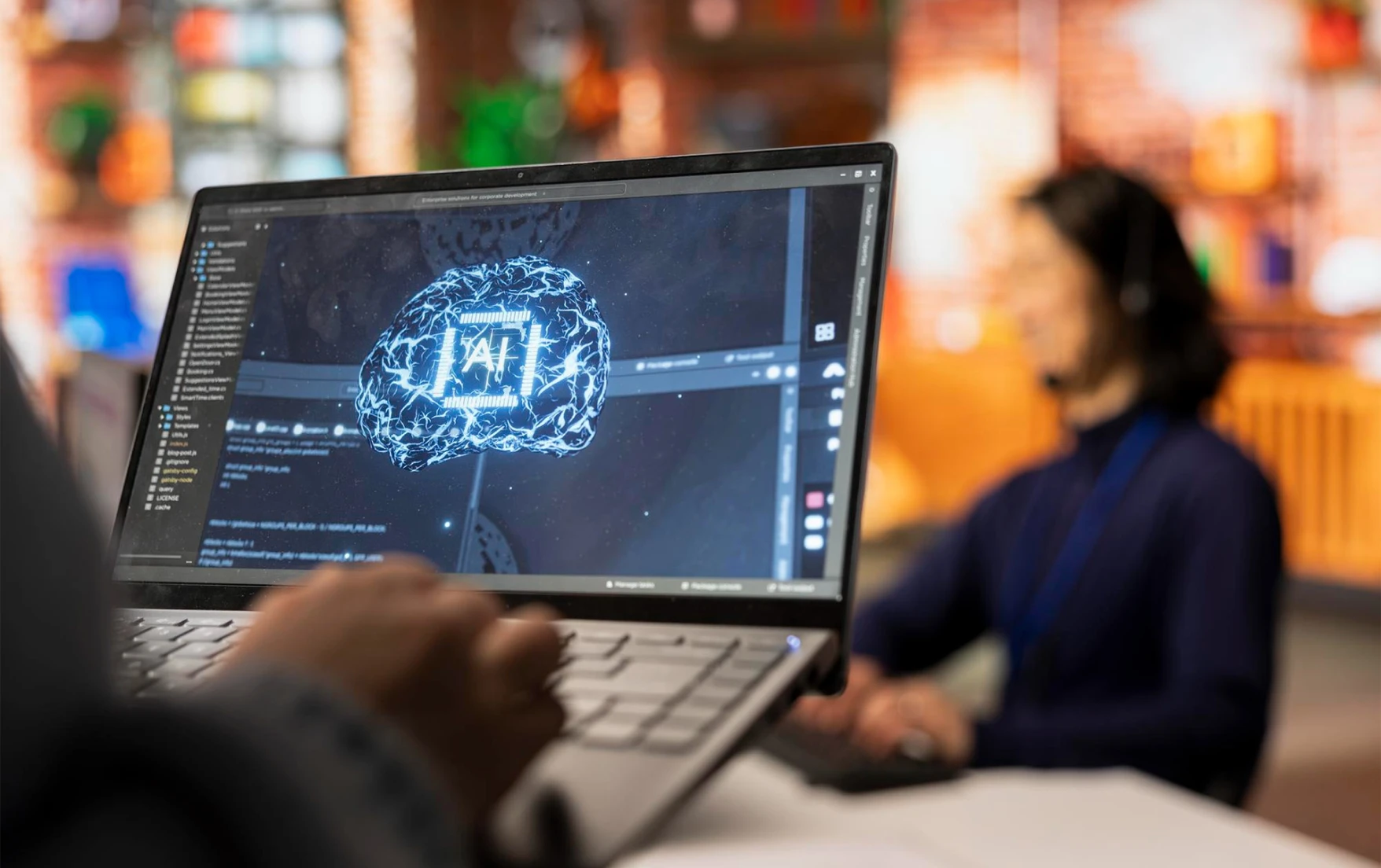

Explore the evolution of marketing from print to AI disruption. Today, AI and generative AI are reshaping marketing strategies by automating routine tasks. Discover how marketing leaders use AI systems to analyze consumer data and gain a competitive advantage.
The golden age of print: Dominance before television
From the late 1800s through the early 1900s, newspapers and magazines ruled the advertising world. Print media relied on visual storytelling and persuasive copy to reach mass audiences. For decades, it shaped how products were discovered and purchased.
Print was slow and tangible. It consisted of ads you could hold in your hands. By the mid-20th century, radio and television began pulling attention away.
Television revolution: The rise of moving ads
By the end of the 1950s, television had entered most households. This ushered in a golden era of broadcast advertising. Television combined sight and sound to create shared cultural moments. Celebrity endorsements and product placements became essential tools for capturing attention.
For the first time, brands could tell emotional stories to millions at once. But just as TV cemented its power, another disruptor was waiting in the wings.
Search engines and the digital era emergence
In the late 1990s and early 2000s, the internet transformed how consumers found information. Search engines like Google made it possible for people to actively seek solutions. Search engine optimization and pay-per-click ads allowed for precise, intent-based targeting.
Many marketers now have data to measure every click. Content marketing became a cornerstone of trust-building. The audience was no longer just watching. They were searching and using data analysis to make decisions.
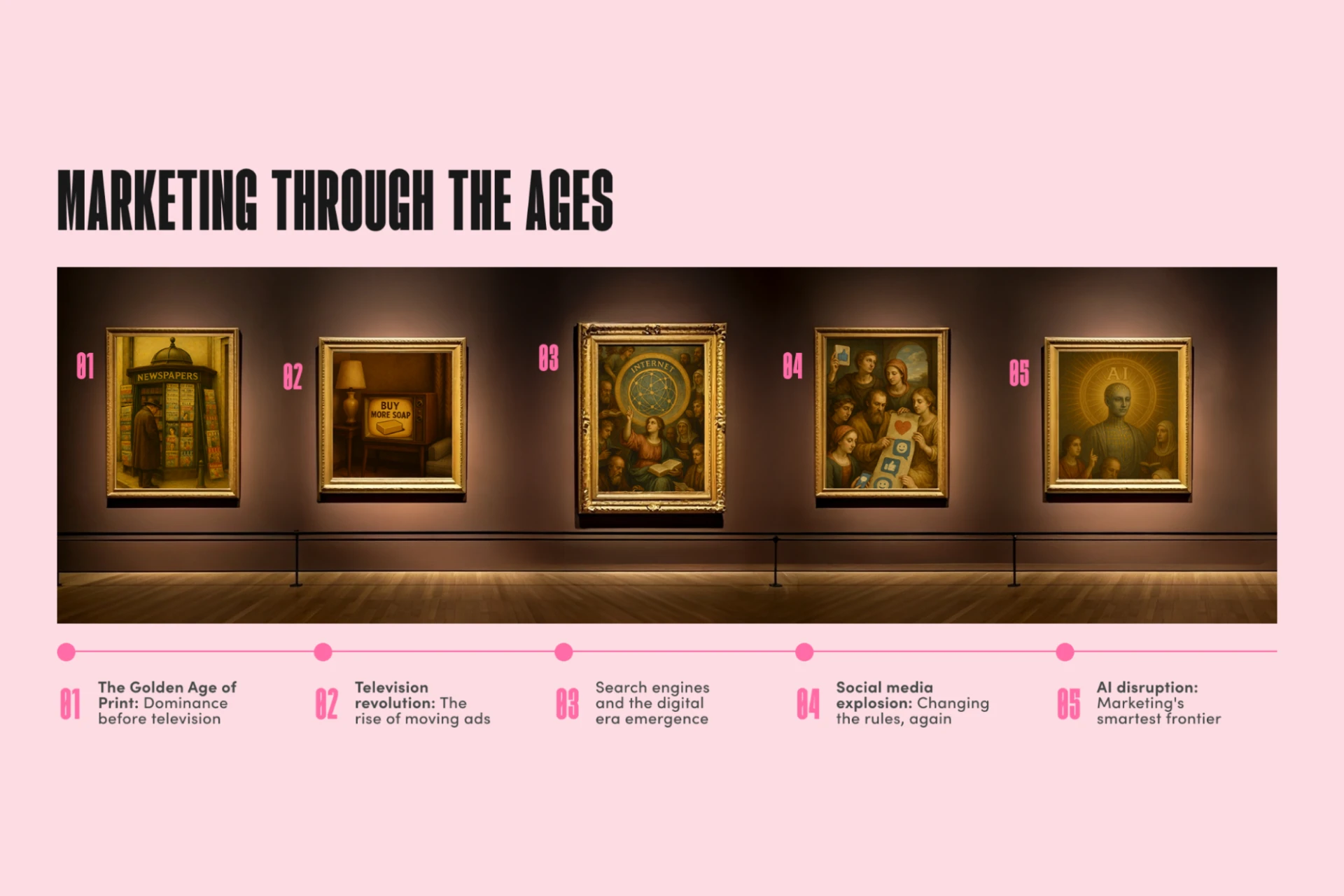
Social media explosion: Changing the rules, again
By the 2010s, social media platforms like Instagram and Facebook reshaped digital marketing. Algorithms decided what content audiences saw, real-time interaction became possible, and user-generated content blurred the lines between brands and communities.
As consumers moved from newspapers to TikTok, brands had to master evolving marketing channels to maintain visibility.
Influencer marketing exploded during this time. This allowed brands to connect with authentic ambassadors who align with their target audience. Marketing became bite-sized and shareable. As social feeds grew crowded, a new AI technology emerged. This technology wouldn’t just change how we communicate, but how we create.
AI disruption: Marketing's smartest frontier
Today, artificial intelligence in marketing is redefining the industry's rules. Generative AI creates high-quality copy, images, and videos in seconds. AI chatbots deliver instant customer support and improve the customer experience. Predictive analytics anticipate needs before the customer even expresses them.
AI adoption has made one-to-one personalized content a reality. This shifts marketing strategies from reactive to proactive. Instead of waiting for audiences to search, brands can meet them at the exact moment of need. This involves integrating AI into every part of the marketing campaign.
Keeping up with current AI marketing trends is essential for any brand that wants to stay relevant in a crowded digital space.
Understanding the 30% rule for AI tools
A key concept for marketing leaders today is the 30% rule in AI.
This rule suggests that artificial intelligence can currently automate roughly 30% of the tasks in most occupations. In marketing, this often applies to routine, repetitive, and administrative tasks.
By incorporating AI to handle these entry-level tasks, human workers can focus on higher-value tasks. This includes strategic planning and deep brand strategy. The goal of AI integration is not to replace the human element but to provide a competitive advantage by increasing efficiency.
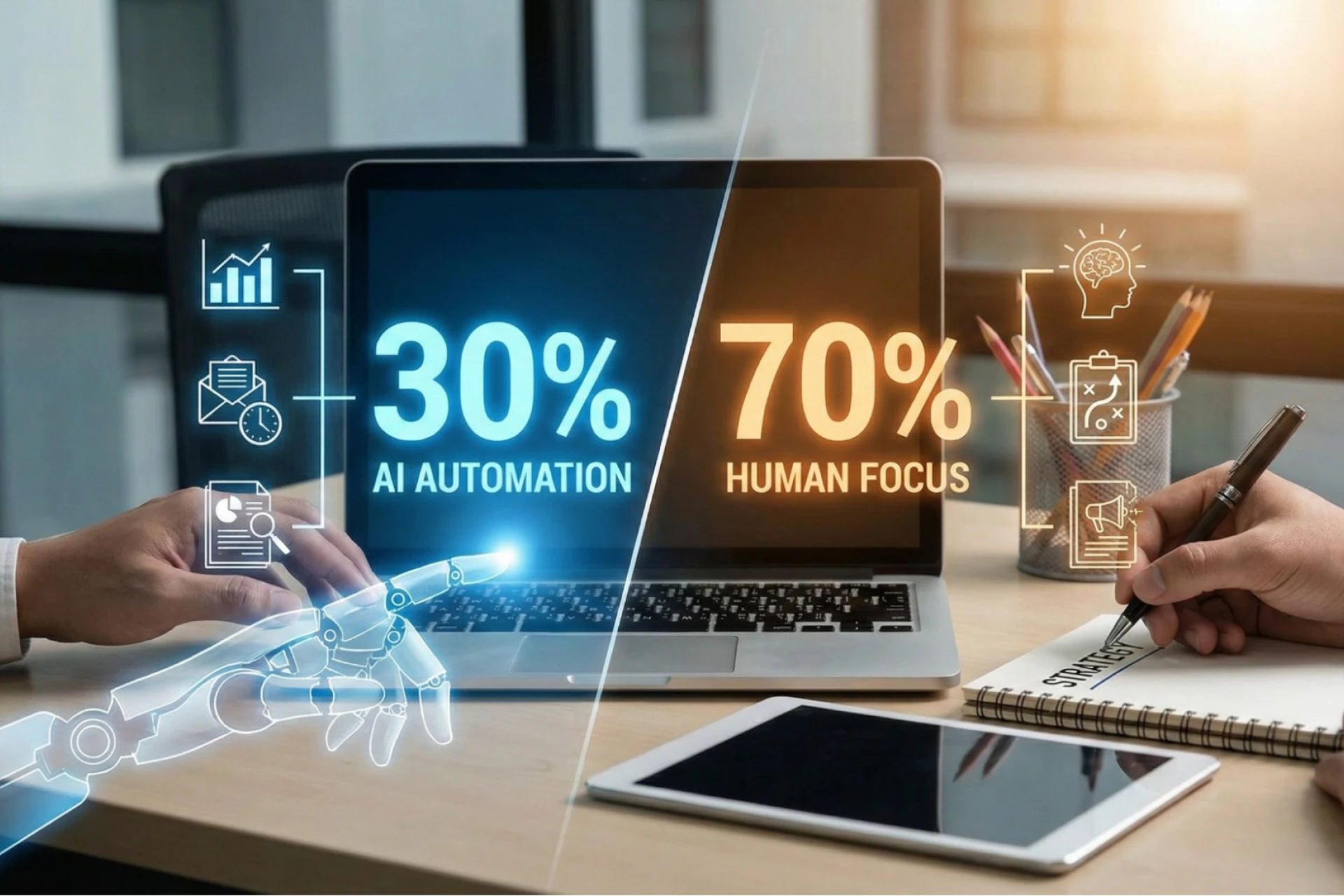
Image Source: AI-generated
Learning from the 5 biggest fails in AI adoption
Even with cutting-edge AI tools, things can go wrong. Understanding these failures is vital for AI adoption.
- The Willy Wonka Experience: A viral event used generative AI to create deceptive images that didn’t match the actual warehouse setting.
- Air Canada’s Chatbot: An AI chatbot gave a customer incorrect information about bereavement fees, leading to a legal dispute.
- Google Gemini: The AI systems generated historically inaccurate images, showing the risks of machine learning bias.
- DPD’s Cursing Bot: After a system update, a customer support bot began swearing at a user.
- Microsoft’s Travel Guide: An automated tool recommended a food bank as a top tourist attraction, proving that AI capabilities still require human oversight.
These examples highlight why ethical considerations and data privacy are essential when using AI.
Which industry is most disrupted by AI integration?
While almost every sector has felt the impact, the content creation and social media industries have experienced the most significant AI disruption. Generative AI can now produce social media posts and email marketing copy at a scale previously impossible.
Other sectors, like e-commerce, use predictive analytics to track purchase patterns and customer behavior.
However, industries involving high-stakes patient care or physical labor are less likely to be fully disrupted in the near term.
FAQs About Artificial Intelligence
Key takeaways
The future of business operations
From print’s permanence to the predictive power of AI systems, every disruption forces marketers to adapt. The winners have always been the early adopters, the people who reimagine their marketing strategies for the next medium.
"OpenAI CEO Sam Altman has said AI will one day do 95% of what marketers currently rely on agencies for. I don’t buy it," says Emily Baillie, Marketing & AI Strategist at Compass Content. "Audiences still crave authenticity and human connection. These are things no algorithm can fully replicate."
The future-proof marketer is one who understands AI technology while maintaining a human touch. It comes down to how fast you can learn. You must apply cutting-edge AI tools responsibly. AI may be today’s disruptor, but it’s also tomorrow’s baseline.
The real question isn’t if it will change your marketing, but how fast you’ll adapt when it does.
If you’re looking for a partner to help navigate these changes and build a resilient strategy, explore our suite of AI marketing services today.