


Modern marketing strategies require a shift from static demographics to dynamic behavioral signals. TIA Persona 3.0 uses generational marketing strategies to reach your target audience. Discover how incorporating AI audience segmentation and insights into your campaigns drive measurable success and growth.
For decades, marketers built personas around demographics like age, gender, income, and education. But in today’s hyper-personalized media ecosystem, demographics don’t always dictate behaviors. Two people in the same age group can have completely different discovery habits, content preferences, and purchasing behaviors.
In an AI-curated feed, format and timing are just as important as the message itself. A campaign’s success is now shaped by when and where a target audience encounters it, not just what it says.
This shift changes how generational marketing strategies should be designed.
What is generational marketing?
Generational marketing is the practice of tailoring marketing strategies to the specific preferences, values, and behaviors of different age groups. Each generational cohort is defined by the era in which they grew up, which shapes their worldview and their relationship with technology.
By incorporating generational marketing insights into a campaign, brands can speak more directly to the unique needs of their target market.
Why is generational marketing important?
This approach is vital because it allows for a more nuanced understanding of consumer behavior. It helps brands identify patterns in how different generations interact with traditional and digital media. Without these generational insights, a brand risks adopting a one-size-fits-all approach that may fail to resonate with diverse generations or specific target audiences.
The purpose of labeling generations is to help marketers categorize large groups of people based on shared historical experiences and life stages. These generational labels provide a starting point for understanding how different generations may react to certain marketing efforts.
What are the 5 generations of marketing?
To build a robust social media strategy or an effective marketing campaign, you must first understand the five main generations currently dominating the market.
1. The silent generation
Born before 1945, the silent generation typically values tradition and stability.
They often prefer brands that provide clear information and reliable service. While they’re not digital natives, many have adapted to mobile devices for staying in touch with family.
2. Baby boomers
The baby boomers, born between 1946 and 1964, remain a powerful economic force.
Baby boomers expect personalized customer service and often prefer brands that communicate through trusted traditional media, such as print media or direct mail. When baby boomers interact with digital marketing, they appreciate skimmable headlines and informative content.
3. Gen X
Generation X, or Gen X, was born between 1965 and 1980. Often called the bridge generation, Gen Xers are tech-savvy and comfortable using both traditional and digital media.
Gen Xers often bridge the gap by researching on Google while also engaging with community-driven content on platforms like Meta.
4. Millennials
Millennials, born between 1981 and 1996, were the first to grow up with the internet.
Social media millennials are digital pioneers who value brand values and social responsibility. They often use mobile phones to research products and are highly influenced by peer recommendations.
5. Gen Z
Generation Z, or Gen Z, is the first generation of true digital natives.
Born after 1997, Gen Z is the most diverse generation in history. Gen Z discovers products through social media marketing, user-generated content, and visual social platforms like TikTok or Instagram.
Why personas need a reboot
Discovery has shifted from search-first to algorithm-first. Social platforms, AI recommendations, and influencer marketing greatly influence what content people see before they even think to look for it. This shift is a key building block in the development of Persona 3.0.
How do generational demographics impact marketing today? They still matter, but they’re expressed through behavior rather than just labels. For example, younger generations may prioritize video marketing while older groups prefer long-form articles.
Priyanka Tiwari Pathak, a thought leader in AI and marketing, says that moving beyond demographics fundamentally transforms audience segmentation from static groupings to dynamic, action-based understanding.
What are the four main marketing strategies?
When building a campaign, marketers typically rely on four main marketing strategies:
- Product strategy: What you are selling and what problem it solves.
- Price strategy: How much it costs and how that reflects the brand values.
- Place strategy: Where the target market can find the product, such as on social media networks or in physical stores.
- Promotion strategy: The specific marketing campaigns and digital advertising used to reach the audience.
Enter: TIA persona 3.0
TIA Persona 3.0 is a generational marketing strategy framework built for the AI age. Instead of treating personas as static snapshots, it uses AI audience segmentation to create a living, evolving map of how different generations behave online and offline.
It focuses on three key pillars:
1. Behavioral signals
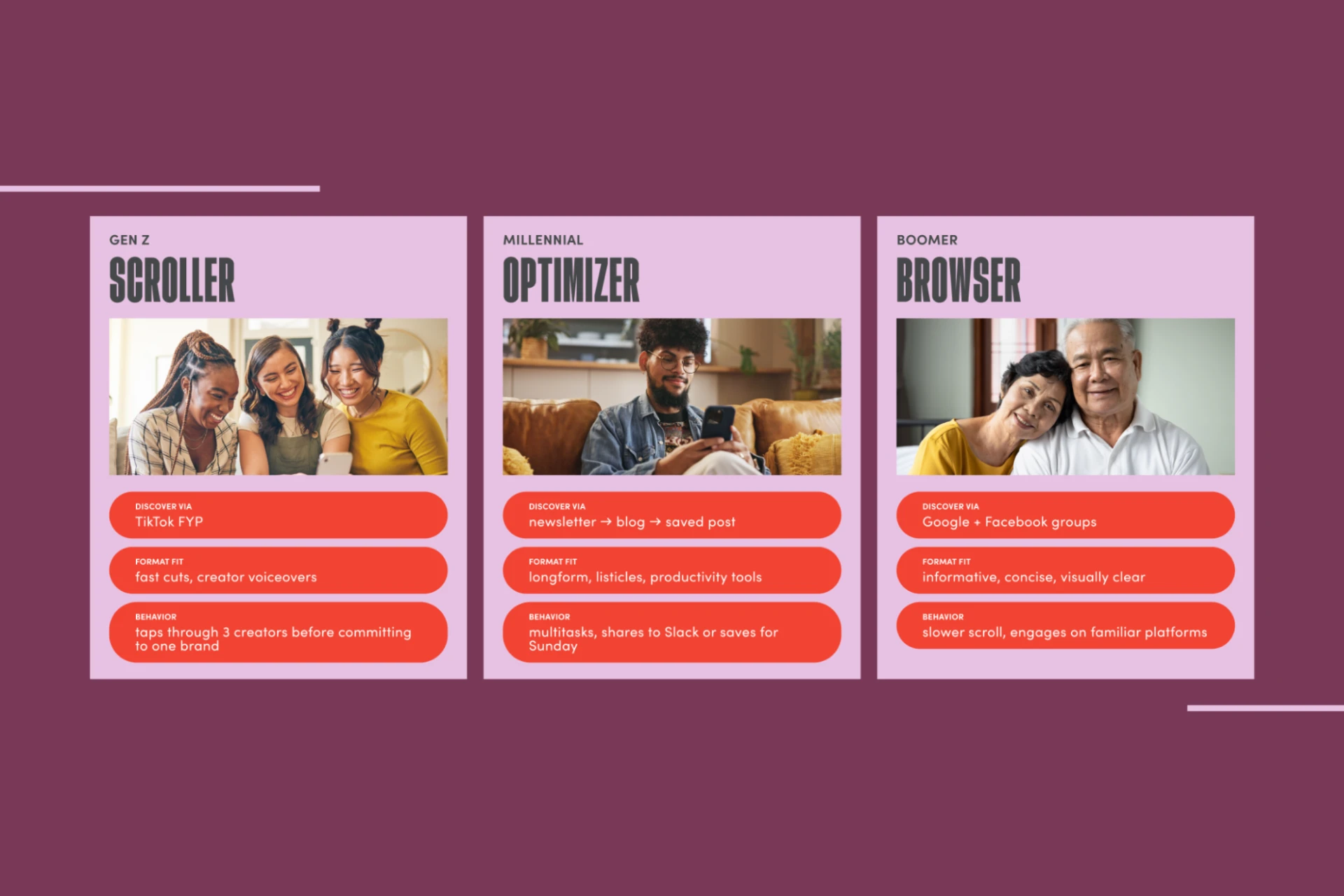
Persona 3.0 begins by tracking how people interact with content, not just what they say they like. This includes scroll patterns, platform purpose, and device habits. These signals offer actionable insights marketers can use to tailor campaigns, from influencer marketing to digital advertising.
One thing all generations share is using AI, such as ChatGPT, to help them make customer decisions. In an August 2025 survey conducted by The Influence Agency, we found that across all generations, 81% of respondents used AI to summarize options and request product recommendations.
This is a perfect example of AI segmentation in action, where the tool groups users by their intent rather than their age group.
2. Discovery habits
Generational differences become especially clear in how people find content. Persona 3.0 looks beyond basic demographics to identify influence flows, such as social discovery versus search intent.
Younger generations often discover brands through social platforms and creator-led content, while older cohorts still lean on direct search.

Image source: Freepik
3. Content format fit
Even the perfect message can fail if it’s delivered in the wrong format. Persona 3.0 evaluates short versus long-form content, static versus interactive elements, and silent scrolls versus sound-on preferences.
Matching these to the attention spans of different age demographics is crucial for social media posts, video marketing, and mobile devices.
The three key pillars of persona 3.0
The transition to Persona 3.0 shifts the focus from static demographic snapshots to a dynamic, behavior-first framework. This strategic approach ensures that every campaign is both creative and results-oriented.
What are the 4 types of customer segmentation?
To implement Persona 3.0 effectively, you must understand the four types of customer segmentation:
- Demographic: Age, gender, and income.
- Psychographic: Values, interests, and lifestyle.
- Behavioral: Purchasing behaviors and past interactions.
- Geographic: Where the customer lives.
Some experts also include a fifth type: firmographic segmentation for B2B businesses, or benefit-based segmentation, which focuses on the specific advantage a customer seeks.
What is an example of multigenerational marketing?
An example of multigenerational marketing would be a brand like Apple or Nike. They create marketing efforts that resonate across multiple generations by focusing on universal themes such as innovation and athletic achievement. However, they use different social platforms and influencer marketing tactics to reach each specific generational cohort.
For Gen Z, they might use fast-paced social media posts featuring user-generated content. For baby boomers, they might focus on customer feedback and responsive customer service to build brand loyalty.
FAQs about generational marketing campaigns
Key takeaways
Elevate your brand with a data-driven strategy
By mapping these factors, Persona 3.0 allows marketers to incorporate generational insights into campaigns that work across diverse age groups, while still delivering the personalized, authentic brand messaging audiences expect.
Behavior-first insights allow for real-time personalization, ensuring that each marketing campaign drives customer loyalty and purchasing decisions.
Ready to move beyond traditional demographics and unlock the power of behavioral personas? Reach out to our team today to discover how we can tailor a generational marketing strategy that puts your brand at the center of the conversation.