



Building an optimized AI tech stack is essential for a modern marketing strategy. This guide explores how a unified marketing technology stack meets generational needs, driving digital marketing success through better data, content, and personalization for your entire marketing team.
Your marketing strategy is only as strong as the technology driving it. AI is currently reshaping the tools in your marketing technology stack and the way we deploy them, making personalization, targeting, and optimization feel native to each audience.
This piece isn’t a simple catalogue of platforms. It’s a strategic map of the AI tech stack, showing how each layer, from data to content to distribution, works together to meet generational behaviors where they are.
This approach moves audiences from discovery to decision through a holistic marketing technology lens where CRM meets content AI and data analytics.
Why you need an AI stack now
Modern marketing is no longer a simple funnel. Marketing campaigns don’t move audiences in straight lines from awareness to purchase. Instead, customer journeys loop, pause, and change direction in real time.
Customers discover brands on social media, compare reviews on search engines, and switch between devices before converting. An AI tech stack is the connective tissue that allows marketing and sales teams to adapt to this non-linear reality.
Generational behavior makes the challenge more complex because:
- Gen Alpha gravitates toward interactive, play-driven experiences where storytelling feels like participation.
- Gen Z expects hyper-personalization, lo-fi formats, and instant recognition of cultural context.
- Millennials demand digital convenience and clear demonstrations of value.
- Gen X values research-driven clarity and detailed resources.
- Boomers prioritize consistency, transparency, and communication that feels accessible.
AI-powered personalization ensures each audience feels understood without forcing one-size-fits-all campaigns. Brands risk providing outdated experiences without a modern martech stack for segmentation. Marketing automation platforms, a content management system, and analytics tools must work together to drive marketing performance and create continuous improvement loops.
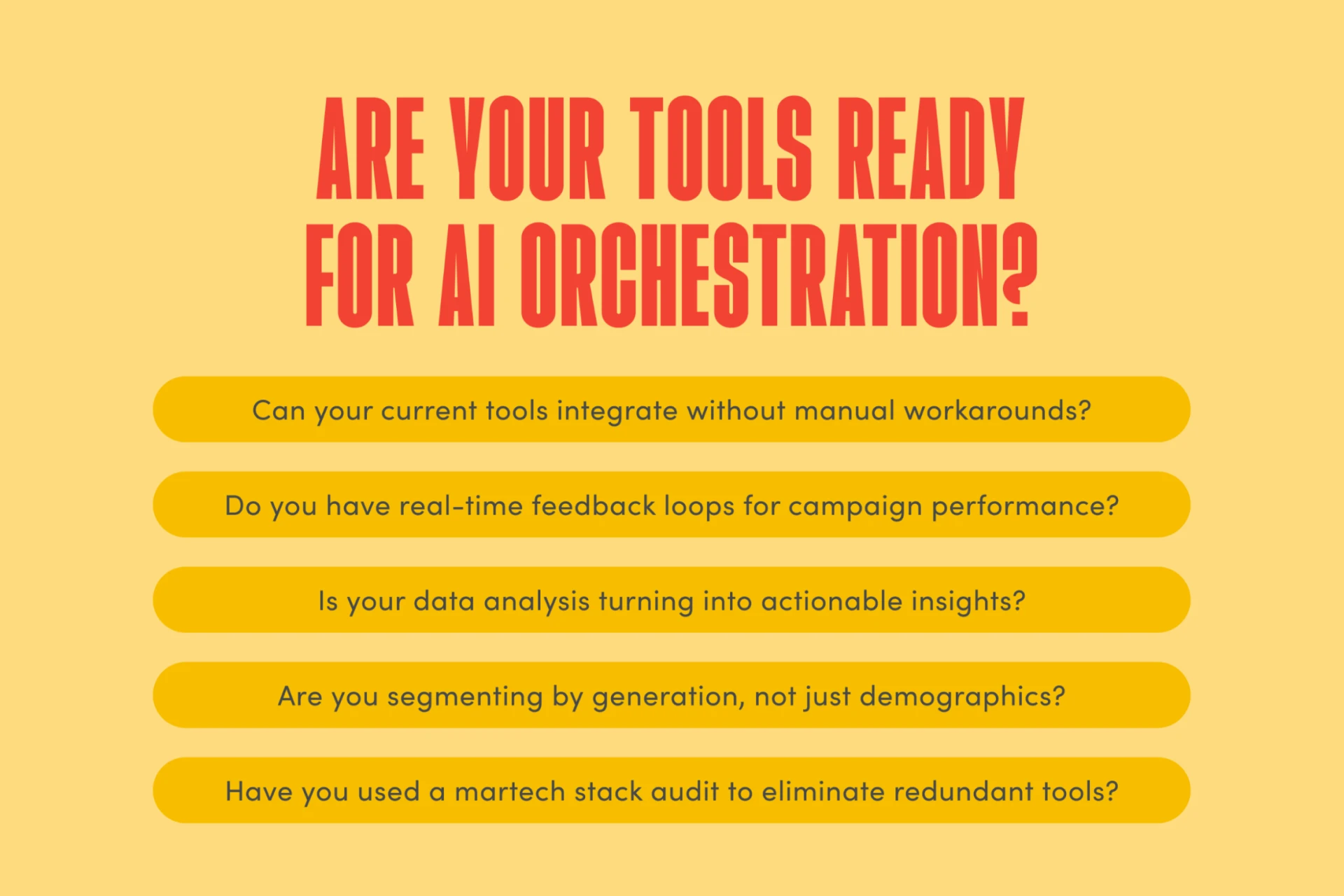
Many organizations overspend on redundant tools that don’t integrate or provide actionable insights. True marketing technology stack optimization requires an audit process that eliminates inefficiencies and ensures seamless integration across customer relationship management, data analysis, and campaign performance.
When your marketing technology stack is optimized, marketing operations shift from manual guesswork to orchestrated precision. Campaigns become faster, more adaptive, and far more aligned with customer expectations, which is what today’s business strategy demands.
The modern AI tech stack (in 5 layers)
A marketing technology stack is an interconnected system that enhances the customer experience. The days of piecing together disconnected platforms are over. To achieve marketing success today, organizations need a martech stack that functions as a unified ecosystem.
Think of it in layers, where each layer builds on the one before it:
- Audience intelligence provides the raw insight.
- Content generation translates those insights into creative assets.
- Asset management ensures campaigns can scale without losing consistency.
- Distribution engines deliver the right message to the right audience at the right time.
- Measurement and feedback loops close the cycle, turning campaign performance into actionable insights.
This layered approach ensures that marketing and sales teams can create content, launch campaigns, and optimize strategies with precision. It also supports martech stack optimization by eliminating redundant tools and creating seamless integration across marketing automation platforms, a project management tool, and customer relationship management systems.
When these layers work together, the martech stack becomes more than technology: it becomes a business growth engine that empowers the marketing team to move faster, personalize smarter, and build stronger customer relationships across generations.
1. Audience intelligence
Audience intelligence is the foundation of the modern martech stack. It gathers behavioral data, psychographics, and sentiment analysis to help brands understand what different generations value.
Personalized marketing with AI starts here. Understanding that Gen Z prefers lo-fi video while Gen X values long-form research helps tailor content marketing effectively. Without this layer, campaigns risk being irrelevant.
- Gen Alpha: Discovery happens in ecosystems like YouTube Kids or Roblox.
- Gen Z: Discovery is social-first on TikTok and Instagram.
- Millennials: Often research user-generated content before purchasing.
- Gen X: Looks for case studies and expert reviews.
- Boomers: Prefer jargon-free communication and proven reliability.
Example martech tools include SparkToro and Audiense. These platforms provide the marketing team with real-time insights by centralizing customer data collection.
2. Content generation & planning
This layer includes the AI-powered platforms that create copy, visuals, and video. From ChatGPT for text to Midjourney for design, AI has become the creative partner for marketing and sales teams.
Generational content expectations vary dramatically. Gen Z expects fast-turnaround video memes, while Millennials look for clear visual explainers. The ability to scale content formats quickly is what gives businesses a competitive edge.
Example tools: ChatGPT, Jasper, and Notion AI. These tools streamline content marketing and help achieve marketing goals efficiently.
3. Asset management & collaboration
Managing, storing, and versioning creative assets is vital for marketing operations. This layer ensures the marketing team can access, edit, and adapt assets quickly.
Gen Z culture shifts overnight, meaning your team must adapt fast. Meanwhile, Boomers and Gen X expect stability in design, which requires strong version control.
Use a project management tool like Airtable, Figma, or Canva to maintain this balance. This supports the martech stack effectively by ensuring everyone is on the same page.
4. Distribution & personalization engines
Distribution is about timing and fit. Generational behaviors determine which channels matter most. Marketing technology ensures each message lands at the right time in the right format.
- Gen Alpha: Use recommendation engines for interactive content in parent-approved environments.
- Gen Z: Prefers organic recommendations within TikTok and YouTube Shorts.
- Millennials: Respond well to mobile apps and retargeted ads. Partners like The Influence Agency help brands show up credibly through trusted creators.
- Gen X: Relies heavily on email and LinkedIn.
- Boomers: Prefer email newsletters and consistent communication patterns.
Example tools: HubSpot, Sprout Social, and AI-enhanced digital marketing plugins. These tools optimize marketing campaigns for specific audience habits.
5. Measurement, tuning & feedback loops
Analytics tools and AI overlays measure performance and feed back insights into the system. Continuous improvement is the goal of any optimized martech stack.
Predictive analytics helps marketers foresee audience changes, while A/B testing optimizes resource allocation. For custom reporting, data can be exported to Google Sheets to provide actionable insights for the next campaign cycle.
Example tools: Google Analytics and Segment. These martech tools transform raw data into business growth.

Image source: Freepik
How to build an audience-first stack
Martech stack optimization begins with understanding the audience, not just buying software. AI-driven, personalized marketing aligns your current marketing technology tools with your target audience's needs.
Steps to build audience-first stacks:
- Audit current tools: Use a comprehensive audit to identify gaps and ensure data security.
- Evaluate the procurement process: Ensure that any marketing technology investments align with organizational objectives.
- Ensure seamless integration: Disconnected tools slow down marketing efforts and create friction.
- Train your team: Prompts and automation are essential skills for the modern marketing team.
Considering generational behaviors in a martech stack audit leads to cost savings, better customer retention, and increased revenue growth.
Generational marketing comparison chart
Operational takeaway for asset management
When managing your tech stack, remember that younger generations (Alpha and Z) require novelty and speed in their digital experiences.
Conversely, older generations (Millennials, Gen X, and Boomers) prioritize consistency and reliability in messaging.
An optimized martech stack must be flexible enough to deliver both speed for some and stability for others without creating redundant tools.
FAQs about an AI tech stack
Key takeaways
The stack is the strategy
AI enhances marketing intuition rather than replacing it.
The smartest marketing and sales teams will align their martech stack with how each generation discovers and connects with brands.
Your marketing stack should efficiently power marketing activities, whether for TikTok memes or LinkedIn white papers. Martech solutions offer insights, reduce redundant tools, and support long-term business growth.
The AI marketing tech stack is no longer a background system. It is the strategy. Our strategic approach leverages a vast network of over 2.5 million influencers to craft authentic campaigns that resonate with your target demographics.
Reach out to see how our full-service team can drive measurable growth for your business.