


In 2026, the best AI tools for content research and fact-checking are Perplexity AI for sourced research, Google Gemini for real-time verification, and Originality.ai for final quality control before publishing. Used together, they catch sourcing gaps, unverified claims, and AI-generated errors.
AI chatbots and research tools make content creation faster. It also makes it easier to publish something untrue.
According to The Work AI Index 2026, workers spend 6.4 hours a week just managing AI output: checking facts, fixing errors, and rerunning prompts. That accounts for more time than actual AI-assisted production.
Good thing research tools are built specifically for this. Here are the top three fact-checking tools our teams at The Influence Agency rely on for content research and verification, plus a repeatable research-to-publish workflow to keep your content credible at every stage.
Perplexity AI
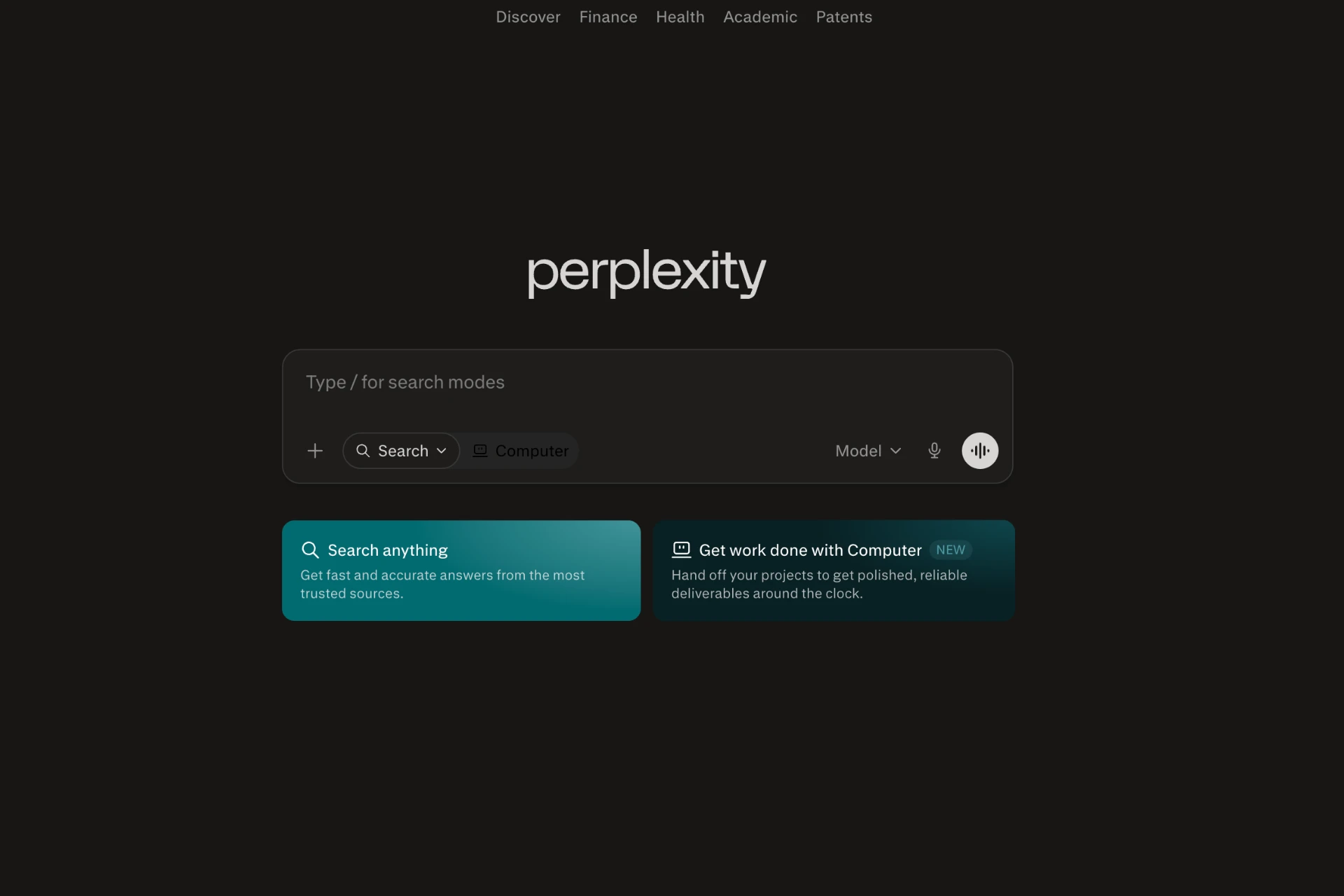
Image Source: Perplexity.ai
→ Best AI tool for deep content research
Perplexity AI is a research-first search engine that provides live, cited sources rather than relying solely on training data. It’s one of the best fact-checking tools because you can easily verify information independently and dive deeper if needed.
Key features:
- Live web search and cited answers. Answers include numbered links to reliable sources (news outlets, journals, official sites, blogs).
- Deep Research. Reads hundreds of sources and writes a summary report in minutes (scored 93.9% accuracy on SimpleQA factuality benchmark in Perplexity's own testing).
- Academic mode. Prioritizes peer-reviewed journals and scholarly sources for complex and data-heavy topics.
- Pro Search (paid). Multi-step, deeper queries draw on more sources and yield more rigorous verification.
- File and document fact-checking. Upload PDFs, articles, or notes; Perplexity analyzes and cross-references the text against current sources.
Pricing: Free tier available · Pro $20/month · Max $200/month · Enterprise $40 to $325/seat/month
Best used when: You're starting research from scratch, building a content brief for a blog post, verifying marketing stats, or need sourced secondary data with a clear paper trail before writing.
That kind of reliance on other verification tools is a stronger endorsement than any benchmark score.
Learn more: How AI Is Changing Search & What Brands Must Do
Google Gemini
→ Best AI tool for real-time fact-checking
Google Gemini is an AI assistant built on top of Google Search. It checks claims against live web results, not a fixed dataset. For content teams, it’s one of the most reliable ways to verify whether a specific statistic, date, or claim is still accurate before it goes live.
Key features:
- Real-time Google Search integration. Ground responses in current, verifiable information.
- Deep Research mode (available in Gemini AI Pro and above). Autonomously browses multiple sites, compares sources, and produces a detailed cited report.
- Massive context window. Ingests up to one million tokens. Upload entire PDFs, reports, or transcripts and fact-check them in a single prompt.
- Information Agents. Customizable monitors that run in the background, scanning the web and news for updates on topics you're tracking.
- Multimodal inputs. Reads and verifies images and AI-generated images alongside text.
- Workspace integration. Pulls securely from Gmail, Chat, and Drive (Docs, Slides, Sheets, PDFs) without switching tools.
- Double-Check Response (G-button on mobile). This built-in button searches Google independently to verify Gemini's response and flags any inconsistencies. Note: not available for responses with code, markdown tables, app-generated content, or non-factual text.
Pricing: Free via Google account · AI Plus $4.99/month · AI Pro $19.99/month · AI Ultra starting at $99.99/month
Best used when: You need to analyze massive internal documents alongside live web data, want automated background agents to monitor evolving topics, or need to quickly double-check generated claims against Google's search index.
Originality.ai
→ Best AI tool for content quality control before publishing
Originality.ai is a content quality assurance platform that checks your finished draft for AI-generated text, plagiarism, factual errors, and readability in a single pass.
It’s designed for publishers, editors, and agencies. It’s best used at the tail end of content production to ensure each piece is factually sound, original, and free of AI-generated hallucinations or plagiarism.
Key features:
- AI content detection. Identifies text generated by ChatGPT, Claude, Gemini, and other major models; useful for reviewing content produced by multiple writers or contractors.
- Plagiarism checker. Scans against live web sources and flags copied or closely paraphrased content.
- Fact checker. Scans the full document, flags potentially false or unverifiable claims, and returns source references for each one.
- Readability score. Evaluates sentence structure and reading level so you can produce high-quality content that’s readable to your audience.
- Google Docs integration. The Chrome extension runs scans directly within Google Docs and tracks the document creation process to verify that the research and writing were human.
- Bulk scan. Run quality checks across multiple pieces or an entire site at once; best for agencies managing high content volumes across multiple clients.
- Team dashboard. Supports multiple users, shared credit pools, and a full audit trail.
Pricing: Pay-as-you-go $30 for 3,000 credits · Pro $14.95/month · Enterprise $179/month
Best used when: You’re reviewing news articles, blogs, social media posts, and other content submissions, need to ensure factual accuracy and zero plagiarism, and want a definitive quality assurance pass before hitting publish.
Knowing which tool to reach for is only half the job. Here’s how to wire Perplexity, Gemini, and Originality.ai into one workflow your whole team can run, so fact-checking stops depending on whoever remembers to double-check.
The foolproof AI workflow for editorial teams
Relying on a single AI tool to do everything inevitably leads to blind spots and hallucinations. A more foolproof AI workflow uses separate tools for content research, verification, and quality control.
Here's how to structure it across your team:
Stage 1: Topic and keyword research (Perplexity)
→ Owner: Content manager/search engine optimization (SEO) lead
Use Perplexity (or ChatGPT) to identify trending topics, surface supporting data, and validate search intent before committing to a content direction. Supplement with SEO tools like SemRush, SurferSEO, and Ahrefs to get traffic data, search volume, and find specific keywords to target.
Stage 2: Brief creation and writer assignment
→ Owner: Content manager
Build the brief on Claude or Perplexity with the target keyword, content angle, sources to reference, or specific claims the writer must verify before submitting. Assign to an in-house writer or freelancer.
Stage 3: Content creation
→ Owner: Writer (in-house or freelancer)
Use your preferred generative AI tools to create content. Treat it as a draft, not a finished product. Edit for voice, revise for accuracy, and flag every stat, date, and specific claim for verification in the next stage.
Tip: Claude and ChatGPT are both strong for AI-assisted drafting, though our experience suggests Claude tends to produce cleaner long-form writing.
Stage 4: Fact-checking and verification
→ Owner: Writer
Run every flagged claim through Gemini. The live Google Search integration makes it the most reliable option for researching content and checking whether a stat is current or claims are supported.
Tip: Check multiple sources to confirm a claim holds up across multiple references. Paste source URLs directly to Gemini to confirm what they say. If something can't be verified, cut it or find a more authoritative source.
Sample prompts:
- "Is this statistic still accurate: [paste claim]? Find current sources that support or contradict it."
- "Does this source say what I think it says? [paste URL] Summarize its key claims."
Stage 5: QA before editorial review
→ Owner: Writer (before submission)
Before the draft goes anywhere, run it through Originality.ai. Use the AI detection, plagiarism-checker, and fact-checking tools.
Treat this as a submission requirement: if the draft doesn't pass, it doesn't move forward.
Stage 6: Editorial review
→ Owner: Editor, then content manager
By the time a draft reaches the editor, the research, fact-checking, and quality analysis should be complete. That frees the editor to focus on voice, structure, and overall quality. Optionally, the content manager can do a final pass before publishing or sending to the client.
Learn more: Human-Centric Marketing Content in an AI World
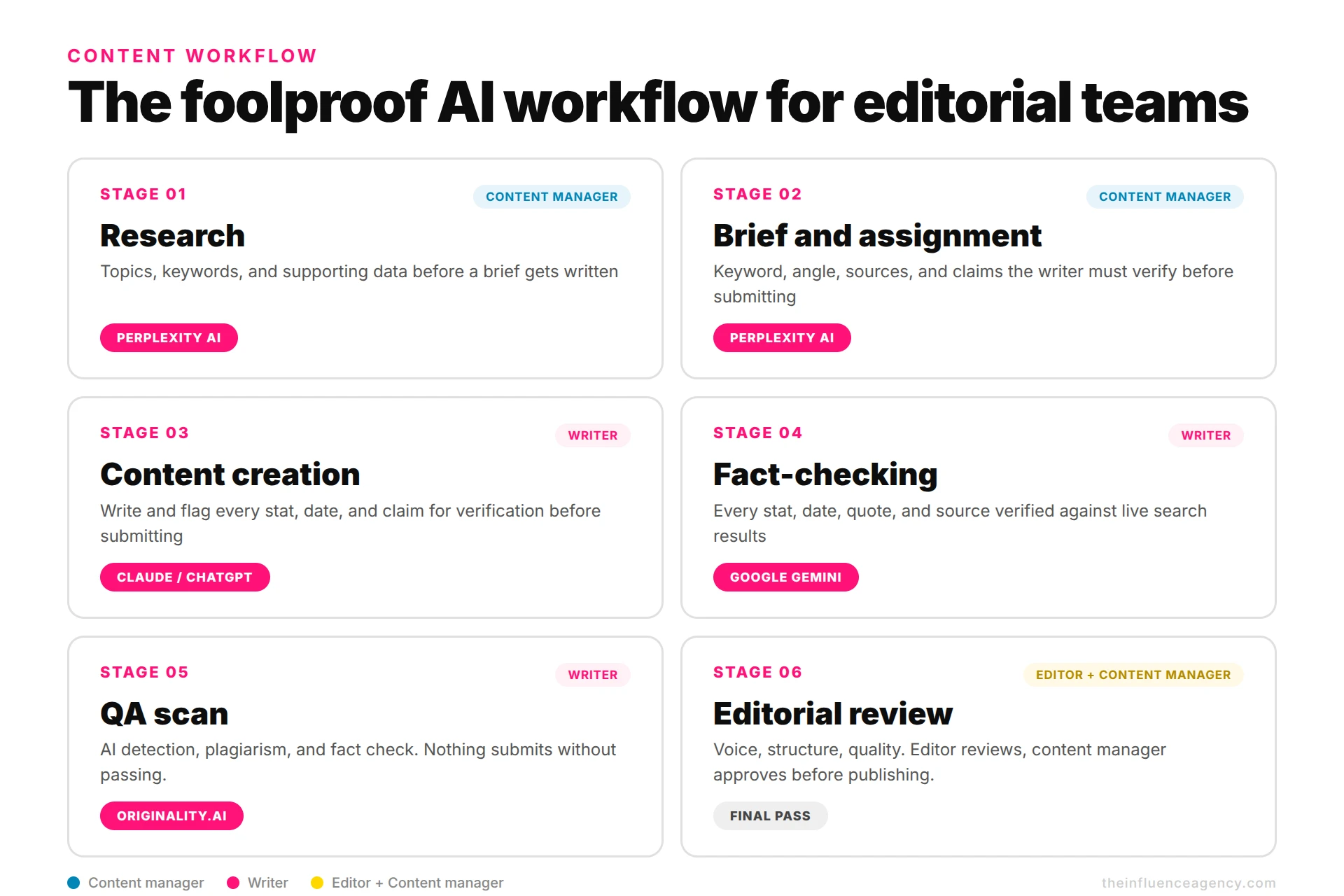
Image Source: Claude, 2026
FAQs
In summary
Want content that's been triple-checked before it reaches your target audience?
Fact-checking should be a regular part of any content strategy and development process. While AI tools help make an often challenging task easier, they still need to be run by people who know what to look for.
At The Influence Agency, every piece goes through a research, verification, and QA process. Our content marketing team knows exactly where content goes wrong and how to catch it, so your brand never has to publish something it can't stand behind.
Contact us today to build a content program that's accurate, on-brand, and ready to scale.